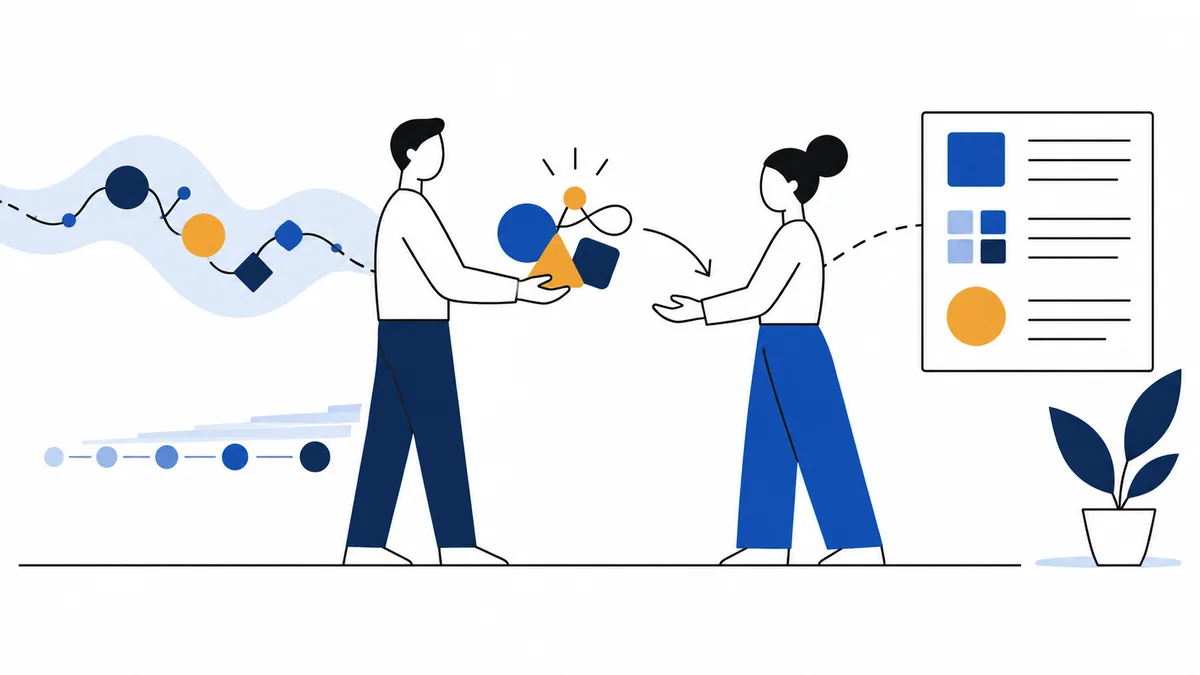
One directly relevant 2021 survey suggests emotional intelligence (EI) was more strongly associated with tacit than explicit knowledge sharing, and that the tacit association was stronger among employees in the study’s higher-experience group. The sample was 245 employees in global IT companies located in India. This is a useful, specific result, not a workplace law: it is cross-sectional, the accessible abstract omits key measurement and group details, and adjacent studies use different outcomes and models. In practice, distinguish sharing a written procedure from explaining the judgment behind an exception. Then observe the exchange and its conditions instead of treating an EI score or years of service as a cause or guarantee.
A closer link to tacit sharing is plausible, but still a single-study result
A knowledge repository can contain every approved step and still leave a new colleague unsure when to stop following the steps. One employee may upload the procedure; another may explain the small warning sign that makes an exception worth investigating. Both acts share knowledge, but they ask for different things from the people involved.
A 2021 study asked whether emotional intelligence relates differently to those two forms of sharing and whether work experience changes the relationships. Its abstract reports a stronger positive EI association with tacit sharing than explicit sharing. It also reports a stronger EI–tacit-sharing relationship in the higher-experience group, while experience groups did not differ significantly on the EI–explicit-sharing relationship. The study surveyed 245 employees of global IT companies located in India and used structural equation modeling.
That is unusually close to the question readers ask. It is also one survey, from one national and occupational setting, and the abstract does not provide the instrument, group thresholds, group sizes, confidence intervals, or a direct statistical test comparing the two path estimates. So the careful answer is: the pattern appeared in this study; whether it is stable across workplaces remains unsettled. The distinction can still help someone examine an actual exchange, provided they do not turn an association into a personal verdict.
The phrase ‘more strongly associated’ also needs care because a statistical model reduces a complicated workplace to measured variables and estimated paths. It does not watch one employee teach another or reveal whether a colleague felt safe enough to ask a follow-up question. The abstract’s result is a useful prompt to inspect the form of exchange, not a substitute for observation. A team might find that its written material is complete while people remain uncertain about exceptions. Another might have willing experts but no maintained repository. Those are different operational problems even if both are described as weak knowledge sharing.
The central finding also should not be read as a claim that emotional intelligence is the only or strongest influence on sharing. The abstract reports paths in a model; it does not compare EI with every organizational factor that might matter. Access to a shared system, clear ownership, psychological safety, workload, incentives, and expertise may shape the same behavior. The article’s question isolates one relationship, not a complete causal account of workplace knowledge flow.
What counts as tacit or explicit sharing at work?
Explicit knowledge is relatively easy to put into a stable form: a checklist, a decision tree, a troubleshooting note, or a record of what happened. Tacit knowledge is more difficult to express fully because it is connected to practice, context, and judgment. A useful distinction is not ‘facts versus skill’ in the absolute. It is whether the knowledge can travel adequately in a codified representation or needs demonstration, conversation, or guided practice to make sense.
Imagine a written procedure for reviewing a complex account. It might tell a colleague which fields to compare and which documents to retain. It may not explain how an experienced reviewer notices that two individually plausible details do not fit together. The file carries explicit instructions. A conversation about what to inspect next, what uncertainty to tolerate, and when to ask for a second view carries more experience-based know-how.
The border is porous. A conversation can pass along an exact rule, and a document can preserve a hard-won judgment as a case note. People also differ in what they can articulate: a practiced worker may recognize a pattern before they can name its cues. In its 2024 discussion of tacit knowledge, the SAGE Open study describes it as ambiguous, context-linked, and harder to transmit through language, text, and data. That is a framing of the problem, not proof that every tacit exchange requires high EI.
The distinction matters because ‘share the document’ and ‘show me how you handle the edge case’ are different requests. The first may be satisfied by access and a reliable repository. The second may need time, a willing expert, a safe question, and a chance to watch or try the task. A real work problem may require both. If a handoff fails, first identify which part failed: was the information missing, or was the decision rule hard to see?
The labels also refer to how researchers operationalize the idea. Some studies ask about willingness or frequency; others ask about behavior, contribution, or perceived access. Tacit knowledge itself is difficult to count because an employee may not recognize that a judgment is knowledge worth sharing. One study’s tacit-sharing measure may therefore capture a different slice of behavior than another’s. This is one reason the 2021 result should not be compared casually with a study of general sharing or knowledge hiding. Before comparing findings, check the actual outcome and population, not just the shared phrase in an article title.
Some knowledge is tacit for the expert but can become more explicit through careful explanation. A person might first demonstrate a procedure, then help a learner name the cues, and later add a case note to the guide. The movement between forms is part of learning at work. It is one reason a manager should not decide in advance that all experience belongs in conversation or all useful information belongs in a database. The receiver’s task and the knowledge’s current form matter.
What did the closest study actually test?
The article titled ‘The nexus between emotional intelligence and types of knowledge sharing: does work experience matter?’ appeared in the Journal of Workplace Learning in 2021. The publisher abstract says the researchers surveyed 245 employees in global information-technology companies located in India. They used structural equation modeling to examine proposed relationships between EI and tacit and explicit knowledge sharing, followed by a multigroup analysis of work-experience groups.
Structural equation modeling is a way to estimate relationships among measured variables within a specified model. Here it lets the researchers examine the two sharing outcomes in a common study framework. It does not establish that one variable happened earlier or caused another. If employees who share more also report greater emotional skill, the direction could run partly the other way; or a third condition could support both. A survey at one point in time cannot sort those possibilities out by itself.
The setting is relevant but bounded. Employees in information technology often exchange problem-solving knowledge, and global firms in India offer a particular organizational and cultural context. That does not make the sample uninformative; it tells us where the result was observed. A reader in health care, public administration, manufacturing, or a small local business should not assume that the same coefficient or experience pattern applies unchanged.
The abstract does not identify the EI measure or detail how the knowledge-sharing scales were constructed. It does not give the experience cutoff, numbers in each group, confidence intervals for the coefficients, or the full model diagnostics. Those details matter. Different EI measures can represent perceived typical behavior, a broad competency model, or performance on emotion problems. Different sharing questions may ask about frequency, willingness, contribution, or perceived behavior. Without the instrument and item wording, readers should not silently substitute their own idea of what the study measured.
The source does report its central sample, method, and findings clearly enough to support a narrow conclusion: in this surveyed group and model, EI was positively related to both forms of sharing, with the reported estimate larger for tacit sharing; the high-experience group showed a stronger tacit relationship. The abstract is the accessible basis for those details, not a substitute for the full paper. We therefore keep the study’s own labels and avoid asserting unreported measurement properties.
This matters for anyone considering an EQ assessment. The survey’s EI construct cannot be assumed to match every profile marketed as an EQ test. In particular, EQ Test’s 32-item Emotional Skills Profile is an educational reflection tool about recent behavior and authored scenarios. It has no validated norms or established ability-test validity, and it was not used in this knowledge-sharing study. Its output cannot be translated into a prediction about who will share expertise.
The phrase ‘global IT companies located in India’ also has a precise implication. It describes firms with a global character situated in India; it does not show that respondents came from multiple countries. We should not turn ‘global’ into an international sample or assume a cross-cultural comparison. Work norms, hierarchy, language, job roles, and organizational knowledge systems can all shape whether employees explain expertise. The abstract does not tell us how those factors varied among the 245 respondents, so they remain possible context rather than measured explanations.
The choice of self-report would matter if the study used it, but the abstract does not name its instrument or response source. We should therefore not assert that employees rated themselves, that supervisors rated them, or that any particular method bias occurred. The right statement is narrower: the accessible publisher summary does not let us inspect who rated each construct or how the measures performed. This missing information limits deeper evaluation and should be resolved from the full article before making claims about measurement quality.
Does the tacit–explicit difference survive a fair comparison?
The abstract reports beta estimates of 0.78 for the EI–tacit-sharing path and 0.59 for EI–explicit sharing; both are reported with p < .001. A beta is a model coefficient on the scale and under the specifications used in that analysis. It is not a percentage, a probability, or a promised change in someone’s behavior. These numbers should not be carried over to a different workplace or assessment.
Comparing the estimates within the same sample is more informative than comparing an EI–sharing result from one country with a different result from another. Many conditions are held more nearly constant: respondents, survey period, broad organizational setting, and analytic approach. The study’s authors characterize the tacit association as stronger. That is a reported within-study pattern worth noting.
There is still a statistical distinction that the abstract does not resolve. Two estimates can each be statistically distinguishable from zero without their difference being statistically distinguishable from zero. To establish that the tacit coefficient is larger in a formal sense, the paper would need to report a direct comparison or an equivalent test. The abstract does not show one. Its wording and estimates support describing the difference as reported by the study, but not claiming that a direct coefficient-difference test has been verified here.
Nor does a larger coefficient automatically mean the difference is large in daily practice. Practical meaning depends on scale construction, variation in responses, how often the behavior occurs, and the consequences of a sharing act. A shift in a model estimate does not say whether a team saved time, reduced errors, or learned faster. None of those outcomes is reported in the abstract.
The fair reading therefore has two parts. In the study’s model, the estimated EI association was larger for tacit than explicit sharing, and both were positive. The abstract leaves open whether the paths differ significantly from one another and how much that difference would matter operationally. Keeping those parts separate preserves the useful contrast without turning it into a ranking of knowledge types or workers.
The p-values tell a different story from the relative size of the estimates. A reported p < .001 indicates that, under the model’s assumptions, the data would be unusual if the tested path were zero. It does not tell the reader the probability that the hypothesis is true, whether the effect is important for a workflow, or whether the two estimates differ from each other. This distinction is especially easy to lose when both paths are significant and one number is larger. Statistical evidence for each relationship is not itself a test of their difference.
The same restraint applies to the term ‘effect’ in the article title and abstract. In empirical writing, effect can refer to a modeled statistical path without proving an intervention caused a change. For a reader, ‘association’ communicates the evidence more safely because the design is a survey. It preserves the authors’ result while avoiding an unintended promise that raising EI will make a colleague share more tacit knowledge.
Why might sharing know-how place different demands on an exchange?
A plausible explanation begins with the work itself. An instruction can often be copied and accessed. Experience-linked judgment may need to be narrated, demonstrated, questioned, and adapted to a specific case. That creates more moments in which emotions and interpretation could affect the exchange: a learner may feel embarrassed to ask, an expert may feel rushed, or a question may sound like criticism even when it is meant to clarify.
The 2024 SAGE Open paper describes tacit knowledge as difficult to transmit through text and data and tied to context and experience. It studies emotional intelligence and tacit sharing through a different model, rather than testing the 2021 paper’s explicit-versus-tacit contrast. Its framing makes interpersonal mechanisms plausible; it does not show that EI caused the contrast in the earlier survey.
Consider a single handoff: the written checklist says to compare two records, but not what to do when each appears valid and the timing conflicts. Someone with relevant experience might explain which clue they inspect first, demonstrate the check, and let the newcomer ask why. Emotional awareness could help the explainer notice confusion; regulation could help them stay patient when the learner repeats a question. Empathy could inform whether the explanation needs another example. Those are plausible behaviors associated with emotional skill, not findings observed in the 2021 study.
Several other conditions may be just as important. The experienced colleague needs time, permission, and a reason to teach. The organization might reward fast individual output more than mentoring. The learner may lack the background to interpret an explanation. A critical insight might be sensitive or risky to share. Someone may protect a hard-earned advantage, or simply be unsure how to put an intuitive judgment into words. The same observable silence can arise from different causes.
The practical implication is to inspect the exchange, not infer its cause from a label. Did the expert have a scheduled opportunity to explain? Could the learner ask without penalty? Was the decision rule demonstrated on a real example? Did the receiver try it and get correction? Those observations can guide a better next step whether or not EI plays a role.
A useful workplace test is to ask the explainer to narrate the decision rather than merely state the answer. ‘I look at the mismatch first because the records are often individually accurate’ is more transferable than ‘I just know when it is wrong.’ The receiver can then replay the reasoning on another case. This example is a proposed practice, not a tested intervention from the cited research. It makes the hypothesized interpersonal demand observable: explanation, checking understanding, and adjusting the account when the listener gets stuck.
Sources: The nexus between emotional intelligence and types of knowledge sharing: does work experience matter?; Examining the Relationship Between Emotional Intelligence and Tacit Knowledge Sharing using a Moderated Mediation Model
Why can explicit sharing follow a different pattern?
Codified information can sometimes be shared with less live negotiation. If an approved procedure already exists, a colleague can grant access or point to its location. That may help explain why the EI coefficient was smaller for explicit than tacit sharing in the 2021 model. But the study abstract does not test this explanation, and written material is not automatically clear or easy to find.
A document still reflects choices: what to include, how to label it, whether to update it, and who can use it. A newcomer may not know which version is current. A technically complete guide can bury a crucial exception in a footnote or assume background knowledge. Someone must notice the gap, communicate it, and sometimes negotiate ownership before the shared resource becomes useful.
The distinction between the two forms also depends on the task. A spreadsheet of prior cases is explicit in format, yet interpreting a pattern may rely on tacit judgment. A short conversation can communicate a precise explicit rule. Treating tacit and explicit as sealed boxes oversimplifies ordinary work. They are useful analytic categories for asking what the receiver needs, not permanent labels for all knowledge.
A fair comparison in practice might ask two questions. First, can the recipient retrieve accurate codified information at the point of need? Second, can they recognize how to adapt it when the situation falls outside the written example? If the answer to the first is no, improving interpersonal skill will not repair a broken repository. If the second is no, adding another file may simply reproduce the same gap.
This is why the study’s result should not be translated as ‘EI matters only for tacit knowledge.’ Both reported paths were positive and statistically significant in that model. The narrower conclusion is that the estimated association differed, with explicit sharing still related to EI in the reported analysis. The proposed explanation about the relative interpersonal demands remains an interpretation to test.
Documentation also changes the cost of sharing. A maintained, searchable guide lets one explanation reach many people and reduces dependence on a particular expert being available. But repository quality has its own human ingredients: someone must decide what is reusable, remove sensitive details, update a stale instruction, and signal that a change matters. These tasks may involve coordination and emotion, but the knowledge-sharing distinction alone cannot tell us how much. The central study’s positive explicit-sharing path is a reminder that codified exchange remains part of the relationship it examined.
When a written procedure does not work, ask the recipient to use it on a representative example and say where the instruction stops being clear. That can reveal whether the document needs a missing step, a definition, or a rule for escalation. A conversation that generates a better guide may convert some tacit know-how into explicit material. The suggestion is a practical inference from the categories, not an experimentally established effect of EI or a finding from the 2021 survey.
Sources: The nexus between emotional intelligence and types of knowledge sharing: does work experience matter?; Examining the Relationship Between Emotional Intelligence and Tacit Knowledge Sharing using a Moderated Mediation Model
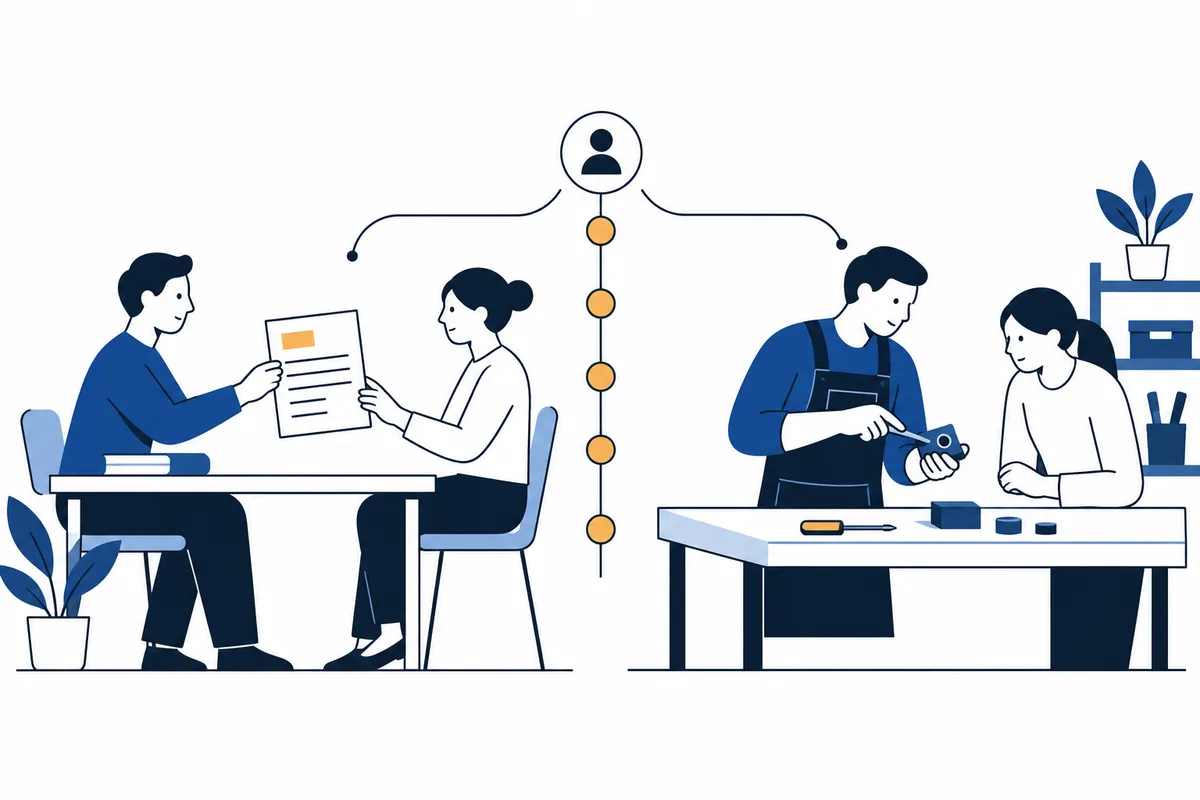
Does experience change the relationship, or only the tacit-sharing result here?
The 2021 abstract reports that work experience differentiated the EI–tacit-sharing relationship: it was stronger in the high-experience group than the low-experience group. For explicit sharing, the analysis found no significant experience-group difference. That is what the abstract says; it does not give the group thresholds, group sizes, or the underlying estimates.
Experience could plausibly supply more situations in which emotional skills and know-how exchange intersect. Someone who has seen recurring edge cases may have more specific knowledge to pass along, and perhaps more opportunities to notice how a learner responds. Yet years in a role are not the same as relevant experience, teaching practice, or access to colleagues. Seniority can also bring workload, status boundaries, or incentives that discourage explanation.
A multigroup result is not evidence that experience itself produced the stronger relationship. The high-experience group may differ in role, autonomy, tenure at the organization, expertise, or selection into the job. The survey does not establish which condition accounts for the pattern. Nor does ‘no significant difference’ for explicit sharing show that the groups are equivalent; it means the analysis did not detect a difference under its method and sample.
It is also important to separate moderation from a simple difference in average behavior. Moderation asks whether the relationship between EI and sharing changes across experience groups. It does not, by itself, say that experienced people share more overall, or that an inexperienced person with strong emotional skills shares less. The abstract’s finding is about a relationship, not a ranking of groups.
For a reader, the sensible use is a question, not a conclusion: does this exchange depend on knowledge that comes from practice, and does the person have a real opportunity to teach it? A newer employee may know a current system better than a long-serving colleague; a veteran may hold judgment that has never been documented. Years can indicate exposure, but the work example shows whether relevant know-how is available and shareable.
A broader answer needs direct replication: comparable measures of both sharing forms, transparent experience groups, adequate group sizes, and a direct test of whether paths differ. It would help to follow workers over time or observe knowledge exchanges rather than rely on one-time self-reports. Until such studies accumulate, experience moderation is an interesting result from one sample, not a dependable rule for assigning mentors or predicting who will contribute.
Experience is also an imperfect proxy for expertise. Time in a job can mean repeated exposure to meaningful cases, or it can mean years spent on tasks that rarely vary. Experience in one system may not transfer to another. A worker can be highly experienced and still lack practice explaining their judgment to someone else. If a study groups people by tenure, that grouping may be convenient while concealing differences in the quality and relevance of experience. The accessible abstract does not tell us whether its grouping captured years in the occupation, organization, or another threshold.
A study that wants to establish experience as a meaningful condition should describe it in a way readers can reproduce and interpret. Years in an occupation, tenure with an employer, and time performing a specific task are not interchangeable. Group cutoffs can also discard information when a continuous range is split into ‘high’ and ‘low.’ Because the accessible abstract gives no thresholds or group sizes, readers cannot judge how the categories were formed or whether a different split would yield a similar pattern.
What would challenge the idea that more EI always means more sharing?
The phrase ‘more EI means more sharing’ is too broad even before comparing tacit and explicit knowledge. EI can refer to different things: a person’s self-view of emotional behavior, a mixed set of competencies, or performance on emotion-related tasks. Knowledge sharing can mean seeking help, offering expertise, contributing a document, or reporting willingness. The result depends partly on which parts are measured.
A 2026 study published in Information & Management offers a useful complication. Its publisher abstract reports a sample of 357 individuals nested in 86 software teams across seven US companies and multilevel modeling. Different EI facets had different relationships with knowledge sharing: management of others’ emotions and awareness of one’s own emotions facilitated sharing; awareness of others’ emotions inhibited it; management of one’s own emotions was not associated in the reported findings. This is not a tacit-versus-explicit comparison and does not test experience. It does challenge the idea that one overall EI quantity must have one uniform relationship with sharing.
The abstract is the evidence available for that recent study here. It does not give enough detail to assess every measure or establish causality. Still, the reported facet pattern makes an important point: noticing another person’s emotion could have different consequences from noticing one’s own, depending on the situation and how the skill is used. Awareness might encourage a sensitive response, or it might lead someone to avoid a difficult conversation. The abstract’s direction should not be converted into a universal explanation of those mechanisms.
An earlier study titled ‘Ability-based emotional intelligence and knowledge sharing’ surveyed 121 employees in 13 service-sector organizations in northern India and used hierarchical regression. The accessible publisher abstract reports positive direct effects for EI and coworker trust on general knowledge sharing, but no moderating effect of trust on the EI–sharing relationship. Its outcome is general sharing, not separately measured tacit and explicit exchange; it did not test experience. It therefore adds context about another proposed condition, not a direct replication.
These studies disagree less than a headline might suggest. One compares sharing forms and experience groups; another separates EI facets; the service-sector study tests trust as a moderator. They ask different questions. The useful synthesis is that relationships may vary by the EI component, outcome, and workplace conditions. A claim that emotional intelligence invariably increases all knowledge sharing erases those distinctions and outruns the evidence.
In a real exchange, observe what the person does. Do they describe their own uncertainty? Do they invite the recipient to explain what is unclear? Can they set a boundary around confidential material while still sharing safe lessons? These behaviors are more informative for development than assuming a broad score explains whether a file or a skill will be shared.
The recent software-team study is especially useful as a challenge to a single-score story, but its abstract should not be used to tell an employee how to behave. The reported negative association for awareness of others’ emotions is an empirical pattern in that study’s model. It does not mean that noticing a colleague’s feelings is generally harmful. Perhaps the facet, measure, or team conditions matter; perhaps an unmeasured process matters. The source abstract does not let us choose among those explanations. It does justify resisting the assumption that every EI component must point in the same direction.
Sources: The role of emotional intelligence facets in employees’ knowledge sharing behavior; Ability-based emotional intelligence and knowledge sharing
What other conditions could change the link?
The 2021 study chose work experience as its moderator, but it is not the only plausible condition. A 2024 study in SAGE Open examined EI, professional commitment, perceived organizational support, and tacit knowledge sharing among 278 effective questionnaire responses in knowledge-intensive Chinese industries. It reported a positive direct association between EI and tacit sharing, a partial indirect relationship through professional commitment, and a stronger indirect pattern at higher perceived organizational support.
That study offers a different picture of where the link might travel: employees’ connection to their work and their sense that the organization supports them were included in the model. The authors report that data were collected and evaluated simultaneously and explicitly state this limits causal conclusions. Thus, its mediation analysis does not demonstrate that EI first creates commitment and commitment later causes sharing. Nor does it test explicit sharing or work experience. It is adjacent evidence that organizational conditions deserve attention, not a substitute for the direct comparison.
A 2012 exploratory study of 412 nurses in 11 Turkish military hospitals reported positive relationships between several EI subdimensions and selected knowledge-sharing dimensions. Its measures included perceptions about sharing and internal channels, rather than the direct tacit-versus-explicit outcomes in the 2021 paper. The population and institutional setting are distinctive, and the accessible abstract calls the research heuristic. It broadens the contexts in which EI and sharing have been examined, but it cannot tell us whether one knowledge type has a stronger association.
A university journal record describes another study: 100 employees in Aceh’s Education Department, selected purposively across management levels, answered questionnaires analyzed with path analysis. The article reports positive relationships among EI, tacit sharing, and innovative work behavior, with tacit sharing mediating the modeled EI–innovation association. This is a small, organization-specific sample. A mediation path in questionnaire data is not proof of a causal sequence, and the study has no explicit-sharing comparison or experience moderator.
Across these papers, trust, commitment, organizational support, profession, and institutional setting appear in different models. No single study settles their relative importance. But they suggest a practical check before attributing a sharing gap to emotional skill: is there protected time, access to the right person, psychological room to ask, recognition for teaching, and a system that makes the information usable? If those conditions are absent, a person may be unable to share effectively despite strong interpersonal awareness.
This is not a reason to dismiss personal development. It is a reason to match the response to the obstacle. If a colleague is unclear when explaining a decision, practice structuring an explanation and checking understanding. If nobody has time to teach, change the workflow. If workers fear that sharing expertise will reduce their standing, address incentives and recognition. Emotional skills can shape an exchange; they cannot substitute for a workable exchange system.
The 2024 study’s support finding also cautions against reading a person in isolation. If an organization signals that employees are valued and supported, sharing may carry a different interpersonal risk than it does in a setting where expertise is treated as scarce power. The paper’s model connects perceived support with the EI-to-commitment path and an indirect route to tacit sharing. That is a specific reported model, not a finding that support will reliably amplify EI in every workplace. Still, it points to a question workers can answer more directly than ‘How emotionally intelligent is this person?’: what happens when someone takes time to teach?
Workplace support can mean more than a general positive feeling. It may be visible in protected mentoring time, acknowledgment for maintaining guidance, a safe channel for questions, or permission to disclose a mistake without humiliation. The 2024 study measured perceived organizational support within its questionnaire model; it did not test each of these concrete practices as separate interventions. They are examples of what a team might inspect, not a list of proven remedies.
Sources: Examining the Relationship Between Emotional Intelligence and Tacit Knowledge Sharing using a Moderated Mediation Model; A Research on the Relationship Between Knowledge Sharing and Emotional Intelligence in the Process of Knowledge Management; Effect of Emotional Intelligence to Innovative Work Behavior of Employees Mediated with Tacit Knowledge Sharing in Education Department of Aceh
Why an EI association is not a verdict on team effectiveness
A relationship between an EI measure and a sharing measure does not establish that a team performs better. Sharing is one process among many, and more sharing is not always better: the information must be accurate, relevant, safe to disclose, and understood by the receiver. A team can circulate large amounts of material while leaving the key decision obscure.
A 2025 study in the European Management Review surveyed 209 respondents and used hierarchical regression to examine knowledge sharing and perceived team performance. Its abstract reports a direct effect of knowledge sharing on perceived team performance, while EI was not a necessary precondition in the reported relationship. It also distinguishes knowledge obtaining from knowledge providing. This is a different model and outcome; it does not refute the 2021 tacit/explicit finding. It does caution against presenting EI as a required gateway to useful exchange or team performance.
The distinction between obtaining and providing is especially practical. A worker may be good at asking for a needed explanation but reluctant to contribute their own method. Another may document routinely yet rarely seek clarification. Combining those behaviors into a single ‘sharing’ label can hide the point where a team gets stuck. The 2025 abstract’s distinction encourages researchers and managers to ask which direction of exchange they mean.
The 2026 software-team study also cautions against collapsing EI facets into one score: its abstract reports positive, negative, and null associations across different facets. Neither that study nor the 2025 survey establishes that a particular person’s EI caused a team outcome. Both rely on bounded samples and the accessible abstracts do not offer grounds for promising productivity gains from an assessment.
A workplace example makes the distinction concrete. Suppose a project handoff repeatedly produces questions after the owner has moved on. The trouble could be missing documentation, an unclear rationale, no overlap time, or a receiver who is new to the task. Calling the problem ‘low team EI’ would conceal these possibilities. A short observation can locate the gap: what question did the new owner ask, what information was available, and what response followed? This is an illustrative diagnostic approach, not a research finding.
Managers should not use EI profiles to select, rank, or score employees for knowledge-sharing roles. The studies discussed here are not validation evidence for such uses, and the individual profile offered by EQ Test is not a hiring instrument or performance predictor. Development is a different purpose: a person can reflect on how they notice emotion, regulate a response, ask for feedback, set a boundary, or repair a misunderstanding, then choose a small behavior to practice. That supports reflection without promising a team result.
A cautious reading of the 2025 survey similarly keeps the outcome modest. Perceived team performance is not the same as independently measured team output, quality, safety, or learning. If respondents report both sharing and team performance, their perceptions matter, but they do not establish an objective production effect. Nor does the reported lack of an EI precondition mean emotional skills are irrelevant. It says the study’s tested relationship did not require EI in the way the authors considered. That is a reason to avoid converting association research into a business case with promised returns.
The contrast between providing and obtaining knowledge also changes what a development conversation should ask. If employees have trouble finding help, a useful action might be to make expertise discoverable and normalize requests. If people ask questions but no one contributes, the issue may concern time, recognition, confidentiality, or clarity about ownership. The 2025 abstract does not identify which intervention works, but its distinction prevents a team from assuming that one general ‘sharing’ score describes both directions. A local review could record whether a request received a useful response and whether a contribution reached its intended recipient.
A team can also protect against the opposite error: pressuring employees to disclose knowledge that is confidential, personal, proprietary, or unsafe to circulate. Good sharing includes judgment about boundaries. In a practical handoff, the contributor can identify what is safe to document, what needs a restricted audience, and what cannot be shared. Emotional skills may help people discuss that limit clearly, but a policy and secure process must define the actual permissions.
Sources: The role of emotional intelligence facets in employees’ knowledge sharing behavior; Are You So Good That They Cannot Ignore You? Effect of Coworker Support on Knowledge Sharing Through an Affective Events Theory Perspective
Turn the finding into one observable next step
The best-supported verdict is narrow: one survey of 245 employees in Indian IT companies reported a stronger EI association with tacit than explicit knowledge sharing, and a higher-experience difference for the tacit relationship. The result is worth following because it separates two forms of exchange that workplaces often blur. It does not establish causation, a universal effect, or a dependable experience rule.
When a handoff stalls, identify whether the missing piece is a retrievable fact or a judgment learned through practice. Ask for the procedure if the information is codified. Ask for a demonstration or a recent example if the difficult part is recognizing when the procedure applies. Notice whether there is time, access, and permission to ask. Then agree on one next action: update the guide, schedule a short walkthrough, or make the decision rule explicit in the next handoff.
An emotional-skills profile can support private reflection on how someone responds to confusion, feedback, or disagreement. EQ Test’s 32-item Emotional Skills Profile offers that kind of educational reflection and practical prompts; it does not measure knowledge-sharing performance or predict whether a colleague will share. Explore it when the personal question is which emotional habit to examine and practice next, while treating the actual work exchange as the evidence that guides the conversation.
If the issue is personal development, choose one behavior small enough to see. In a conversation, pause to ask what part of the explanation is unclear. When offering expertise, state the cue behind the recommendation and invite the receiver to test it against a case. If the work is sensitive, name the boundary and identify what can safely be shared. Afterward, note what helped the exchange move. These steps do not claim to validate a theory or assessment; they give the reader concrete evidence about a real interaction.
The evidence would become more convincing if later studies repeated the comparison with clearly described EI measures and distinct tacit and explicit outcomes, then reported direct tests of the coefficient difference. Replication across occupations and countries would show whether the Indian IT finding travels. A longitudinal design could establish whether emotional skills precede later sharing, while observation or records could reduce dependence on a single survey snapshot. Researchers would also need transparent experience definitions and sample sizes for each group. Until those tests exist, the reader’s next step is modest and local: locate the specific knowledge gap, ask for the form of explanation it requires, and see whether the current conditions allow that exchange. If the difficulty is a personal response under pressure, select one behavior to practice and review what happened. If the difficulty is access, time, or incentives, address that condition directly. This approach respects the study’s signal without asking it to answer questions its design did not test. Keep the conclusion tied to the observed exchange, not to a score, seniority label, or assumption about personality. The evidence supports inquiry, not an individual forecast.
Questions readers ask
Does the study prove experienced employees with higher EI share more tacit knowledge?
No. It reports that the EI–tacit-sharing relationship was stronger in its higher-experience group, based on a cross-sectional survey of 245 employees in IT companies located in India. The result does not show that experience caused sharing, that higher-experience employees shared more overall, or that the pattern applies in other workplaces.
Sources
- The nexus between emotional intelligence and types of knowledge sharing: does work experience matter?
Publisher abstract reports a survey of 245 IT employees in India, the two path estimates, and the experience-group findings central to the article.
- Examining the Relationship Between Emotional Intelligence and Tacit Knowledge Sharing using a Moderated Mediation Model
Full text describes tacit knowledge as context-linked and difficult to transmit and reports a separate 2024 questionnaire model involving commitment and organizational support.
- The role of emotional intelligence facets in employees’ knowledge sharing behavior
Publisher abstract reports differing directions across EI facets in 357 people nested in 86 software teams at seven US companies.
- Ability-based emotional intelligence and knowledge sharing
Publisher abstract reports a survey of 121 service employees, positive direct associations for EI and trust, and no trust moderation of their general sharing relationship.
- A Research on the Relationship Between Knowledge Sharing and Emotional Intelligence in the Process of Knowledge Management
Journal record reports exploratory findings from 412 nurses across 11 Turkish military hospitals using different EI and sharing dimensions.
- Effect of Emotional Intelligence to Innovative Work Behavior of Employees Mediated with Tacit Knowledge Sharing in Education Department of Aceh
University journal abstract reports questionnaire and path-analysis results for 100 purposively sampled employees in Aceh’s Education Department.
- Are You So Good That They Cannot Ignore You? Effect of Coworker Support on Knowledge Sharing Through an Affective Events Theory Perspective
University repository abstract confirms an adjacent survey of 430 employees examining coworker support, vitality, and knowledge contribution and seeking.
- Hidden emotional labor in daily chats: The dual effects of small talk on knowledge sharing
Publisher abstract reports a three-wave, one-month-interval survey of 273 Chinese employees on small talk, emotional labor, EI moderation, and general sharing.
- Emotional intelligence and innovative work behaviour in knowledge-intensive organizations: how tacit knowledge sharing acts as a mediator?
Publisher abstract reports a structured survey of 171 employees in five Indian high-tech firms and positive modeled EI links with tacit sharing and innovation.
Apply it to the real situation
Choose one emotional habit to examine in your next handoff
From this guide: If the difficulty is how you respond when a colleague is confused, interrupted, or hesitant to ask, focus on that observable moment rather than trying to explain the whole exchange with one score.
The research cannot tell you which emotional habit matters in your own conversations. The private 32-item Emotional Skills Profile offers a structured reflection on recent emotional behavior and authored scenarios, with practical guidance for choosing a development priority. Use it to select something to notice or practice; assess the knowledge-sharing problem itself through the work and the conditions around it.