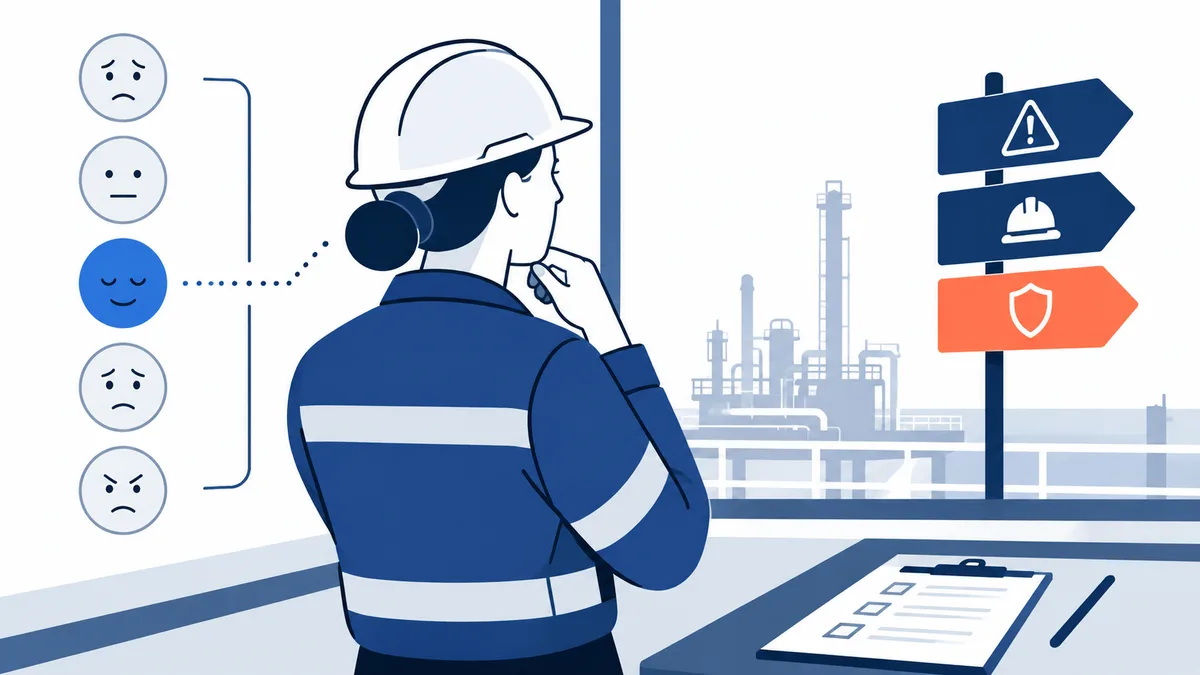
Current evidence supports a possible, context-specific relationship between some emotional-intelligence measures and reported safety behavior. Small studies of commercial pilots propose different pathways, including situational awareness and thriving at work. A construction training study reports changes in selected measures. These findings do not establish that emotional intelligence prevents accidents or predicts who will work safely across jobs. Safe practice also depends on training, procedures, equipment and supervision.
What does current evidence support about EI and safety-critical work?
An EQ result may prompt a question about attention or communication under pressure. It cannot tell you whether you are a safe worker. Current evidence supports a possible link between some emotional-intelligence (EI) measures and reported safety behavior. Two time-lagged commercial-pilot surveys propose different routes: situational awareness in one and thriving at work in another. Neither establishes that EI prevents accidents or predicts who will perform safely across jobs. Both measured reported safety performance, distinct from injury or accident records.
In “Linking emotional intelligence to safety performance: The roles of situational awareness and safety training,” 133 full-time commercial pilots provided time-lagged data. EI was related to situational awareness when safety-training inadequacy was more salient, with an indirect modeled relationship to safety performance through awareness. “Why and when do emotionally intelligent employees perform safely? The roles of thriving at work and career adaptability” used a two-wave survey of 131 full-time airline pilots. It reported a pathway through thriving at work and a stronger EI–safety-performance relationship among pilots with higher career adaptability. These observational findings concern particular measures, people, and outcomes; time separation alone cannot show that EI caused the reported behavior.
Together, the studies make it reasonable to ask whether emotional skills help people notice conditions, communicate concerns, or act on procedures at work. They do not establish an accident-prevention effect or make an EQ score a safety qualification. Outcomes also depend on training, procedures, equipment, supervision, and whether concerns are heard. The practical question is which observable behavior a person can develop and check within those safeguards, not whether a score can certify judgment.
Sources: Linking emotional intelligence to safety performance: The roles of situational awareness and safety training; Why and when do emotionally intelligent employees perform safely? The roles of thriving at work and career adaptability
What does an EI measure mean in these studies?
The studies do not measure one universal EQ capacity. Emotional intelligence (EI) broadly concerns recognizing, understanding, and managing emotion, but researchers turn that idea into different kinds of measures. A self-report asks people how they see their own emotional functioning; a performance measure asks them to solve emotion problems with responses judged as more or less correct. Those results cannot be treated as interchangeable estimates of maximum ability, much less as direct readings of how safely someone will work.
The 2022 review, “Evidence on the Relationship Between Emotional Intelligence and Risk Behavior,” explicitly separates three construct-and-method pairings. Its self-report mixed approach combines emotional and personality-related qualities assessed by questionnaire. Its self-report ability approach asks people to rate their perceived emotional abilities. A performance-based ability measure instead presents emotion problems with correct and incorrect answers. The review notes that these distinctions may help explain why findings vary. For a safety question, the practical point is simple: a relationship involving perceived ability or a broad self-description does not automatically establish that emotion-solving performance changes conduct around hazards. The label EI alone does not tell a reader what was measured.
The commercial-pilot studies illustrate why the measure must stay attached to the result. “Why and when do emotionally intelligent employees perform safely?” reports a two-wave survey of 131 full-time airline pilots and models EI, thriving at work, career adaptability, and safety performance. The accessible abstract reports positive modeled relationships among these variables, but does not identify the instrument in the abstract. Its findings therefore describe that study’s EI measure and reported behavior, not every EQ assessment or an observed ability to avoid accidents. The 2021 pilot study’s accessible abstract describes its EI measure as self-perceived, another reason to keep its conclusion specific to that operationalization.
A separate comparison, “Trait emotional intelligence in American pilots,” used the Trait Emotional Intelligence Questionnaire with 44 volunteer US pilots matched to population controls. The pilots reported lower scores on global trait EI and several factors, while self-control did not differ significantly. That small, mostly male sample measured perceived trait profiles; it did not measure safety behavior or incident risk. Its relevance here is narrow: “pilot” does not imply a uniformly elevated EQ profile, and a group profile says nothing by itself about an individual’s operational conduct. Readers should therefore ask which EI measure and which work outcome a claim connects when interpreting workplace safety evidence. A finding about one questionnaire cannot certify that a personal EQ score captures the same construct, predicts safe conduct, or transfers to another occupation.
Sources: Evidence on the Relationship Between Emotional Intelligence and Risk Behavior: A Systematic and Meta-Analytic Review; Why and when do emotionally intelligent employees perform safely? The roles of thriving at work and career adaptability; Trait emotional intelligence in American pilots
Why broad risk-taking evidence cannot settle a work-safety question
The 2022 review, “Evidence on the Relationship Between Emotional Intelligence and Risk Behavior: A Systematic and Meta-Analytic Review,” is useful partly because its answer resists a simple slogan. Across 12 studies and 5,100 participants, its overall pooled relationship between emotional intelligence (EI) and risk behavior was not statistically significant. When the reviewers separated outcomes by domain, they found a small negative association for health-related risks, while the estimate for financial and gambling risks was not significant. This is evidence against saying that higher EI generally means less risk-taking. It is not a direct test of whether EI helps a worker follow a procedure or prevent an incident.
The included studies examined health-related behavior such as substance use, sexual risk, and driving, alongside financial choices and gambling tasks. These decisions differ in cues, stakes, and what counts as a risky response. A choice on a gambling task is not the same outcome as reporting a hazard at work; a health behavior measure does not tell us whether a worker pauses a task when conditions change. The review itself frames risk as domain-specific: behavior in one area need not carry over to another. That makes its health-domain result relevant background, but not a result that can be transferred directly to occupational safety.
The domain estimates also conceal variation inside each category. For health-related outcomes, the pooled estimate was negative, but the review describes mixed findings across individual studies. Two studies of risky driving did not point to a protective pattern: one found no relationship between EI and risky driving, and another found a positive relationship. The latter study included 1,214 participants and used self-report measures; the review reports a positive association between all measured EI dimensions and traffic risk-taking. That counters treating the health average as a universal rule. It does not show that EI increases danger in every driving context, still less that it predicts safety performance at work. The financial and gambling group was mixed too: among six studies, two reported positive relationships, two negative relationships, and two no relationship.
How EI and risk were measured varied as well. The review grouped EI measures into self-report mixed models, self-report ability models, and performance-based ability measures. Risk outcomes ranged from questionnaires to laboratory gambling tasks. The authors noted variation in samples, measures, and covariates; where a study reported separate dimensions rather than one overall EI score, the meta-analysis averaged those effects to estimate a global relationship. Pooling makes a broad pattern easier to inspect, but it cannot make unlike decisions identical. Nor does a correlation establish that emotional skills caused a person’s choice. In the review’s health subgroup, the estimate was modest, and the authors’ search covered studies available through April 2020. Later occupation-specific studies therefore answer a different question rather than simply confirming or overturning this result.
For a safety-critical workplace, the practical consequence is to ask about the behavior and setting directly. Does the evidence concern noticing changing conditions, communicating uncertainty, following a checklist, or actual injury records? The broad risk review cannot answer those occupational questions on its own. It supports a narrower conclusion: associations between EI and risk vary with the domain and measure. To understand safety at work, we need studies that measure workplace behavior in that setting, then keep reported behavior distinct from accidents and injuries.
Two pilot studies propose different routes from EI to reported behavior
Two commercial-pilot studies relate emotional intelligence (EI) to reported safety performance through different proposed routes. “Linking emotional intelligence to safety performance: The roles of situational awareness and safety training” used time-lagged data from 133 full-time commercial airplane pilots. EI was significantly related to situational awareness when safety-training inadequacy was more salient, and the indirect relationship with safety performance through awareness increased as reported inadequacy increased. A later two-wave study, “Why and when do emotionally intelligent employees perform safely? The roles of thriving at work and career adaptability,” surveyed 131 full-time commercial airline pilots. Its abstract reports positive relationships among EI, thriving, and safety performance, with a stronger EI–performance relationship among pilots with higher career adaptability. Both studies address work behavior in aviation; neither establishes that EI prevents accidents. Situational awareness means attending to relevant conditions and interpreting what is changing. In the 2021 study, it is the proposed link between EI and safety performance. The model found that EI’s relationship with awareness was more evident when pilots reported inadequate training. This is more specific than saying emotionally intelligent pilots are safer: it is a conditional association in this sample. It does not show that personal skill replaces instruction or makes inadequate training acceptable. The training result complicates a simple “more EI means more safety” message. The authors suggest inadequate training may make personal emotional capacities more relevant to safety-related cognition and behavior. Their practical discussion points organizations toward monitoring training adequacy and effectiveness, so performance relies less on personal attributes. The abstract also suggests prioritizing pilots with low EI when training capacity is temporarily limited. That is an author recommendation, not evidence that an EQ screening rule improves safety. The later study proposes another route: thriving at work links EI to safety performance, while career adaptability changes the strength of the relationship. Thriving means a sense of energy and learning at work. The abstract reports a two-wave survey, not an intervention that assigned pilots to different EI levels or work conditions. Its analysis tests whether the measured relationships fit the proposed pathway. It cannot establish that thriving caused safer behavior, or that adaptability is a safety qualification. These studies do not replicate one mechanism. The first centers on attention to changing conditions and reports that the EI–awareness relationship varies with training inadequacy. The second centers on thriving and reports a stronger EI–performance relationship among pilots with higher career adaptability. The abstracts do not establish that the same EI measure, pathway, or definition of safety performance was used. They cannot be combined into a single measure of “safety intelligence.” Time-separated surveys distinguish some measurements in time, but do not turn observational associations into causal results. The abstracts describe reported safety performance, not accident or injury records. Self-reports about emotional functioning and safety behavior can share reporting influences, and features of training or work organization may relate to both perceptions and behavior. These limits set the distance between the reported relationships and a claim about preventing harm. The evidence is more directly relevant to safety-critical work than studies of general health or financial risk choices, because it examines pilots’ reported work performance. Still, two occupational surveys do not establish that a high EI score predicts safe performance across pilots, other aviation roles, or other jobs. They also do not show that changing EI would change incident rates. Their proposed pathways instead suggest questions for development and operational review: what cues narrow attention, whether training prepares workers to interpret those cues, and whether work supports learning and energy. Those questions do not justify ranking workers. For an individual, the translation is behavioral. Under pressure, can you notice when attention is narrowing, check the relevant information, and raise uncertainty through the established procedure? Can colleagues receive a concern clearly, and does the organization respond? The studies did not test this as an exercise, so it is an application of their proposed pathways, not a proven intervention. Their findings support examining emotional and cognitive behavior as one part of safety performance. Training, procedures, supervision, equipment, and incident outcomes remain separate matters an EQ score cannot settle.
Sources: Linking emotional intelligence to safety performance: The roles of situational awareness and safety training; Why and when do emotionally intelligent employees perform safely? The roles of thriving at work and career adaptability
Why training adequacy changes the proposed EI pathway
In the 2021 study, the link between emotional intelligence and safety performance appeared most clearly under a condition an organization should want to remove: inadequate safety training. The study followed 133 full-time commercial airline pilots using time-lagged data. Its analysis found that EI was significantly related to situational awareness when training inadequacy was more salient; the indirect relationship between EI and safety performance through situational awareness also grew as reported inadequacy increased. The finding is conditional. It does not say that EI reliably improves safety in every setting, or that pilots with a particular score are safer.
Situational awareness means noticing relevant conditions, making sense of them, and recognizing how they may change. In the study's proposed pathway, emotional intelligence was connected to this safety-related cognition, which in turn was connected to safety performance. The researchers tested whether the strength of these relationships varied with training inadequacy. Their result makes EI look less like a stable protective shield and more like a personal resource that may become more relevant when the work setting supplies less support. That is an interpretation of the model, not proof that weak training activates a causal ability inside a pilot.
The distinction matters because a statistical boundary condition is not an acceptable operating plan. “Linking emotional intelligence to safety performance: The roles of situational awareness and safety training” concludes that effective training may complement lower EI and recommends that aviation managers monitor training adequacy and effectiveness. It also suggests prioritizing pilots with lower EI if training capacity is temporarily limited. That final suggestion is a proposal in the article, not evidence that score-based triage improves safety. The accessible abstract does not report a trial comparing allocation strategies, nor does the study establish a threshold that could identify who needs training. Treating an individual score as a substitute for adequate instruction would stretch the finding beyond what it tested.
A systems-first reading follows more securely. When a procedure is unfamiliar or instruction has not prepared a worker for a changing condition, organizations should find and repair that gap. The study gives a reason to examine training alongside human behavior, not to make workers carry the cost of weak provision. Its practical recommendation is to monitor whether training is adequate and effective. For someone doing safety-critical work, that means uncertainty about a procedure deserves clarification through the established channel, and a concern raised through that channel needs a usable response.
Emotional skills can still matter in that exchange. Noticing that pressure is narrowing attention, naming uncertainty clearly, and asking for a check may help a person act on relevant information. Whether those actions improve performance in a particular role must be judged against its procedures and observed work, not inferred from a general EQ profile. Training, equipment, supervision, and clear escalation routes remain organizational responsibilities. A profile may prompt private reflection on a habit worth practicing; it cannot determine who is safe or compensate for missing preparation. The study's most useful lesson is therefore about dependence: individual capacities may show a stronger association with safety-related behavior when training is inadequate, which is precisely when the organization has a clearer reason to strengthen the training.
What counts as evidence of safer work?
A safety behavior is an action, or reported action, related to carrying out work safely. It is closer to conduct than an injury count, but it is a different kind of evidence. “Linking Emotional Intelligence to Safety Performance: The Roles of Situational Awareness and Safety Training” used time-lagged data from 133 full-time commercial pilots to model links among emotional intelligence, situational awareness, and safety performance. “Why and When Do Emotionally Intelligent Employees Perform Safely? The Roles of Thriving at Work and Career Adaptability” used a two-wave survey of 131 full-time commercial airline pilots and also examined safety performance. Both abstracts describe behavior-related outcomes; neither reports accident or injury records. Their results speak more directly to reported performance than to whether fewer people were harmed. The labels cover different endpoints. Following a procedure is one behavior; raising a hazard or helping improve a safety practice is another. A report of noticing changing conditions describes awareness. A near miss is an event in which harm was narrowly avoided; an injury or accident is a recorded outcome shaped by hazard exposure as well as conduct. Evidence about one endpoint cannot silently stand in for another. An association between an EI measure and a safety-performance report does not show that the measure predicts a lower accident rate. That step needs its own evidence. Separating survey measurements in time can reduce the chance that every answer reflects the same moment or immediate mood. It does not turn a survey into independent observation. When participants describe both their emotional functioning and their work behavior, shared reporting habits or a desire for consistent answers may affect the association. Time separation also cannot rule out influences on both reports, such as experience, workload, or available training and procedures. These are observational designs: their modeled pathways are patterns consistent with proposed explanations, not demonstrations that changing EI caused safer conduct. The 2025 construction article “Impact of Emotional Intelligence Training on Safety Behavior Enhancement in Construction Sites” reports pre- and post-training survey responses from 231 workers and changes in selected measures. Its abstract does not report fewer injuries or accidents, so those changes do not prove reduced harm. A stronger claim about incident prevention would measure the outcome itself, through independently checked observations or reliable injury and accident records, with enough follow-up to interpret results against the amount and kind of work performed. The comparison should address plausible alternatives, including changes in training, supervision, equipment, procedures, and hazard exposure. These are useful questions for evaluating evidence, not a demand that every development study count accidents. A study can inform us about reported behavior; its conclusion should stay at that level. An individual can use this evidence to choose a behavior to observe, such as pausing to check a procedure or raising uncertainty through the proper channel. It does not support using an EQ result as a safety credential or claiming that a profile prevents accidents. A behavior’s contribution to safety depends on its surroundings: procedures must be workable, concerns must reach someone able to respond, and the organization must address hazards.
Sources: Linking emotional intelligence to safety performance: The roles of situational awareness and safety training; Why and when do emotionally intelligent employees perform safely? The roles of thriving at work and career adaptability; Impact of Emotional Intelligence Training on Safety Behavior Enhancement in Construction Sites
Why operational conditions belong in the explanation
A worker can notice risk and still face pressure to continue. That matters when interpreting a proposed link between emotional intelligence (EI) and safe behavior: recognizing concern is one part of a decision; the operation shapes what happens next. A systematic review of risk-taking in helicopter and small-airplane operations offers context. It did not measure EI, so it cannot establish an EI effect. “A Systematic Review of Multilevel Influenced Risk-Taking in Helicopter and Small Airplane Normal Operations” screened 4,742 records and retained ten studies: three qualitative and seven quantitative. It covered commercial pilots in helicopter and small-airplane operations comparable to US Part 135 rules. The most common behavior studied was continuing a visual flight rules (VFR) flight as weather deteriorated toward instrument meteorological conditions (IMC). The authors grouped influences under continuation pressure and acceptance or normalization of risk. They included only published work, a possible source of publication bias. Interview studies described time and financial pressure, customer expectations, career ambitions, fatigue, organizational culture, and social pressure. These findings come from a small set of studies, not a universal account of aviation. A decision under pressure may reflect incentives as well as a worker's appraisal of a hazard. Normalization adds another complication. The review describes accounts in which repeated exposure to deteriorating weather without immediate harm made the practice feel ordinary. One pattern begins with going to “take a look,” then continues as conditions worsen. Studies also describe routine violations accepted as “the way things are done.” This does not show that emotional skill would interrupt every deviation. It shows why one moment of risk perception may be incomplete: an uneventful prior choice and colleagues' expectations can shape the next decision. This account sits beside, not inside, the EI pilot studies. “Linking emotional intelligence to safety performance: The roles of situational awareness and safety training” reports a time-lagged survey of 133 commercial airplane pilots. Its abstract models relationships among EI, situational awareness, training adequacy, and reported safety performance. The aviation risk review examines operational influences without measuring EI. Read together, they suggest an interpretation, not a combined finding: noticing conditions may matter, but workers also need authority and backing to act. The review does not test whether speaking up changes outcomes. For someone in a safety-critical role, practice naming uncertainty, checking a procedure, or raising a concern through the established channel. Whether that behavior improves safety depends partly on whether the procedure is clear, the channel is usable, and the concern receives a response. A personal EQ score cannot represent those conditions or compensate for missing training, equipment, or time. This is an implication, not a set of factors jointly tested by the review. The review focused on a particular class of aviation, with ten studies and varied methods. Its findings should not be assumed to describe other occupations. It did not examine EI or establish that organizational pressure causes a particular flight decision. Its value is to make the level of explanation visible: an individual tendency may contribute to attention or communication, while work design and group expectations shape whether attention becomes action. Emotional skills may help a worker notice a change, manage disagreement, or communicate uncertainty; this review does not show that those skills independently prevent accidents. In safety-critical work, development belongs alongside role-specific training, usable procedures, supervision, and a credible escalation path. Ask whether a worker can identify a cue, follow the required check, raise a concern, and receive a response. If a link is missing, the remedy may lie in the system as much as in the individual.
Sources: A Systematic Review of Multilevel Influenced Risk-Taking in Helicopter and Small Airplane Normal Operations; Linking emotional intelligence to safety performance: The roles of situational awareness and safety training
What does the construction training evidence add?
A 2025 study in the Journal of the Society of Disaster Information examined emotional-intelligence training with construction workers. The abstract describes a pre–post survey of 231 workers and path analysis linking emotional-intelligence components, motivation, and safety behavior. After training, the authors report increases of 36.75% in emotion regulation, 37.53% in impulse control, and 38.32% in causal reasoning. These are changes on the study’s measures, not accidents prevented or incidents avoided.
The proposed pathway matters because the study did not treat self-awareness as a direct route to motivation. The abstract says self-awareness had no direct effect on motivation, while its indirect effect through self-regulation and social awareness was significant. Self-awareness was linked to motivation through the proposed roles of self-regulation and social awareness. That path is a model of measured relationships, not proof that each link caused the next; it does suggest why noticing alone may not capture the emotional skills involved.
The study’s scale of reported change can sound decisive, but the design details available on the publisher page set a narrower boundary. The abstract identifies pre- and post-training survey responses and path analysis; it does not describe a comparison group, random assignment, a later follow-up, independently observed behavior, or injury and accident records. Without those details, the reported differences cannot show how much change was due to training rather than other influences, whether the measures stayed changed, or whether behavior on a site changed accordingly.
Read alongside the pilot studies, this result adds a development question without settling the safety-outcome question. Pilot surveys connect EI measures with reported safety performance through proposed situational-awareness or thriving pathways. The construction abstract reports pre–post shifts in psychological measures and a proposed path to safety behavior. These outcomes cannot be combined into one estimate. The findings make it reasonable to investigate whether some emotional skills can be developed and relate to work behavior in particular settings. They do not show injury reduction, transfer to another occupation, or that an EQ score identifies who will act safely.
For an individual reader, the practical implication is modest but useful. Emotional-skill development can sit alongside technical safety education, as the study’s conclusion recommends. Practice might involve pausing before an impulsive response or noticing when a colleague’s concern needs attention. The useful check is whether a behavior appears in the task and fits procedure, with feedback from an appropriate supervisor or instructor. Emotional awareness cannot replace sound instruction, equipment, supervision, or hazard-reporting processes.
The conclusion should therefore stay proportional to the evidence: this construction study suggests that measured emotional-skill components may change after training and reports a model linking them with motivation and safety behavior. Its accessible abstract does not establish durable change, transfer to observed job conduct, or fewer accidents. That makes the study a reason to examine specific behaviors in context, not a basis for promising that emotional-intelligence training makes a site safe.
Sources: Impact of Emotional Intelligence Training on Safety Behavior Enhancement in Construction Sites
What can an individual do with this evidence?
For an individual, the question is narrower than “Am I good at safety?” Pick one moment when pressure tends to change how you respond: attention narrows, a concern goes unspoken, or disagreement makes it harder to check a step. Identify the pause, checklist, or escalation procedure that governs it. Decide on wording for raising uncertainty, then ask a colleague or supervisor for feedback on whether the concern was clear and the agreed process was followed. This is a way to observe a behavior, not an informal safety rating. The commercial-pilot study “Linking emotional intelligence to safety performance: The roles of situational awareness and safety training” examined reported safety performance and a proposed role for situational awareness; it does not show that an EQ result predicts accidents. A private profile can help choose what to reflect on. The 32-item Emotional Skills Profile covers recent emotional habits and judgments about authored scenarios,. It is an educational reflection tool, without validated norms or established ability-test validity. Use a result to frame a development question, then check it against behavior and feedback. Keep training, supervision, and equipment in view. Current evidence leaves EI as a possible contributor to some responses under pressure; it does not establish accident prevention or identify who is safe. Practice one behavior, seek specific feedback, and follow the safety process.
Sources: Emotional Skills Profile; Linking emotional intelligence to safety performance: The roles of situational awareness and safety training; Impact of Emotional Intelligence Training on Safety Behavior Enhancement in Construction Sites
Questions readers ask
Does emotional intelligence prevent accidents in safety-critical work?
Current studies do not establish that emotional intelligence prevents accidents. Small, observational studies report relationships with safety behavior, while the accessible evidence does not establish fewer injuries or accidents.
Sources
- Evidence on the Relationship Between Emotional Intelligence and Risk Behavior: A Systematic and Meta-Analytic Review
This review reports domain-specific results across health and financial or gambling risk studies; it does not synthesize safety-critical occupational performance.
- Linking emotional intelligence to safety performance: The roles of situational awareness and safety training
The accessible abstract reports a time-lagged survey of 133 commercial pilots and a modeled pathway involving situational awareness and training inadequacy.
- Why and when do emotionally intelligent employees perform safely? The roles of thriving at work and career adaptability
The repository record and article abstract describe a separate commercial-pilot pathway involving thriving at work, career adaptability, and reported safety performance.
- Why and when do emotionally intelligent employees perform safely? The roles of thriving at work and career adaptability
The accepted manuscript abstract reports a two-wave survey of 131 airline pilots and modeled relationships involving thriving and career adaptability.
- Impact of Emotional Intelligence Training on Safety Behavior Enhancement in Construction Sites
The publisher abstract reports pre-post survey measures from 231 construction workers; it does not establish accident reduction.
- A Systematic Review of Multilevel Influenced Risk-Taking in Helicopter and Small Airplane Normal Operations
This review covers ten studies of operational risk-taking in helicopter and small-airplane normal operations, without measuring emotional intelligence.
- Trait emotional intelligence in American pilots
The study compares trait-EI self-reports from 44 volunteer US pilots with matched controls; it does not measure safety behavior or incident risk.
- Emotional Skills Profile
The first-party page describes the private 32-item educational reflection tool and its scope; it does not establish safety outcomes or validated norms.
Apply it to the real situation
Turn an emotional-skill reflection into one behavior to practice
From this guide: The studies suggest possible links with reported behavior, but they cannot tell you which habit matters in your own work.
The evidence points to questions about attention, emotional habits and how concerns are raised under pressure. The private 32-item Emotional Skills Profile can help you reflect on recent habits and authored scenarios, then choose a development question to examine through behavior and feedback. It does not assess safety qualification or predict accidents.