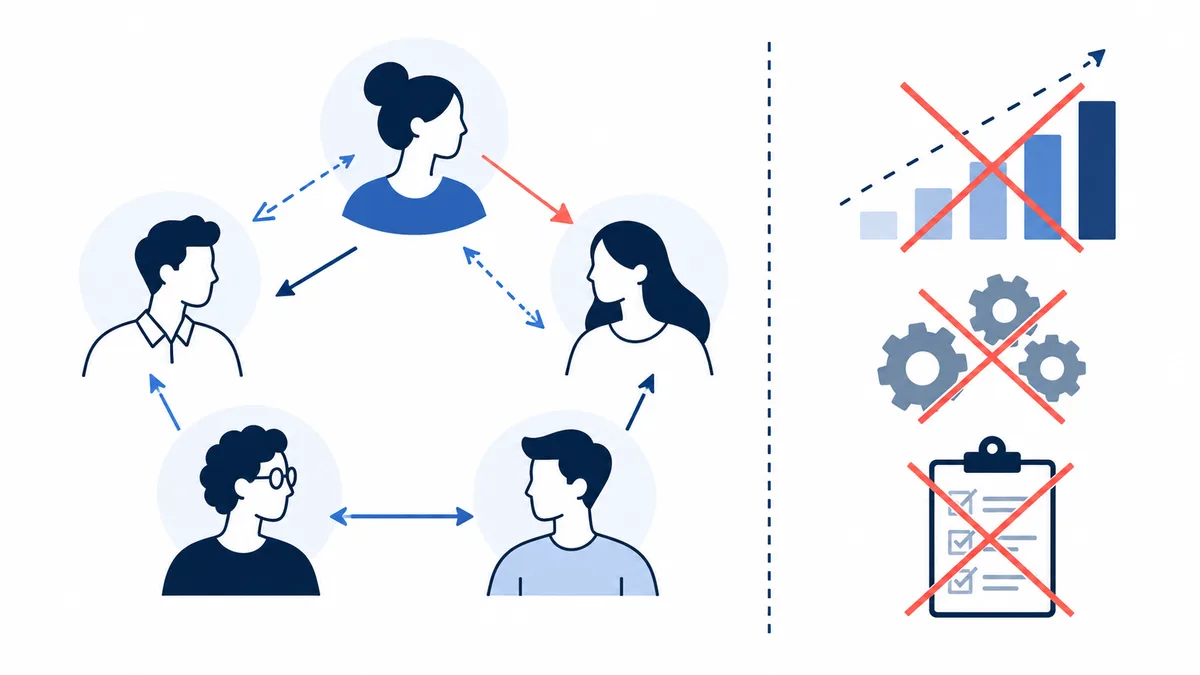
The Emotional Contagion Scale (ECS) measures an individual’s self-reported susceptibility to other people’s expressed emotions. One person’s score cannot show that emotion spread through a team, identify who influenced whom, or explain a work outcome. A manager needs evidence from multiple people and relevant moments to describe a team pattern; a causal claim requires stronger evidence tied to the setting.
What does the Emotional Contagion Scale measure?
The Emotional Contagion Scale (ECS) describes how susceptible one respondent says they tend to be to other people’s expressed emotions. The original 15-item scale was a self-report: the person answers about a general tendency, rather than an observer recording what happened in a meeting. Its title can sound like a measure of emotions moving through a group. Its scope is narrower: an individual difference in reported susceptibility. In “The Emotional Contagion Scale: A Measure of Individual Differences,” the 1997 development paper describes susceptibility in terms of feedback generated by mimicry, such as emotional feedback that may accompany mirroring another person’s expression. The abstract reports three development studies involving 1,988 participants. This history explains the idea behind the measure; it does not make a respondent’s score a record of an episode. A tendency and an event are different kinds of evidence. For a manager, the score can at most open a private conversation about which interactions a person finds affecting. It cannot show that emotion spread in the team, identify who influenced whom, or establish the team’s emotional state. Those are questions about multiple people and their interactions, not one respondent’s reported tendency.
Sources: The Emotional Contagion Scale: A Measure of Individual Differences
What does an ECS score describe?
The Emotional Contagion Scale (ECS) describes a respondent’s reported susceptibility to other people’s emotions. “Susceptibility” here means a tendency to be affected, as the person reports it, rather than a record of what happened in a particular exchange. In “The Emotional Contagion Scale: A Measure of Individual Differences,” the scale’s account links that susceptibility to afferent feedback generated by mimicry. The original paper reports three development studies with 1,988 participants in total. Study 1 examined reliability and reported Cronbach’s alpha of .90. Alpha is a measure of internal consistency: it indicates how closely responses to the items in that sample tended to move together. It does not show that every response is accurate, that the instrument captures every relevant part of emotional life, or that a team shares the same mood. A coherent set of answers can still describe a narrow self-reported tendency rather than a person’s conduct in a specific meeting. Study 2 examined how ECS susceptibility related to other individual differences. The abstract reports positive associations with reactivity, emotionality, sensitivity to others, social functioning, self-esteem, and emotional rather than cognitive modes of empathy. It reports negative associations with alienation, self-assertiveness, and emotional stability, and no relationship with masculinity or approval motivation. These are reported correlations: they show that scores varied together in that study, not that one quality caused another or that any association will hold for every group. Awareness means noticing emotion; understanding concerns how emotions relate to events or change; regulation concerns how a person responds. A single susceptibility score does not separately measure those skills. Study 3 added an experiment. According to the abstract, ECS scores predicted biases in participants’ evaluations; scores also correlated with responsiveness to afferent feedback and with self-reported emotional experience after exposure to emotional expressions. This gives the scale evidence connected to reactions under the study’s conditions. It still leaves a clear boundary: an experimental exposure and a person’s report about emotional experience are not a recording of workplace behavior. The study does not establish that a respondent will adopt a colleague’s mood in a particular meeting, transmit emotion to others, or respond skillfully once affected. A person can report being readily moved by others’ expressions and still pause, ask a clarifying question, or choose how to act. For a manager, then, the score can at most open an individual conversation about situations the respondent finds emotionally affecting, if that person chooses to discuss it. It cannot independently document what happened in the room, whether another person’s emotion changed, or whether the respondent handled the exchange well. Those are different questions requiring evidence about specific behavior and interactions. The ECS is useful to understand as a narrow report of an individual tendency; the original studies make that scope more concrete, while leaving team-level conclusions to evidence gathered at the level of the team. The scale’s name can make the result sound like a measurement of contagion itself. The distinction is important: the questionnaire asks about an individual difference, while “contagion” in an episode would describe a process between people. The score is therefore a report about the respondent’s general susceptibility, as represented by the original items. It does not timestamp an emotional shift or identify its source. Those judgments require details of the situation and the person’s actions, which are outside the construct described in the original paper.
Sources: The Emotional Contagion Scale: A Measure of Individual Differences
Why do scale versions and samples matter?
A scale result travels with the version that produced it. This matters for the Emotional Contagion Scale (ECS), because translations have not all yielded the same picture of its internal structure. In the 2025 study “Validation of the German Emotional Contagion Scale and development of a mimicry brief version,” researchers tested a German adaptation and built a separate four-item version focused on mimicry. The work is evidence about those instruments in the samples studied, not blanket confirmation that every ECS translation, item set, or workplace use carries the same meaning. The researchers’ German main form was a 12-item version, with the three items about love removed. They judged those items conceptually problematic for the measure’s stated aim. They then selected four items addressing observable mimicry. In their account, mimicry means matching another person’s expression or behavior, such as posture or vocal tone; the theory treats it as one possible stage in emotional contagion. The four-item form narrows what is represented. It is not simply the full questionnaire in a shorter package, and the study does not establish that it is preferable for managerial use. The authors tested the German versions in three samples of 195, 442, and 180 people. Their analyses found that a bifactor model, which estimates a general tendency while allowing some item responses to share emotion-specific influences, fit the 12-item form acceptably across the studies. They also reported evidence relating the total score to other measures in ways consistent with convergent and discriminant validity. Some expected relationships appeared, while the measure remained distinguishable from at least some other measured characteristics. These results support a general susceptibility factor for this German form under the tested conditions. They do not show that any one respondent will absorb a colleague’s mood in a given meeting. The first and third were largely students: 93.3% of the first sample and 92.8% of the third were students. The middle sample consisted of nursing staff, selected because the work involves frequent contact with people and care for their wellbeing. Adding nurses gives evidence beyond students, but the authors note both groups may have frequent interpersonal contact, which could limit variation in empathy and susceptibility. None was a manager’s ordinary project team observed through its daily work. The study tested measurement properties, not a team’s emotional climate. Earlier language studies help explain why these details matter. The PLOS One article describes Swedish, Greek, Italian, and Polish research that did not consistently support a simple one-factor structure; some analyses favored factors corresponding to particular emotions. The German researchers found a general factor could be represented when the model also accounted for emotion-specific influences. This is more qualified than saying the ECS is universally one-dimensional. Adaptation, wording, sample, and analytic model affect what an overall score can reasonably summarize. For a manager reviewing a result, the first practical question is specific: which ECS version and language did the respondent complete? If the report does not identify them, the manager cannot tell whether its interpretation is supported by this German study, the original English research, or another adaptation. Even when the version is clear, the study offers evidence about an individual measure, not a shortcut from one person’s answer to a team conclusion. Keep that boundary in view before using the score as a prompt for private reflection; a claim about shared mood requires evidence from the team and its interactions.
Sources: Validation of the German Emotional Contagion Scale and development of a mimicry brief version
What can one person's score not tell a manager about a team?
One person's Emotional Contagion Scale (ECS) score cannot establish that a team shares a mood, identify who influenced whom, show that emotional influence occurred in a particular interaction, or explain a work result. The score belongs to the respondent: it reflects a reported tendency, while a claim about a team concerns several people, their interactions, and change over time. Moving from one level to the other requires evidence the score does not contain. The original scale was introduced as a 15-item, one-dimensional measure of individual differences in susceptibility to others' emotions. In “The Emotional Contagion Scale: A Measure of Individual Differences,” three development studies included 1,988 participants. The abstract reports that in Study 1 the items had a Cronbach alpha of .90, a measure of how consistently responses to the items moved together in that sample. In Study 3, an experiment exposed participants to emotional expressions; scale scores predicted evaluation biases and related to participants' reported emotional experience afterward. These findings describe the measure's development and individual-level results. They do not make the score a record of what happened in a manager's meeting or a direct measure of colleagues' reactions. There are separate steps between a personal score and a conclusion about team performance. The score is a person-level report, not a team measure. A general reported tendency does not show that the respondent was affected during a particular episode; one episode does not show a recurring team pattern. Similar feelings at the same time do not establish direction: they cannot reveal who affected whom, or whether another process affected everyone. Even evidence of influence does not alone explain a work outcome. Each step changes the question and needs evidence matched to it. Consider an explicitly illustrative case: several colleagues appear tense while a deadline is close. A high ECS score for one person would not show that this person’s tension spread to the others. The deadline could be a common pressure affecting the group; some members may be concerned for different reasons; or reactions could be linked through interaction. A manager who names one colleague as the team's emotional source would be turning a personal report into a group finding and then into a causal story. Emotional contagion research concerns social influence over time, not merely resemblance between two moods. The review “Emotional contagion in organizational life” describes research at dyadic and group levels and notes that investigators have used different evidence, including reports of susceptibility, reports of current mood, and ratings by outside observers or other group members. Its summary of a field study of nurses and accountants says team-level contagion was found after researchers controlled for shared work problems. Researchers considered a common work condition that could otherwise offer another account of related moods. A manager should not use an ECS score to label a colleague as the source of a team's mood, assign blame, rank employees, make hiring decisions, or score team performance. If the concern is personal, the result can at most open a private reflection about which interactions the respondent reports finding affecting. If the concern is shared, one person's score does not answer it. The next question is what evidence, gathered across people and relevant moments, could support a careful description of the team's pattern.
Sources: The Emotional Contagion Scale: A Measure of Individual Differences; Emotional contagion in organizational life
What would count as evidence of a team pattern?
A team-level description needs evidence from more than one member, collected at relevant moments and connected to the interactions and conditions in question. One person's general report of susceptibility cannot establish what a group felt during a particular meeting. Those measures can include members' mood reports at more than one time and observations of expression, posture, or tone. Each captures a different part of the event: reports describe felt emotion, while observers record visible behavior. The question is whether accounts and observed behavior show a pattern across situations.
The organizational review describes a field study of nurses and accountants in which researchers found emotional contagion after controlling for shared work problems. The review also describes a managerial negotiation experiment where outside video coders, group members rating one another, and participants' own mood reports converged. It strengthens a description because the conclusion does not rest on one source's impression. The negotiation was a defined study task, not a protocol for every workplace.
Repeated reports are useful when timing matters. If team members record how they feel before and after a recurring interaction, a manager can ask whether changes tend to appear together, whether they follow a particular exchange, or whether they cluster around a shared event. Notes about workload, decisions, or unexpected disruptions help preserve competing explanations. Observers can note speaking pace or participation, though these do not reveal emotion alone. Peer ratings add perspective but may reflect expectations. None of these sources is automatically decisive. Their value comes from a clear question, records gathered independently where possible, and enough repeated occasions to distinguish a recurring pattern from one memorable meeting. A brief record can also separate an emotion label from its trigger: “anxious after the client changed the deadline” says more about sequence than “the team was anxious.” That distinction does not prove transmission, but it helps identify which observations should be compared next time. If members report the same feeling at different points, a simple group average could hide the sequence; preserving individual timing lets the manager inspect whether reports moved together or merely shared a broad label. This is a description aid, not a new score.
Measurement deserves the same scrutiny as the pattern. *A Scoping Review of Emotional Contagion Research with Human Subjects* mapped 277 articles published from 1992 through 2022. It reports that about 28% used nonvalidated questions to measure contagion, and that the literature relied heavily on college-aged, predominantly white participants. Some studies assessed general susceptibility without measuring an actual group episode. For a manager, those distinctions make the wording of a claim important: a question about general tendency is not an observation of shared mood, and a single item asking how someone felt cannot carry the same meaning as repeated, defined measures.
For a recurring team concern, gather accounts from several members separately and at more than one relevant time. Pair those reports with concrete observations of the interaction, and note shared events that could have affected everyone. Then describe only what the evidence shows: for example, that tension reports rose together during a particular recurring handoff. The timing may justify asking what happened in the exchange; it does not, by itself, identify who influenced whom. A pattern becomes more credible when independent sources and occasions converge, while its explanation still depends on context and stronger evidence. This gives a grounded account before deciding what might explain the pattern.
Sources: Emotional contagion in organizational life; A Scoping Review of Emotional Contagion Research with Human Subjects
When can an individual tendency help explain a group pattern?
An individual susceptibility score can help explain variation in a group pattern when researchers also measure how members’ moods change together over time. In that design, the score is one person-level factor associated with stronger or weaker linkage; it is not a substitute for measuring the group. A field study of professional cricket players offers an example because it joins these levels without collapsing them. In “Emotional Contagion in Organizational Life,” the authors summarize Totterdell’s 2000 study of two professional cricket teams. Players reported their moods several times at breaks during competitive matches. The analysis found that a player’s happiness was significantly correlated with the average happiness reported by teammates during the game, even after accounting for match characteristics, game hassles, and whether the team was winning or losing. The review also reports that susceptibility to emotional contagion moderated the linkage: players with greater susceptibility showed stronger linkage between their happy mood and the ongoing collective happiness of teammates. The result concerns measured mood covariation in those teams, observed repeatedly in a shared match setting. A moderator is a factor associated with a relationship being stronger or weaker under different conditions or for different people. Here, susceptibility helped describe why the relationship between one player’s mood and the team’s mood varied. That is a more precise role than treating a susceptibility score as a direct reading of the team. The research question was not answered by collecting ECS scores alone. It required repeated mood reports from individual players, a group-level measure constructed from teammates’ reports, and information about the match as it unfolded. Those observations supplied the pattern that susceptibility could help explain. The finding corrects the view that an individual measure has no place in research about groups. A person-level tendency may help researchers account for differences among people who share a setting. Other conditions can shape that association too. The review notes that Totterdell’s study found team commitment moderated contagion processes, and describes a separate study of 70 work teams in which mood convergence varied with membership stability, group mood-regulation norms, and task and social interdependence. Susceptibility sits among individual and group conditions, rather than acting as a complete explanation by itself. The setting also sets a firm boundary on what a manager can take from it. A competitive match is a particular environment with shared events, coordinated play, and a visible record of whether the team is ahead or behind. Repeated reports from two professional cricket teams do not show that an employee’s ECS score identifies the source of tension in a project group, predicts which colleagues will influence one another, or explains a workplace outcome. Even in the cricket study, mood linkage is the observed relationship; the evidence does not make a score an isolated cause or a personal verdict. For research, the ECS can contribute a measure of individual difference when the study separately records relevant group moods and conditions across time. A manager looking at one person’s result does not have that group evidence. The score may prompt a private question about which interactions the respondent finds emotionally affecting, but the team-level question needs observations or reports from multiple members in repeated, relevant team moments. Individual scores can help explain variation in a measured group pattern; they cannot establish that pattern on their own.
What can a controlled group study establish that a score cannot?
A controlled group study can test whether a defined emotional expression changes other participants’ reported or observed responses during a particular task. An Emotional Contagion Scale (ECS) score alone cannot test that sequence: it records one person’s reported general susceptibility, while an experiment can vary an emotional cue and measure what follows. The distinction matters because the causal question is about what changed after an exposure, among people who shared a setting, not simply who says they tend to be affected.
In “Emotional contagion in organizational life,” Barsade, Coutifaris, and Pillemer summarize a group experiment by Barsade (2002) built around a managerial negotiation exercise. A trained confederate, working with the group, expressed a defined emotional condition. Researchers then compared several kinds of evidence: outside video coders’ ratings, group members’ ratings of one another, and participants’ own mood reports. The measures converged, and the study found differences in group cooperation and conflict associated with the emotional condition. Convergence is useful here: an apparent change did not rest on one participant’s account alone. The deliberate setup also gave the researchers more leverage to connect the expressed affect to subsequent group responses than a simple record of coworkers feeling similarly could provide.
That leverage has a boundary. The exercise tested emotional influence within a structured negotiation, with an arranged expression and measures chosen for that setting. It cannot establish that every tense meeting follows the same path, or that one person’s mood explains a later team outcome. A manager’s real group has ongoing relationships, changing tasks, and events the experiment did not reproduce. Even a well-controlled result describes what happened under its conditions; applying it elsewhere requires evidence that the relevant conditions are comparable. The review’s account supports the narrower inference that emotional influence can be tested in a group and related to group responses. It does not show that the ECS itself was the manipulation, or that the scale predicted which person would transmit a mood in a manager’s team.
Natural team records answer a different question. Repeated mood reports or observations across members and moments can show that reactions move together during actual work, preserving the setting managers care about. Yet shared workload, a difficult client exchange, or an impending deadline could affect several people at once. Selection also matters: people may work closely because they already respond similarly. A field pattern can therefore make team linkage visible while leaving its direction or cause unresolved. Experimental control strengthens a causal test but narrows the setting; field observation captures ordinary conditions but leaves more competing explanations. Neither kind of evidence turns an individual ECS score into a causal instrument.
For a manager, the practical threshold is plain: seeing one colleague tense before others become quiet is an observation, not proof of transmission. Describe what was seen, when it occurred, and what shared conditions were present. If the concern recurs, gather accounts from several people across relevant moments before explaining the pattern. Reserve causal language for evidence that tests influence, and keep even that conclusion tied to the task and group studied.
What can an individual do with the result?
If someone chooses to use an Emotional Contagion Scale (ECS) result, the proportionate use is private reflection: consider situations they report finding emotionally affecting, then examine a response they want to understand or practice. The score describes a reported tendency, not what happened in one meeting or a verdict about a group. Start with a specific interaction rather than a label. What emotion was visibly expressed? What did the respondent notice in themselves while it was happening? What did they do next: pause, match the other person's energy, ask a question, withdraw, or move the conversation toward a practical issue? Those details are prompts for reflection, not claims about what any particular ECS respondent does. The scale supplies no script for that choice. The useful distinction is between noticing that another person's emotion may affect you and choosing how to respond once you notice it. Feeling tension in a tense exchange, for example, does not by itself show that the feeling was copied, that the exchange changed anyone's judgment, or that one participant caused a wider pattern. The respondent can then ask a narrower practice question: in a comparable conversation, what response would they like to make easier to notice? That might mean naming their own reaction before answering, checking what the other person meant, or taking time to respond rather than echoing the emotion in the room. These are possible reflection prompts, not skills the ECS measures or promises to develop. They keep attention on an observable choice the person can describe and revisit. A note about the situation, reaction, and next action is more useful than turning a score into a label such as “easily influenced.” One interaction also cannot establish a stable pattern; the point is to find a question worth observing in future situations. A manager who receives an employee's result should not convert that private reflection into a team explanation. If someone voluntarily discusses a result, the conversation can stay with what they noticed and what response they want to practice. The score does not identify a source of tension, assign responsibility for a group's mood, or rate performance. The team question requires evidence about members' experiences and interactions. Keeping those questions separate lets an individual use a result without making it a label others must carry. For someone who wants broader reflection on emotional skills at work, EQ Test's Emotional Skills Profile is a separate individual tool. Its 32 items address recent behavior and authored emotional situations across recognition, understanding, regulation, and responding to others; its report separates those two kinds of material. It is an educational development profile. It does not measure ECS susceptibility, and an ECS result does not validate the profile. A reader can explore the profile at /assessment to consider their own habits and possible next behavior to practice. That is an individual reflection route, not evidence about a team's shared emotional pattern. Any such pattern still has to be examined through the team's interactions and conditions. A useful outcome of reflection is a more precise question, not a stronger label: “What do I notice in this kind of exchange, and what would I like to do next?” The ECS may help someone begin that inquiry about their reported susceptibility. What the team is experiencing remains a separate question, answered through evidence from the team rather than inferred from one person's result.
Sources: Emotional Skills Profile
What should a manager do next?
A manager who has an Emotional Contagion Scale (ECS) result can use it to open a private reflection: which interactions feel emotionally affecting, and what does the person notice themselves doing next? The original scale was designed to measure individual differences in reported susceptibility, as “The Emotional Contagion Scale: A Measure of Individual Differences” describes. That answer belongs to the respondent; it does not settle a question about the team. For a recurring team concern, gather accounts from several members at relevant moments and record the situations around them. Repeated reports can support a careful description of a pattern. The review “Emotional contagion in organizational life” discusses team studies using repeated mood reports and other measures, while also describing conditions that shape group processes. Such evidence can make a team-level pattern more credible, but co-movement alone does not show who influenced whom or establish why it happened. Shared events and work conditions still matter. Keep the conclusion matched to the evidence: a single ECS response may guide a personal conversation, repeated multi-person observations may justify describing a team pattern, and a claim of causal influence needs stronger evidence tied to its setting. For now, ask what people experienced and when. Leave the explanation open until evidence about the team's interactions can support it.
Sources: Emotional contagion in organizational life; The Emotional Contagion Scale: A Measure of Individual Differences
Questions readers ask
Does the Emotional Contagion Scale measure a team's mood?
No. The original ECS is an individual self-report of susceptibility to other people’s emotions. A team-level description needs evidence from multiple members and relevant moments.
Can an ECS score show who caused a team's mood to change?
No. A score alone cannot establish that influence occurred or identify its direction. Shared events and work conditions can also affect several people at once.
Sources
- The Emotional Contagion Scale: A Measure of Individual Differences
Supports the original 15-item self-report scope, development studies, and reported individual-level findings.
- Validation of the German Emotional Contagion Scale and development of a mimicry brief version
Supports version-specific evidence from three samples for the German adaptation and four-item mimicry brief version.
- Emotional contagion in organizational life
Reviews organizational field and experimental studies, including team measures, moderators, and contextual limits.
- A Scoping Review of Emotional Contagion Research with Human Subjects
Maps 277 articles from 1992–2022 and reports measurement and sample-composition limitations in that corpus.
- Emotional Skills Profile
Supports the assigned destination for separate individual emotional-skills reflection, not ECS measurement.
Apply it to the real situation
Turn an emotional-skills reflection into a practical next step
From this guide: An ECS result concerns reported susceptibility; a separate reflection can help someone consider their own recent behavior and responses to emotional situations.
If you want to reflect more broadly on emotional habits at work, the Emotional Skills Profile offers a separate individual exercise across recognition, understanding, regulation, and responding to others. Its report distinguishes recent-behavior reflections from judgments on authored scenarios. It does not measure ECS susceptibility or explain a team’s mood. Use it to consider one behavior you may want to notice or practice next.