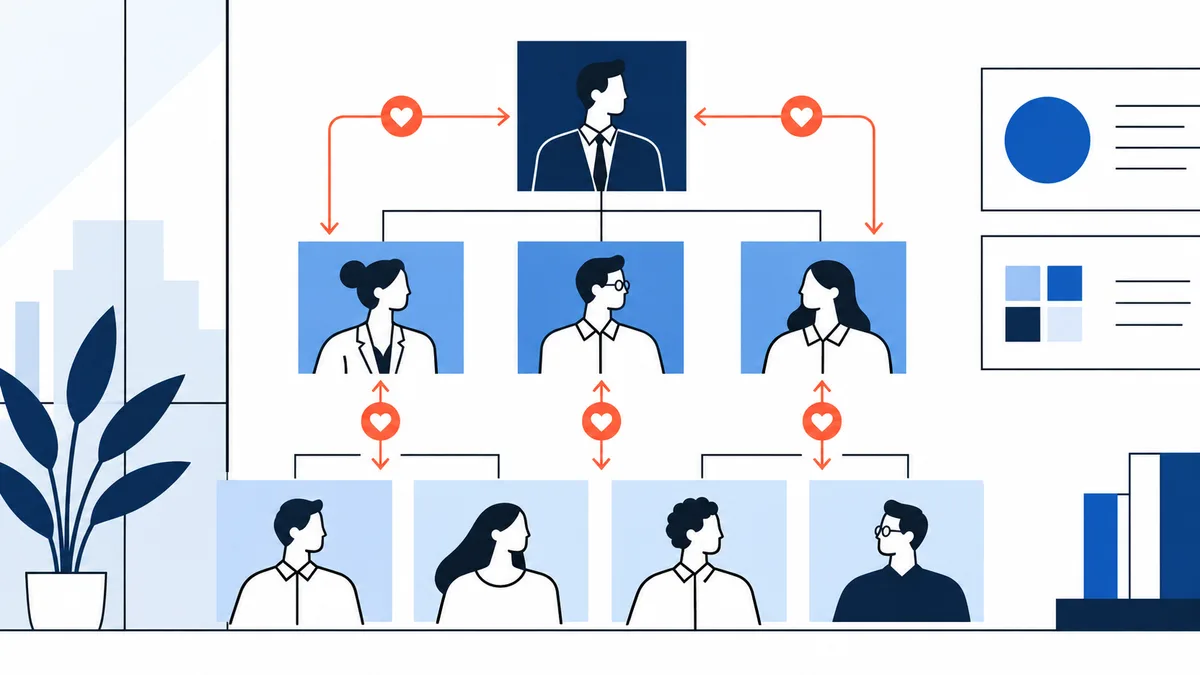
The 2026 research extends earlier studies of emotional acknowledgment and interpersonal trust by examining who acknowledges whom across workplace rank. Across three preregistered studies, the researchers report a rank-related pattern and find that instructed acknowledgment upward prompted more acknowledgment downward in a team negotiation exercise, where the response was associated with better performance. This makes reciprocity a plausible team process; it does not establish that speaking to a manager is safe or beneficial in every workplace.
What did the 2026 research change?
The 2026 research changes the question from whether acknowledging someone’s emotion can shape trust to how acknowledgment moves across workplace rank, and whether that exchange reaches team performance. Its contribution is a rank-and-reciprocity account: rank shapes who is expected to notice whom, and an unexpected acknowledgment upward may prompt a response downward. This is evidence about a studied team pattern, not an individual EQ score or a universal instruction for employees to speak to managers.
The timeline matters. “Feeling Seen: What to Say When Your Employees Are Not OK,” a 2022 Harvard Business School account, described the earlier research as focused on coworkers and identified manager-subordinate interactions as an open question. Bradley and Greer’s 2026 account, “Hey boss! Are you doing okay? Overcoming rank-based norms for emotional acknowledgment improves team performance,” examines acknowledgment across rank and the less expected upward direction. The University of Michigan’s “Why Acknowledging Emotions Improves Team Performance” summarizes the shift: upward acknowledgment can encourage reciprocal acknowledgment from leaders, with a team-performance result in the researchers’ work.
It extends the earlier trust question to a team outcome. Whether one employee should acknowledge a manager’s emotion still depends on the relationship and whether speaking is safe; the study does not make that choice for every workplace.
Sources: Feeling Seen: What to Say When Your Employees Are Not OK; Hey boss! Are you doing okay? Overcoming rank-based norms for emotional acknowledgment improves team performance; Why Acknowledging Emotions Improves Team Performance
What counts as emotional acknowledgment in this research?
Emotional acknowledgment is a verbal response that signals recognition of another person’s expressed emotion. In “Emotional acknowledgment: How verbalizing others’ emotions fosters interpersonal trust,” the authors distinguish it from simply noticing a display: the speaker names an interpretation, as in “You seem upset.” That sentence conveys two things: the listener noticed an emotional cue and interpreted it as upset. The study’s definition concerns an observable conversational behavior, not a direct reading of someone’s private state. A coworker may look tense after a meeting, but the listener cannot know from that expression alone whether the person feels anger, embarrassment, fatigue, or something else. A tentative acknowledgment makes the interpretation available for correction; it does not establish that it is right. That distinction separates acknowledgment from empathic accuracy, the ability to infer another person’s thoughts or feelings accurately. It also differs from emotional understanding, which concerns abilities such as comprehending emotional information and how emotions change. Someone might read a colleague’s distress accurately yet say nothing; someone else might acknowledge an emotion while mislabeling it. The paper treats acknowledgment as an interpersonal act: one person communicates an interpretation to the person displaying the emotion. It is therefore different from offering a solution, affirming an opinion, or showing general concern, even when those responses occur in the same conversation. They may support a person, but do not necessarily name an emotion. The authors place acknowledgment near active listening and responsiveness, while focusing on how a listener responds to a nonverbal emotional display. A frown or sharp exhale is more open to interpretation. Naming what one thinks one sees can communicate attention and willingness to engage; it can also put a mistaken label into the conversation. That uncertainty is part of the behavior being studied, not proof that acknowledgment is always helpful or harmful. The paper examines accuracy, and its findings do not reduce to a rule that a listener should confidently name every emotion. For EQ research, the boundary matters. Acknowledgment can be relevant to emotional skill because it involves noticing a display and choosing how to respond. But the 2021 paper does not define it as a general emotional-intelligence score or stable personal capacity. It studies what happens when people voice an interpretation in work-related relationships. Keeping the unit of analysis this small lets later findings about rank, reciprocity, trust, or team outcomes be read as evidence about a specific behavior and its distribution. None alone tells us a person’s overall EQ, whether they can always identify another person’s inner state, or how they will act across situations.
Sources: Emotional acknowledgment: How verbalizing others’ emotions fosters interpersonal trust
How did the 2026 studies test hierarchy and reciprocity?
Bradley and Greer describe three preregistered studies, each answering a different part of the hierarchy question. Together, they test expectations across rank, look for the pattern in ongoing workplace relationships, and manipulate upward acknowledgment in a team exercise. These details come from the authors’ accessible account, “Hey boss! Are you doing okay?” The University of Michigan’s summary, “Why Acknowledging Emotions Improves Team Performance,” independently describes the rank asymmetry and reciprocal possibility, but gives no sample sizes or methods. The first study was an online experiment with 340 working adults. Participants said they would be less likely to acknowledge the emotions of someone above them than those of a peer or someone below them. This shows a rank-related difference in stated willingness under the study’s conditions; it does not tell us how often employees spontaneously make such comments at work. The authors say perceived norms accounted for the difference: participants felt less expected to acknowledge a leader’s emotions. This offers a proposed social mechanism, while leaving real-world behavior to be checked separately. The second study followed 137 employee-leader pairs across two waves. In these ongoing relationships, acknowledgment was again less likely upward than toward peers or lower-ranked colleagues, and perceived norms explained the difference, according to the authors. This field setting shows that rank expectations appeared in established work relationships, not only online responses. But researchers did not assign employees to behave in a particular way. The study supports the presence of the pattern in workplace pairs; the reported association cannot establish that perceived norms caused every instance of acknowledgment or silence. The third study tested what might happen if lower-ranked members acknowledged a leader. Researchers assigned 573 participants to 191 three-person teams for a negotiation exercise. Each team had one higher-ranked member and two lower-ranked members. Some lower-ranked members were encouraged to acknowledge the leader’s emotions; comparison teams received no such instruction or were told not to do so. In teams where upward acknowledgment was encouraged, leaders then provided more acknowledgment to the rest of the team, exceeding the level the authors describe as normally expected. They interpret this as reciprocity: an act that departs from a rank norm may invite a return act. This experiment supports the proposed sequence more directly than a correlation would: the researchers changed the instruction and observed what followed within a bounded task. Its scope remains that negotiation exercise, with assigned behavior. It cannot establish that an unsolicited comment to a manager is safe, that leaders will always reciprocate, or that the result holds across workplaces. The Michigan summary corroborates the broad interpretation of upward acknowledgment shifting team dynamics; the authors’ account supplies the design details. Together, the studies explain why the 2026 claim is more than an opinion about good manners, while keeping expectation, field pattern, and experimentally prompted reciprocity distinct.
Sources: Hey boss! Are you doing okay? Overcoming rank-based norms for emotional acknowledgment improves team performance; Why Acknowledging Emotions Improves Team Performance
What did the earlier trust studies establish?
The 2021 paper “Emotional acknowledgment: How verbalizing others’ emotions fosters interpersonal trust” asked what happens when someone names another person’s visible emotion. Across six studies, the researchers found that acknowledgment led people to see the speaker as having spent effort on the other person’s needs, and those perceptions were linked to higher trust evaluations. The effect was stronger for negative than positive emotions. The central outcome was whether a person seemed trustworthy, not whether a team performed better or whether a lower-ranked employee could safely speak to a manager. The authors’ explanation draws on costly signaling: an action can appear meaningful because it uses resources or carries social risk. Here, noticing an emotion and saying so may cost time and attention; it may also invite a conversation or expose the speaker to being wrong. A colleague who pauses to say, “You seem frustrated,” can therefore appear willing to spend effort on someone else, even without an immediate payoff. This is the paper’s proposed account of why acknowledgment can affect trust, not proof that every acknowledgment is generous or welcome. Harvard Business School’s 2022 account, “Feeling Seen: What to Say When Your Employees Are Not OK,” put the finding in workplace terms: employees trusted coworkers who acknowledged their feelings, particularly negative ones. It reported that in one scenario or video study, people rated those who commented on negative emotions about 20 percent higher. That figure describes one study’s ratings, not a general increase in trust across workplaces. The accuracy results also resist a simple “name the feeling” rule. The paper reports that calling a positive emotion negative could still raise trust relative to saying nothing, while calling a negative emotion positive did not show the same advantage. The authors suggest this mismatch matters because negative emotions may signal a need that is harder to ignore; glossing that need over can fail to communicate attention. That interpretation does not license confident guesses about someone’s inner state. An emotional display can be ambiguous. A tentative observation leaves room for correction; a label delivered as certainty may do the opposite. The earlier work supplies a relational baseline for the 2026 question: acknowledgment can shape how trustworthy a speaker appears, and emotion valence changes the pattern. Harvard’s account explicitly noted that the studies had examined coworker interactions and that manager-subordinate exchanges remained an open research question. Trust judgments cannot stand in for reciprocal behavior across rank or group performance. The later hierarchy research addresses those outcomes separately. The 2021 findings explain why acknowledgment might matter between people without deciding who should initiate it or what a team will achieve.
Sources: Emotional acknowledgment: How verbalizing others’ emotions fosters interpersonal trust; Feeling Seen: What to Say When Your Employees Are Not OK
Why does rank change who is expected to notice?
The 2026 authors describe a workplace norm that points attention downward: people expect leaders to acknowledge employees’ emotions more often than employees acknowledge a leader’s. In their account, perceived expectations helped explain the rank difference in the first two studies. The pattern therefore concerns what people think each role should do. It does not show that employees feel less concern, notice less, or have weaker emotional skills.
That expectation was visible in the earlier research discussion, too. Harvard Business School’s 2022 article, “Feeling Seen: What to Say When Your Employees Are Not OK,” presents emotional acknowledgment as part of a manager’s responsibility to employees. It also notes that the then-existing research centered on coworkers and that interactions across hierarchy remained an open question. The 2026 work takes up that gap by asking how rank changes the expected direction of acknowledgment, rather than treating every workplace exchange as socially equivalent.
Role expectations can shape a small conversational decision. A manager who notices that an employee sounds discouraged may be seen as doing part of the job: attending to someone whose work and conditions they help oversee. An employee who notices strain in a manager faces a different role boundary. A comment may feel welcome, intrusive, or risky depending on the relationship and the workplace. The studies’ reported norm explanation makes the asymmetry understandable without turning it into a judgment about either person’s empathy. A difference in who speaks can emerge from different expectations attached to their positions.
The evidence supports that interpretation within limits. Bradley and Greer’s accessible account describes three preregistered studies, including an online experiment and a two-wave field study of employee-leader pairs; it reports that perceived norms accounted for the downward-upward pattern in the first two studies. The field component matters because it addresses ongoing work relationships, not only imagined scenarios. Still, the account is the researchers’ summary, while the journal article was inaccessible for this review. It does not justify a claim that every workplace shares the same norm or that rank alone explains every exchange.
For an employee, the finding is not an instruction to monitor a manager’s feelings. It explains why an upward acknowledgment may carry a different social meaning from a manager’s acknowledgment of an employee. Whether to say something depends on local trust, role expectations, and whether the employee can make a tentative observation, be corrected, or leave the conversation without penalty. The research identifies a norm that may be shifted; it does not transfer responsibility for changing it to the person with less authority.
Sources: Hey boss! Are you doing okay? Overcoming rank-based norms for emotional acknowledgment improves team performance; Feeling Seen: What to Say When Your Employees Are Not OK
How can an unexpected upward acknowledgment shift the exchange?
In the third study described in “Hey boss! Are you doing okay?”, lower-ranked team members encouraged to acknowledge their leader’s emotions were followed by more acknowledgment from that leader toward the rest of the team. Leaders did more than meet the level normally expected of someone in their position, the authors report; their response exceeded that baseline. The finding gives the 2026 work its clearest account of how a small act can move across rank: acknowledgment traveled upward, then returned downward.
The setting matters. Researchers assigned 573 participants to 191 three-person teams for a negotiation exercise. Each team had one higher-ranked member and two lower-ranked members. Some lower-ranked members were encouraged to acknowledge the leader’s emotions; other teams received no such instruction or were told not to. Teams worked within a defined task and assigned condition. This design lets the authors compare what followed different instructions in that exercise. It does not show that every spontaneous comment to a manager will produce the same response in ordinary work.
Bradley and Greer interpret the return response as reciprocity. An upward acknowledgment may matter partly because the role norms in their account make it less expected: leaders are generally expected to attend to employees’ emotions, while employees are less expected to attend to a leader’s. When a lower-ranked member notices and acknowledges what a leader appears to feel, the act may register as discretionary attention. The authors describe this as a reciprocal process, not a rule that people always repay emotional attention or a guarantee that a particular leader will do so.
The University of Michigan’s Sanger Leadership Center gives a briefer account of the same direction of change: acknowledgment from lower-ranked members can shift team dynamics through reciprocity. That summary corroborates the interpretation, while the authors’ account supplies the exercise’s participant and team counts and reported sequence. Together, these sources support upward acknowledgment was followed by increased downward acknowledgment in the experiment. They do not establish that the employee caused a durable change in everyday team culture.
This result changes the picture from a one-way duty of care: a response from below can alter what the person above does next. The implication is not that employees must manage leaders’ feelings. Rank shapes the risk of speaking, and an assigned negotiation task cannot settle whether doing so is safe in a particular workplace. The study shows that acknowledgment across hierarchy can be a team process: one direction may invite a response in the other, under the conditions researchers studied.
Sources: Hey boss! Are you doing okay? Overcoming rank-based norms for emotional acknowledgment improves team performance; Why Acknowledging Emotions Improves Team Performance
What changed when the outcome became team performance?
The 2026 research moved beyond asking whether an observer trusts someone who acknowledges emotion. In the authors’ account, acknowledgment from lower-ranked members prompted leaders to acknowledge the rest of the team more often, and that downward response was associated with better performance in a negotiation exercise. The outcome was therefore a team’s task result, not a rating of one person’s warmth or trustworthiness. It extends earlier work, within the limits of this design.
Bradley and Greer describe a preregistered experiment in which 573 participants worked in 191 three-person teams on a negotiation. Each group had one higher-ranked member and two lower-ranked members. Some lower-ranked participants were instructed to acknowledge the leader; comparison teams received no such instruction or were told not to. The authors report that leaders in the upward-acknowledgment condition then gave more acknowledgment downward, exceeding the amount they would ordinarily be expected to provide. They interpret this as reciprocity: an unexpected act may invite a return response. It offers a causal test of that assigned behavior within this bounded exercise, rather than proof that every spontaneous comment to a manager will produce the same chain.
The reported performance link also differs from the 2021 paper’s central result. In “Emotional acknowledgment: How verbalizing others’ emotions fosters interpersonal trust,” six studies found that acknowledgment raised perceptions of the acknowledgment-giver’s costliness and, in turn, trust. Those were judgments about a relationship. Bradley and Greer’s team task asks whether acknowledgment moving across rank accompanies a group result. The outcomes may relate, but are not interchangeable: feeling that a colleague is trustworthy does not itself establish that a team completed a task better.
The 2026 authors also describe a two-wave field study of 137 employee-leader pairs that found the rank pattern in ongoing work relationships. That makes hierarchy relevant outside the negotiation exercise, but it does not show that acknowledgment caused real-world performance differences. For context, Amy Edmondson’s “Psychological Safety and Learning Behavior in Work Teams” studied 51 manufacturing teams and linked a shared belief that interpersonal risk-taking was safe with team learning behavior; learning behavior, in turn, related to performance. This shows why team conditions can matter; it did not test acknowledgment or the 2026 pathway. The defensible conclusion is narrower: the newer experiment connects assigned upward acknowledgment, reciprocal downward behavior, and team-task performance under its conditions. It does not establish a general performance guarantee or make one employee responsible for initiating that process.
Sources: Hey boss! Are you doing okay? Overcoming rank-based norms for emotional acknowledgment improves team performance; Emotional acknowledgment: How verbalizing others’ emotions fosters interpersonal trust; Psychological Safety and Learning Behavior in Work Teams
When is the upward finding safe to apply?
The 2026 finding is not a standing instruction for employees to check on a manager’s feelings. In “Hey boss! Are you doing okay? Overcoming rank-based norms for emotional acknowledgment improves team performance,” the authors describe a team experiment in which lower-ranked members were instructed to acknowledge a higher-ranked member. The reported sequence suggests this unexpected behavior can prompt more acknowledgment downward from the leader, with better performance in that negotiation task. An assigned action in a bounded exercise does not tell us whether the same move is welcome or safe in a specific workplace relationship. An employee’s choice is made under real power constraints. A brief “You seem frustrated; did I read that right?” may be easy to correct where disagreement is ordinary. The same observation could feel intrusive or carry a cost where a manager punishes dissent or expects personal disclosure. These are practical possibilities, not conditions the 2026 account says it tested. A person can also misread a visible expression. Tentative wording leaves room for correction; it does not remove the need to judge whether speaking is prudent. The studies provide different kinds of evidence. The authors report a two-wave field study of 137 employee-leader pairs, placing the rank pattern in ongoing work relationships. Their team experiment involved 573 participants in 191 three-person negotiation teams and tested an instructed sequence. The accessible accounts do not establish that spontaneous upward acknowledgment is safe in every workplace. The University of Michigan summary, “Why Acknowledging Emotions Improves Team Performance,” corroborates the broad finding that upward acknowledgment may encourage reciprocity, but it does not report a measure of psychological safety. The finding should not be stretched to claim that safety was tested or every leader will reciprocate. Team research helps explain why local conditions matter. In “Psychological Safety and Learning Behavior in Work Teams,” Amy Edmondson’s 1999 field study examined 51 manufacturing teams. It defines team psychological safety as a shared belief that interpersonal risk-taking is safe and reports a relationship with team learning behavior, which in turn related to performance. That study did not examine emotional acknowledgment or whether an employee should address a manager. Applying its idea here is an editorial inference: willingness to speak depends partly on what the group has shown happens after someone speaks. One successful exchange cannot establish that shared condition. The 2022 Harvard Business School account, “Feeling Seen: What to Say When Your Employees Are Not OK,” described manager-subordinate acknowledgment as an open research question and emphasized the manager’s responsibility toward employees. The 2026 work adds evidence about the less expected direction and possible reciprocity; it does not transfer responsibility for a healthy climate to the employee. Leaders have greater control over how disagreement and correction are received. They can make respectful observations welcome, accept “I read that wrong,” and avoid pressing someone to explain more than they chose to share. For an employee, the practical decision is modest: consider the relationship, the visible cue, and the likely response to correction before speaking. If the setting permits a low-pressure check-in, leave the other person room to decline or correct the interpretation. If it does not, silence may be the safer judgment. For a manager, the result points to a more direct action: show that acknowledgment can move both ways, and make the conditions for that exchange credible over time.
Sources: Psychological Safety and Learning Behavior in Work Teams; Hey boss! Are you doing okay? Overcoming rank-based norms for emotional acknowledgment improves team performance; Feeling Seen: What to Say When Your Employees Are Not OK
What can a personal reflection tool do after the research?
The research describes patterns across rank and a team negotiation exercise. It cannot tell one employee whether a particular manager will welcome an emotional observation. A personal reflection tool can help with a smaller question: what did I notice, what did I say, and what response might I try next time? Perhaps a colleague sounded frustrated during a handoff. Before naming the feeling, did you check your interpretation with a tentative question, move straight to advice, or leave room for correction? Identify an observable choice, such as asking, “Have I understood what is making this difficult?” This is practice in noticing a behavior, not proof that you read another person’s inner state correctly. The private 32-item Emotional Skills Profile offers structured reflection on recent habits and authored emotional situations. It is an educational development profile without validated norms or established ability-test validity. It does not test the acknowledgment behavior studied in the 2026 research or predict a manager’s response. Use it as a prompt for choosing a behavior to examine in a setting where you can speak and be corrected safely. If that structure would help, explore the Emotional Skills Profile at /assessment. Begin with one exchange and a proportionate next step.
Questions readers ask
What is emotional acknowledgment at work?
It is a verbal response that signals recognition of another person’s expressed emotion, often by naming a tentative interpretation. It is a specific conversational behavior, not a direct measure of overall emotional intelligence.
What did the 2026 research find about employees acknowledging managers?
The authors report that people were less likely to acknowledge emotions upward across rank. In a team negotiation experiment, instructing lower-ranked members to acknowledge a leader was followed by increased acknowledgment from that leader toward the team.
Does the 2026 research show employees should always check on their managers?
No. The team experiment tested assigned behavior in a bounded negotiation task. It does not establish that an unsolicited comment is safe or welcome in every workplace. The relationship and likely response to correction matter.
Can the Emotional Skills Profile measure the behavior studied in the 2026 research?
The private 32-item Emotional Skills Profile offers structured reflection on recent habits and authored emotional situations. It does not test the acknowledgment behavior studied in the 2026 research or predict a manager’s response.
Sources
- Emotional acknowledgment: How verbalizing others’ emotions fosters interpersonal trust
Defines emotional acknowledgment and reports six studies linking acknowledgment with perceived costliness and trust, including findings about emotion valence and accuracy.
- Feeling Seen: What to Say When Your Employees Are Not OK
Establishes that the earlier research account focused on coworker interactions and identified manager-subordinate acknowledgment as an open research question.
- Hey boss! Are you doing okay? Overcoming rank-based norms for emotional acknowledgment improves team performance
The authors’ accessible account describes three preregistered studies, their designs and sample sizes, the rank pattern, reciprocal acknowledgment, and the team-performance result.
- Why Acknowledging Emotions Improves Team Performance
Provides an institutional summary corroborating the reported rank asymmetry, reciprocity, and team-performance direction; it omits sample sizes and design details.
- Psychological Safety and Learning Behavior in Work Teams
The repository abstract describes a study of 51 manufacturing teams and supports limited context about team psychological safety, learning behavior, and performance.
Apply it to the real situation
Choose one emotional response to notice and practice
From this guide: The research describes group patterns, but cannot tell you how a particular manager will respond to an acknowledgment.
If you want a structured way to reflect on your own emotional habits and responses to authored situations, the private 32-item Emotional Skills Profile offers a personal development prompt. Use it to choose one observable behavior to examine in a setting where you can speak and be corrected safely. It does not measure the behavior studied in the 2026 research or predict another person’s response.