
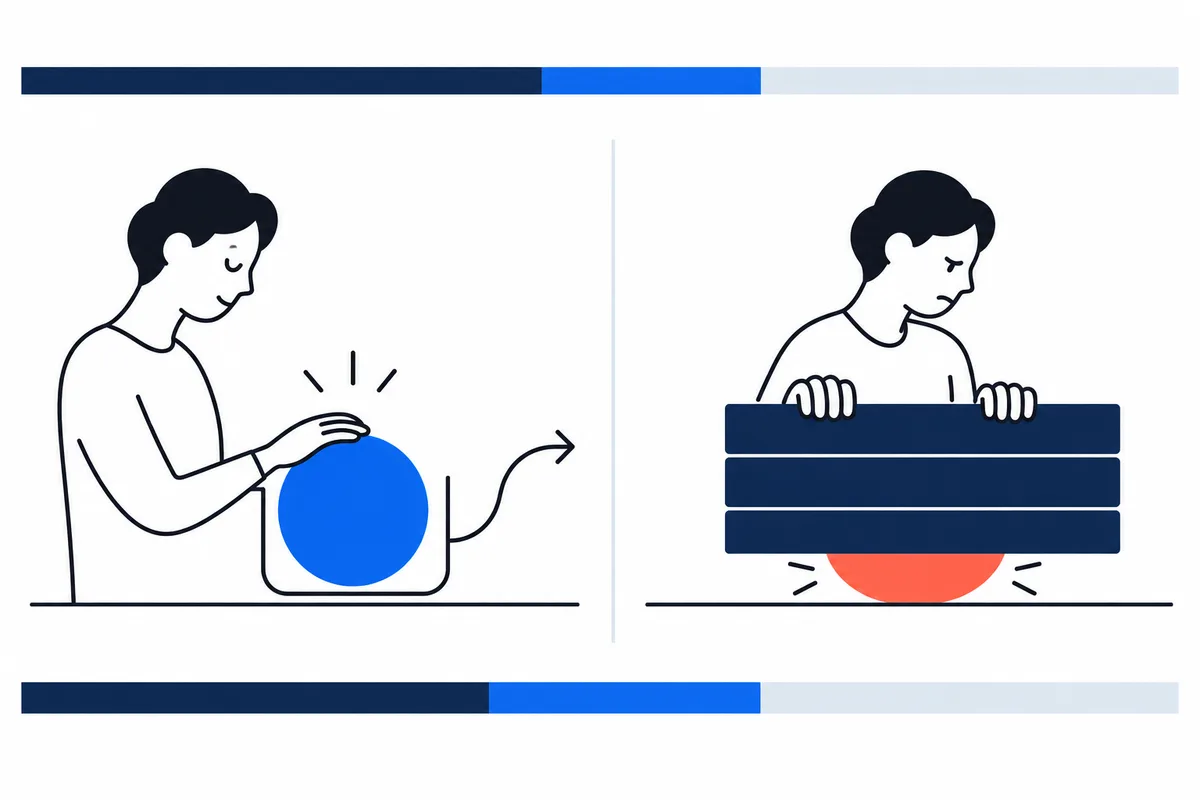
Emotion-regulation practice works with an emotional episode or its surrounding situation to make a considered choice. Expressive suppression specifically inhibits outward signs after an emotion is underway. Since either can look quiet, consider what the response was changing, when and why it began, and whether the concern remained addressable afterward.
A quiet response leaves an open question
Emotion-regulation practice concerns how a person works with an emotional episode: what sets it off, where attention goes, how the situation is understood, and what response follows. Suppression is narrower. In ordinary use, it means holding back an outward expression that is already taking shape. A person can suppress in the moment and still be regulating emotion in a broader sense; the key question is what the pause is for and what happens next.
Imagine, for illustration, that a colleague hears a sharp objection in a meeting and keeps their face still. That quiet display could be a deliberate pause to understand the objection and answer it later. It could also be an effort to hide anger while the disagreement remains untouched. The room sees restraint in either case. It cannot tell from that one display whether the feeling shifted, whether the person felt able to speak, or whether a useful response remains possible.
To judge a practice, ask what it targets, when it enters the episode, what purpose it serves, and what action is still available afterward. Is the person changing the conditions, redirecting attention, reconsidering what the event means, or simply limiting expression? Did the pause create room for a considered reply, or end the exchange without addressing the concern? Colleagues do respond to visible behavior, so a controlled expression can help an interaction proceed. But its value depends on the larger response it serves; quiet by itself settles neither the feeling nor the issue.
What is being changed in an emotional episode?
In “The Emerging Field of Emotion Regulation: An Integrative Review,” Gross describes regulation broadly as influencing which emotions arise, when they arise, and how they are experienced or expressed. His process model identifies five possible points of intervention: selecting a situation, changing it, directing attention, changing its meaning, and modifying the response. The points are useful because they distinguish a change to the conditions of an episode from a change to the feeling’s interpretation or its outward expression.
Situation selection changes whether or when a person enters an emotional setting. Someone who expects a tense exchange might ask to discuss it privately rather than raise it during a crowded meeting. Situation modification changes something after entering: a participant could request an agenda, clarify who is making a decision, or ask for a short pause. These actions do not remove every difficult feeling. They alter the circumstances that may be producing or sustaining it.
Attention deployment concerns what receives focus within the situation. During a critical presentation, a speaker might stop tracking one listener’s frown and return attention to the question being answered. That shift may keep the task manageable, though it does not prove that the frown was irrelevant or that the speaker’s concern has disappeared. Attention can move without the underlying problem being resolved.
Cognitive change concerns the meaning assigned to an event. If a manager’s brief comment sounds dismissive, the employee might consider whether it refers to a specific decision rather than their overall competence, then ask what change is needed. This is not a demand to assume good intent. It is an attempt to test an interpretation before treating it as settled. The facts of the exchange still matter, and a revised reading may prove wrong.
The first two points act on the situation’s source or shape. The third changes which part of it occupies attention; the fourth changes the appraisal attached to what is noticed. Those middle points can look similar from the outside, but they ask different questions: what am I attending to, and what do I think this event means? A worker who rereads a critical message for its concrete request is directing attention to its content. If they then decide the request concerns one deliverable rather than their general worth, they are changing its meaning. Neither move guarantees that the criticism is fair; each creates a different basis for deciding what to do.
Response modification acts on what is already unfolding, including bodily reactions, feelings, or expression. Someone noticing a rising voice might slow their speech or keep an angry expression from dominating a conversation. That can affect what others encounter, while leaving the emotion itself partly or fully present. “The Emerging Field of Emotion Regulation: An Integrative Review” offers these points as an organizing model; it does not require every episode to pass through them in order. Naming a target tells us where an attempt is directed, not whether it helped the person understand, communicate, or address the situation.
Sources: The Emerging Field of Emotion Regulation: An Integrative Review
What does suppression change, and what can the observer actually see?
Reappraisal changes the meaning assigned to an emotional situation; expressive suppression changes what a person shows after an emotional response is already underway. Reappraisal therefore enters earlier in the unfolding response, at the interpretation of what an event means, while suppression addresses its expression. The terms name different targets, not two labels for the same act of appearing composed. In the comparison summarized in Gross’s review, “Emotion Regulation: Affective, Cognitive, and Social Consequences,” reappraisal often reduced both reported emotional experience and outward expression, without the memory effects associated with suppression. Suppression reduced visible expression but did not reduce reported experience in the reviewed studies. The distinction is about the target of the strategy: reconsidering what an event means can alter the emotional response, while restraining its display can leave the response present behind a quieter face or voice.
Suppose a colleague receives a blunt objection during a project review and keeps their expression neutral. An observer can report the visible fact: the colleague did not show much reaction. The observer cannot infer from that alone that the colleague felt calm, accepted the criticism, understood its rationale, or stopped feeling angry. Nor can a quiet face establish that the colleague has reinterpreted the objection. They may be holding back a response while they listen, or they may still be experiencing the emotion without showing it. Those are different internal possibilities that the same outward behavior does not distinguish.
Gross’s review also reports that, across the studies it summarizes, suppression was associated with impaired memory and increased physiological responding for both the person regulating and interaction partners. These are review-level findings from studied strategies, not measurements of what happens in every workplace exchange. The partner finding is easy to miss: controlling a display is an individual strategy, but it takes place in a social encounter. Another person may be responding physiologically even while the conversation appears outwardly composed. That result does not mean a coworker can diagnose strain by watching someone suppress; it means the review found effects extending beyond the regulator in the studies it considered. Nor does impaired memory mean every person who keeps a neutral expression will forget what was said. The reported comparison describes a pattern across reviewed research, not a prediction for a named meeting.
These findings matter because a restrained display can look like a smooth interaction even when the person’s experience and the partner’s response are not similarly settled. A colleague who sees no visible anger may still have received no signal that the objection landed badly; the person holding back may still need to understand or address the disagreement. The review’s comparison therefore cautions against using outward calm as a stand-in for emotion, recall, bodily response, or mutual understanding. At the same time, the difference between displayed and reported emotion is not a reason to treat visible conduct as irrelevant. Expression is one part of the exchange others can encounter directly. What it cannot do is answer all the questions that an observer may be tempted to attach to it: whether the person has accepted a decision, whether they feel safe speaking, or whether their interpretation of the event has changed.
Expression still has consequences between people. Limiting a sharp reply can give a conversation a chance to continue without escalating in that moment, and a colleague responds to what is actually said and shown. That practical effect does not make suppression a moral failing, nor does it tell us what the person privately experienced. It identifies one part of the interaction: the display changed. Whether the emotional meaning changed, and whether the concern was later communicated or resolved, requires evidence beyond that display. The review compares reappraisal and suppression in the studies it covers; it does not turn either term into a judgment about every pause or every difficult conversation.
Sources: Emotion Regulation: Affective, Cognitive, and Social Consequences
Why does the same move behave differently across situations?
A pause that limits expression can serve different purposes depending on what the situation requires and what the person can do next. “Flexible Emotion Regulation: How Situational Demands and Individual Differences Influence the Effectiveness of Regulatory Strategies” reviews theory and selected studies arguing that strategy effectiveness may depend on the interaction between features of a situation and characteristics of the person. Its point is not that one strategy wins across settings. A move that helps preserve attention for an immediate task may be poorly suited to a moment when the task is to raise a concern or decide what should change.
Consider two moments in the same disagreement. While a colleague is explaining a time-sensitive problem, someone may hold back an angry reply long enough to hear the details and identify what needs a decision. The immediate demand is listening and responding to the task; the pause can preserve room for that work. Later, when the urgent decision has passed, the same silence could leave an unresolved objection out of the conversation. If the person now has time and a suitable channel to ask for clarification or state a boundary, simply continuing to conceal the reaction serves a different purpose and carries a different interpersonal cost. These moments do not prove that restraint helped or harmed; they show why timing and available next actions belong in the interpretation.
The review brings situational demands and individual differences into the same account, rather than treating a strategy as equally effective for everyone in every setting. In practice, the relevant features may include what the exchange requires at that instant and what choices are genuinely available to the person. A brief pause during a complex discussion can protect attention; a pause imposed by lack of authority or a public setting may leave fewer ways to respond. The review does not supply a universal threshold for how long to wait or a validated rule for deciding when suppression is useful. Its authors also note that interactions among the factors remain under-studied, so context should not become a retrospective excuse for calling any outcome effective. The person’s aim matters to the practical interpretation, but intention alone cannot establish effectiveness either. An attempt to stay focused may still crowd out useful information; an attempt to avoid escalation may postpone an important boundary. The relevant question is what the strategy made possible under those conditions, judged against the demand that actually existed, rather than against an ideal response imagined afterward.
As an editorial application of that review, examine three questions about a particular pause: What demanded attention then? What was the pause intended to preserve? When that demand passed, what options became available? This is a way to inspect an episode, not a validated scoring rule or a claim about what another person intended. If the pause helped someone listen through a demanding exchange and later made a clear response possible, it may have created useful room to choose. If the work concern remained unaddressed and no later action followed, the quiet display alone is not evidence that the regulation succeeded. The distinction depends on the task and the subsequent choices, not on a universal verdict about holding back.

How do work norms and power affect what restraint means?
A workplace response takes shape in front of other people, under expectations about what a competent employee, manager, or professional should show. “Emotion Regulation at Work: A Social Perspective” places regulation within relationships, occupational and organizational norms, and wider social expectations. Its framework follows those influences through several stages: what emotion a person notices, what goal they set, which response they use, and how the result is received. That account changes what an observer can conclude from a quiet response. The visible behavior may reflect the interaction and its rules as well as the individual's preferred way of handling emotion.
Norms can be explicit, such as a meeting rule to let each person finish, or less directly enforced, such as an expectation that a junior employee remain agreeable when a senior colleague challenges their work. A role can also define which feelings are treated as relevant: urgency may be welcome when a project is at risk, while frustration voiced about how the decision was made may be judged as disruptive. The workplace review offers a framework for asking how those expectations shape emotional goals and responses. It does not establish which expectation operated in any particular room. A still face could reflect attention to the discussion, a wish to meet a professional norm, concern about consequences, or several of these together; the display alone does not identify the reason.
The options available after noticing an emotion are also uneven. In “Emotion Regulation and Emotion Work: Two Sides of the Same Coin?”, von Scheve connects emotion rules with resources that affect whether people can choose or modify a situation. In a workplace, someone with authority may be able to stop a meeting, move a disagreement into a private conversation, or change the decision process. A person with less control may have to stay in the room, wait for a safer opening, or seek another channel. These are applications of the conceptual account, not measured outcomes from a particular occupation. They show why identical advice to “speak up now” overlooks who can set the terms of the exchange and who bears the risk of challenging them.
That difference matters when interpreting restraint. Imagine a project meeting where one employee has a concern about a proposed deadline. Asking a clarifying question in the room may be feasible if the group treats questions as part of planning. If interruptions are punished or the decision-maker has already closed discussion, a written question afterward or a private follow-up may leave more room to make the concern concrete. A boundary may need a similarly workable channel: the person might state what information or time is needed before agreeing to a commitment. Choosing a less public route does not by itself prove fear, agreement, or suppression. It describes an available action that could keep the work issue addressable.
The two sources work at different levels. “Emotion Regulation at Work: A Social Perspective” maps how relationships and norms can enter regulation; von Scheve’s account draws attention to unequal resources and room to alter a situation. Together they caution against treating one employee's visible restraint as a transparent report of preference or capacity. They do not erase agency: an employee still makes choices, and a later question, request, or decision to let an issue rest may be their own. The practical judgment is narrower. To understand what a response accomplished, consider what the role allowed, what channel remained open, and whether the work concern could still be raised. A social explanation should sharpen those questions, not assign a motive to someone whose reasons have not been stated.
Sources: Emotion Regulation at Work: A Social Perspective; Emotion Regulation and Emotion Work: Two Sides of the Same Coin?
What does the corrected 15-day managerial study show?
“Effects of Cognitive Reappraisal and Expressive Suppression on Daily Work-Related Outcomes: Comparison between Younger and Older Chinese Workers” reports a diary study of 141 Chinese managerial employees who completed daily reports across 15 consecutive workdays. Yeung and Wong analyzed the repeated observations with multilevel methods. Their abstract reports that reappraisal was associated with lower daily negative emotion and perceived work stress across age groups. Age moderated the associations between suppression and daily negative emotion, perceived stress, and job satisfaction; the reported associations were more beneficial among older than younger workers. The finding is a specific comparison within this managerial sample, not a ranking of strategies for every employee.
The repeated reports matter because a person's workday is not a single fixed condition. A diary design can distinguish variation from one day to another from differences between people who tend to report different experiences overall. Multilevel analysis is suited to that nested structure: daily observations sit within each employee. It therefore offers a view of whether a strategy's reported use moves alongside that person's daily outcomes, while also examining whether those associations differ across employees or age groups. In this study, the daily time frame makes the question more specific than asking whether a person who generally favors one strategy is more satisfied at work.
The method still records associations. Employees reported their strategies and daily outcomes; the abstract does not describe an experiment assigning them to reappraise or suppress. A difficult day could influence both which response someone reports using and how much stress or negative emotion they report. Other features of a day may also matter. The multilevel analysis helps represent repeated observations, but it does not by itself establish that a strategy caused the outcome. The proper reading is that, in these reports, reappraisal and suppression showed the stated patterns of association, including age moderation for suppression-related outcomes.
The age finding is easy to overread. “More beneficial” describes how the study's reported associations differed across age groups; it does not tell an older employee to suppress more, or a younger employee to avoid suppression. Nor does it establish a general developmental rule. The participants were Chinese managerial employees in one study, and the measures were self-reported daily experiences. The available abstract supports that bounded description. It does not establish that age itself caused the difference, identify what workplace condition produced it, or show that the pattern applies across occupations and cultures.
This study complicates a simple claim that one strategy always has better work outcomes. The reported reappraisal associations appeared across age groups, while the suppression associations varied with age for the outcomes named in the abstract. That is evidence against treating a strategy label as a complete explanation of a day's experience. It is not evidence that suppression is generally adaptive, or that its display should be judged successful whenever a favorable association appears in one subgroup. For an individual work episode, the study cannot decide whether holding back helped; it suggests that research questions about daily outcomes need to preserve who is reporting, what outcome is considered, and how the association differs across people.
The useful contribution is the level of detail, not a prescription. Fifteen consecutive workdays let researchers examine daily reports within one managerial sample, and multilevel analysis kept that repeated structure in view. The results invite a careful question about patterns over time: do reports of a strategy accompany different daily experiences, and does that relationship vary among employees? They cannot answer why any particular person chose a response in a meeting. For that, the surrounding circumstances and what the person could do afterward remain necessary evidence. The study gives a counterweight to universal rankings while leaving individual workplace judgments situated.
Why is the 10-day frontline study a different piece of evidence?
“Frontline Managers’ Task-Related Emotion Regulation, Emotional Intelligence, and Daily Stress” describes a separate study: 83 frontline managers reported across 10 working days. Its abstract places emotion regulation inside work tasks and considers reappraisal, suppression, expression, negative affect during tasks, daily stress, and emotional-intelligence abilities. The abstract’s broad conclusion is that regulation reflects stable, situational, and personal factors. That task-level framing is the useful contribution here: a manager’s response may vary with the task and the person, not only with a general preference for one strategy.
It is important to keep the source correction visible. The detailed findings about daily negative emotion, perceived work stress, job satisfaction, and age differences belong to “Effects of Cognitive Reappraisal and Expressive Suppression on Daily Work-Related Outcomes: Comparison between Younger and Older Chinese Workers.” That is the 141-person diary study spanning 15 consecutive workdays. Those results cannot be reassigned to the frontline study simply because both examine managers, emotion regulation, and workdays. “Frontline Managers’ Task-Related Emotion Regulation, Emotional Intelligence, and Daily Stress” has its own sample, 10-day period, task-related scope, and abstract-level finding. Combining the records would create a result neither abstract reports.
| Study | Participants and period | What the accessible record supports | | --- | --- | --- | | “Effects of Cognitive Reappraisal and Expressive Suppression on Daily Work-Related Outcomes: Comparison between Younger and Older Chinese Workers” | 141 Chinese managerial employees; 15 consecutive workdays | The abstract reports associations between strategies and daily outcomes, including age moderation for suppression-related outcomes. | | “Frontline Managers’ Task-Related Emotion Regulation, Emotional Intelligence, and Daily Stress” | 83 frontline managers; 10 working days | The abstract frames regulation around tasks and reports stable, situational, and personal factors. |
The comparison changes what a reader can claim. The first study’s abstract supports a specific account of daily outcome associations in its Chinese managerial sample. The second adds a task-centered workplace frame and a broad account of factors associated with regulation. It does not, from the accessible abstract, tell us which strategy produced a particular outcome, how each emotional-intelligence ability moderated each relation, or whether one approach improved performance. A task-level design can help locate a question in the work being done, but the available summary does not justify filling in detailed answers that the abstract does not give.
For someone reflecting on a difficult work exchange, this study suggests a useful distinction in the question being asked: Was the response generally characteristic of the person, tied to a particular task, or connected to other personal factors? That is an interpretive prompt, not a finding about what happened in any one employee’s meeting. A task such as correcting an error, handling a customer concern, or coordinating a handoff may pose different demands, but the abstract does not report separate results for those examples. The evidence supports keeping situation and person in view; it does not tell an individual which strategy to use in a named task.
Because the full text is restricted and the abstract does not supply per-strategy results, claims should stop at its stated scope and broad conclusion. It cannot serve as confirmation of the 15-day study’s outcome pattern, nor as a detailed guide to task-by-task effectiveness. Its added value is narrower: it makes the work task part of the research frame, alongside more stable and personal influences. In reading workplace evidence, that is enough to distinguish a task-level question from a daily-outcome association without pretending the two studies answer the same thing.
Sources: Frontline Managers’ Task-Related Emotion Regulation, Emotional Intelligence, and Daily Stress
Do people use the same strategies across daily domains?
“A Domain-Differentiated Approach to Everyday Emotion Regulation from Adolescence to Older Age” widens the lens from managers to everyday hassles across domains. Its experience-sampling study followed 325 participants aged 14 to 88 over approximately nine days distributed across three weeks. The abstract reports that strategy use varied both by person and by domain, with different reported patterns for interpersonal hassles and work or school hassles. This matters because a count of how often someone reports a strategy, detached from the kind of situation, can conceal where that strategy is actually being used.
The study does not establish that every setting produces a different response, or that everyone changes strategies in the same way. Its contribution is more specific: the interpersonal and work/school categories were not interchangeable in the reported patterns. An interpersonal hassle might involve a disagreement or strained interaction; a work/school hassle could involve a task or institutional demand. Those examples clarify the kinds of domains at stake, but they are not individual cases reported by the study. The abstract supports variation across broad categories, not detailed conclusions about a particular conflict, occupation, or school.
The sample also differs from a workplace-only investigation. Ages 14 to 88 encompass adolescents, working-age adults, and older adults, and the daily-hassle measures span more than employment. Results across that range can help establish that everyday emotion regulation is domain-sensitive in the studied sample. They cannot be read as a direct estimate of what office employees do, how frontline staff manage customer conflict, or which response works best in a team. The design asks about reported strategy use in daily situations; it does not turn those reports into a test of workplace effectiveness.
That distinction between use and success is central. If participants report using one strategy more in one domain, the observation says where a strategy was reported, not whether it reduced distress, improved communication, or resolved the underlying problem. The abstract’s domain comparison therefore cannot show that suppression is effective at work, or that a strategy used in interpersonal hassles would have the same effect during a task. Frequency and outcome are separate questions. A reader who treats use as proof of benefit would be adding a conclusion the study did not measure in the claim available here.
A narrow practical implication follows as an editorial application: when noticing a response pattern, record what kind of situation it occurred in. A note that says “I held back” leaves the domain invisible. Adding “during a disagreement with a colleague” or “while trying to finish a time-sensitive task” preserves a feature that may change how the episode is understood. This is not a validated tracking method derived from the experience-sampling study; it is a modest way to avoid flattening situations that its findings suggest can differ. The note should describe the setting, not label the response successful or unsuccessful by itself.
For an individual reviewing several episodes, the comparison invites a sharper question: does a reported strategy recur across different kinds of daily hassle, or cluster in one domain? The study supports asking that question because it found domain-related variation in reported strategy use. It does not supply a universal rule for interpreting the answer, and its broad age range means the finding should not be recast as an office norm. Keeping the situation attached to each observation makes a personal reflection more precise while preserving the boundary between where a strategy is used and whether it works.
Sources: A Domain-Differentiated Approach to Everyday Emotion Regulation from Adolescence to Older Age
What can one practice note or EQ profile contribute?
A useful note separates what happened from what you did with the feeling. Write the observable event first, then name the response target: were you trying to keep your voice steady, understand an unexpected reaction, reconsider what a comment meant, or postpone a reply until you had the relevant facts? Add whether you paused outward expression. These details make the episode reviewable without treating a composed face as proof that the feeling disappeared or that the concern was resolved.
For example, imagine a project discussion in which a colleague says that a handoff arrived too late. This is an illustration, not a research case. A note might say: “The handoff date was challenged in the meeting; I felt irritation; I kept my reply brief while checking the timeline; I wanted to avoid disputing the date from memory.” The target is then more precise than “I controlled my emotions.” The person was buying time to check a factual disagreement. The note also records a pause in expression without deciding, by itself, whether that pause was useful regulation or suppression.
The next line should connect the emotion to the work concern. If the timeline confirms the handoff was late, a proportionate response might acknowledge the missed date and propose how to flag the next dependency sooner. If the dates were misunderstood, the person could share the sequence and ask where the handoff expectation diverged. If the delay came from a blocked approval, the relevant next move may be to identify who can unblock it. Those responses follow different facts. None requires pretending irritation was absent; each gives it a place in a conversation about the work rather than letting the first impulse choose the reply. It also gives the pause a purpose that can be checked afterward: did waiting make room to verify information and choose a response, or did it only conceal disagreement? The answer depends on what happened next, not on the calmness of the meeting-room display.
When the facts are still unclear, the follow-up can be a question: “Can we compare the dates and the approval point before deciding where the delay happened?” If the meeting is too public or rushed, a private return conversation may make clarification easier. If the exchange includes a recurring demand that cannot be met, a boundary may be needed. If the person’s initial reply was sharper than intended, repair can be direct: name the impact, correct the tone, and return to the unresolved handoff. These are possible actions, not a script that fits every disagreement. The record helps match the next move to the actual issue and the available channel. It can also prevent an emotion label from standing in for a work diagnosis. Irritation might signal a missed commitment, an unclear division of responsibility, or simply surprise at criticism. Checking the timeline and asking what was expected gives the feeling information to work with; it does not require treating the feeling as either proof of fault or an obstacle to remove.
A second observation can show whether the chosen action kept the concern discussable: did the timeline get checked, was a request made, did someone clarify the expectation, or did the conversation stop without a workable route back? That is more informative than scoring the episode as “good regulation” or “bad suppression.” It still cannot show that the note caused a better outcome. A meeting may remain tense because the deadline, authority, or information problem remains unresolved. The observation is a prompt for a more specific next attempt, not a verdict on the person’s emotional capacity.
A profile can supply another set of prompts, provided its role stays modest. The current Emotional Skills Profile is a private 32-item educational self-reflection tool. Its result can sit beside specific observations as material to consider when choosing what to practise; it does not function as a validated ability test or a normed measure. A profile response cannot establish that a person behaves the same way in every setting, and one practice note cannot establish a stable skill. The value is in comparing a broad self-reflection with the details of actual exchanges, then choosing one behavior to try in a situation where the work concern can still be addressed.
Sources: Emotional Skills Profile
Choose one next step that keeps the concern addressable
Choose one recent exchange and write down what was said or done, what you were trying to change, and one follow-up that fits the work issue. It might be a factual question, a private return conversation, a clear boundary, or a brief repair. If raising it would be unsafe or unworkable, use a safer channel or leave it there. The aim is a next move you can judge in context, not a score for how calm you looked. Make the action small enough to try: ask for the missing information, set a time to return to the concern, or correct one part of an earlier reply. Afterward, note what the action changed in the conversation and what remains unresolved.
The private 32-item Emotional Skills Profile offers educational self-reflection prompts alongside those observations. It is not a validated ability test or normed score. Use it as a prompt for what to notice next, while keeping the decision anchored in the exchange and its practical stakes. If that perspective would help you choose a behavior to practise, [Explore the Emotional Skills Profile](/assessment).
Sources: Emotional Skills Profile
Sources
- The Emerging Field of Emotion Regulation: An Integrative Review
Gross defines emotion regulation broadly and presents five possible points in the emotion-generative process; supports the once-only definition of regulation and the target/timing distinction.
- Emotion Regulation: Affective, Cognitive, and Social Consequences
Gross's review abstract reports the reviewed-study comparison: reappraisal often reduced reported emotion and expression without memory effects; suppression reduced expression, did not reduce reported experience, impaired memory, and increased physiological responding for regulators and partners.
- Flexible Emotion Regulation: How Situational Demands and Individual Differences Influence the Effectiveness of Regulatory Strategies
Kobylińska and Kusev argue from a review of theory and selected studies that strategy effectiveness may depend on interactions between situation features and person characteristics; they note the research had often treated these determinants separately.
- Emotion Regulation at Work: A Social Perspective
The 2026 review organizes workplace social influences at relational, professional, and societal levels and across regulation phases; it is a field-level framework for why visible behavior is shaped by interaction and norms.
- Emotion Regulation and Emotion Work: Two Sides of the Same Coin?
Von Scheve's conceptual theory links emotion regulation and workplace emotion work to social norms and argues that options for situation selection or modification depend partly on economic, cultural, and social resources.
- Effects of Cognitive Reappraisal and Expressive Suppression on Daily Work-Related Outcomes: Comparison between Younger and Older Chinese Workers
Yeung and Wong report a diary study of 141 Chinese managerial employees over 15 consecutive workdays. Multilevel analyses found reappraisal associated with lower daily negative emotion and perceived work stress across age groups; age moderated suppression associations with daily negative emotion, perceived stress, and job satisfaction, with more beneficial associations among older than younger workers.
- Frontline Managers’ Task-Related Emotion Regulation, Emotional Intelligence, and Daily Stress
Troth et al. report a separate study of 83 frontline managers across 10 working days, examining reappraisal, suppression, expression, negative affect during tasks, daily stress, and moderation by four emotional-intelligence abilities; the abstract says regulation reflected stable, situational, and personal factors.
- A Domain-Differentiated Approach to Everyday Emotion Regulation from Adolescence to Older Age
An experience-sampling study of 325 participants aged 14–88 over approximately nine days in three weeks found strategy use varied by person and domain; reported strategies differed across interpersonal and work/school hassles.
- Emotional Skills Profile
The approved bridge describes a private 32-item Emotional Skills Profile as an educational reflection and development tool; it supports invitation to /assessment, not a validity, norm, ability, or outcome claim.
Apply it to the real situation
Turn a difficult exchange into a clear practice target
From this guide: Use a recent work moment to notice what you did with a feeling and identify one observable next step for the concern.
A single exchange can leave a personal question: did you pause so you could choose a response, or did the issue remain unaddressed? The private 32-item Emotional Skills Profile offers prompts for reflecting on recent emotional habits and possible development priorities. Use it as an educational reflection tool alongside a specific practice note, then choose one behavior to examine in your next difficult exchange.