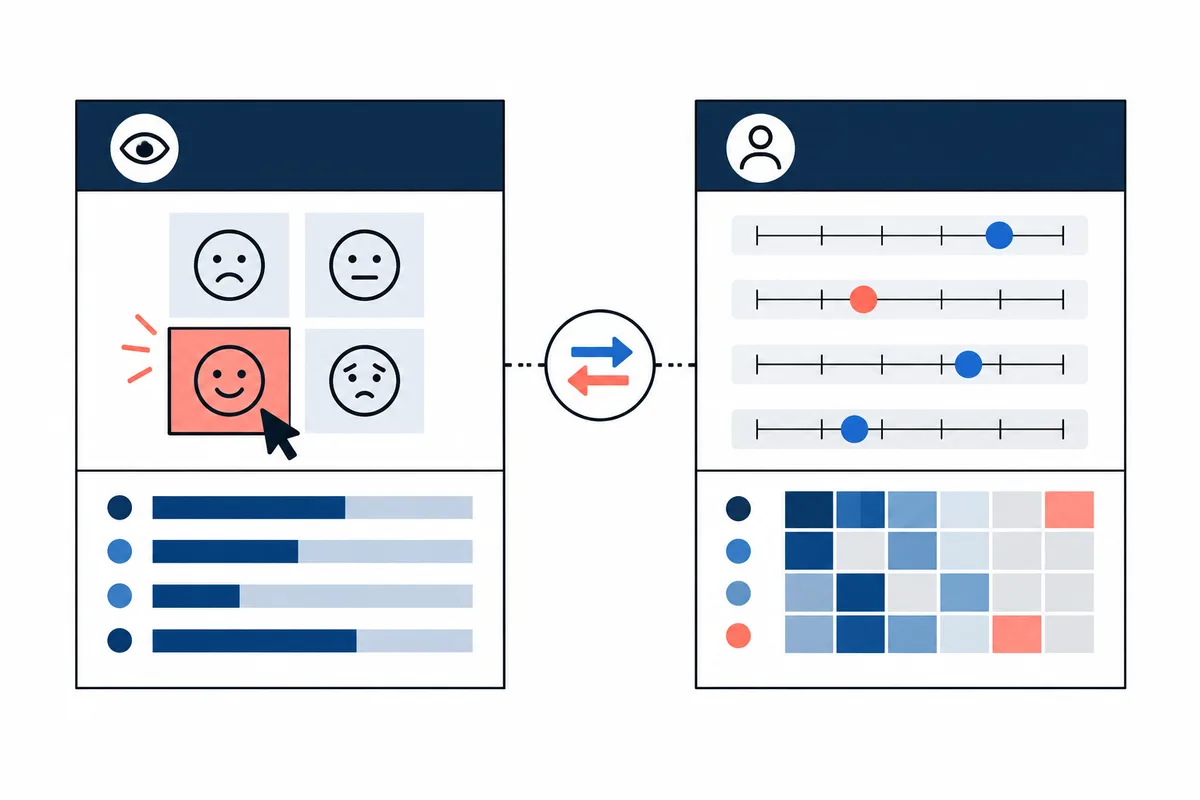
TEIQue-SF measures trait emotional intelligence through self-reports about typical emotional functioning. It does not directly test performance on emotion problems or record what someone did in a particular workplace exchange. Research finds some predictive value for TEIQue measures, but the result depends on the instrument, sample, and outcome studied. To understand one conversation, examine the event and observable behavior.
Does TEIQue-SF measure emotional ability or typical functioning?
The TEIQue-SF is designed to measure trait emotional intelligence: how a person describes their usual emotional functioning, rather than how accurately they solve a set of emotion problems under test conditions. In “Trait emotional intelligence: psychometric investigation with reference to established trait taxonomies,” trait EI is framed through emotion-related traits and self-perceived abilities. The distinction is in the evidence the instrument collects: a self-description reports a person’s view of their typical tendencies; a performance task records answers to defined problems. Neither response, by itself, is a record of what happened in a particular meeting.
That matters when someone uses a score to interpret a difficult exchange at work. A high self-view may suggest that the person generally sees themself as able to notice or manage emotion; it cannot establish that they recognized a colleague’s frustration during yesterday’s handoff. A task score would answer a different question about responses to the task’s problems. The article therefore follows what each kind of evidence can support in that workplace interpretation, rather than treating “EQ” as one interchangeable measure of emotional skill.
What does the answer depend on: the label or the task?
An EQ label does not tell you what a respondent had to do. To interpret the result, start with the response task. “The Measurement of Emotional Intelligence: A Critical Review of the Literature and Recommendations for Researchers and Practitioners” distinguishes approaches partly by this choice: trait measures ask people to describe their typical emotional functioning, ability measures ask them to perform on emotion-related problems, and mixed approaches combine emotional competencies or dispositions. These categories describe different targets and methods; they are not three interchangeable routes to the same score.
A trait questionnaire turns the respondent’s self-knowledge and self-presentation into data. When the TEIQue-SF asks a person to rate statements about themself, the answer is evidence about how that person sees their characteristic emotional tendencies. It is not an observer’s account, a transcript of recent conduct, or a test of the best answer to a standardized emotional problem. That makes the report potentially useful for reflection on a self-view, while leaving a different question open: does that self-view match conduct in the interaction the reader wants to understand?
An ability task changes the demand. Instead of asking how someone usually behaves or feels, it asks for a response to a problem and scores that performance according to the instrument’s method. A mixed measure can draw on competency or disposition ratings that reach beyond a narrow self-description. The review’s distinction is useful because the same phrase—“emotional intelligence”—can otherwise obscure whether the result came from a person’s report, task performance, or a combination. In a workplace disagreement, a self-rating about staying calm and an answer to a structured emotion problem are not competing measurements of one observed meeting; each is relevant to a different inference.
The short form’s summary level also matters. A broad TEIQue-SF result condenses responses into an overall view, with factor-level summaries offering wider groupings of reported tendencies. Those summaries can orient reflection, but they do not isolate one action, such as whether someone asked a clarifying question before rejecting feedback. The label and summary tell the reader how to frame a follow-up question; they do not supply an event record. For that, the relevant evidence has to come from the exchange itself or from a person who observed a specific behavior.
Method is only the start of interpretation. The critical review describes what different EI approaches set out to measure; it does not validate every score, version, or proposed use of the TEIQue-SF. A claim about one workplace decision needs evidence suited to that interpretation. First identify whether the score reflects typical self-perception, performance on a defined task, or a broader competency model; then ask whether the evidence supports the particular conclusion being drawn from it.
What can a performance score add to a self-view?
The study “The Assessment of Emotional Intelligence: A Comparison of Performance-Based and Self-Report Methodologies” compared the MSCEIT, a performance-based measure, with the Schutte self-report in 223 community participants. The researchers examined how the two measures related to each other and to other variables. The scores were unrelated, and their associations with those other variables differed. In this sample, answering emotion problems and describing one's emotional functioning did not yield interchangeable information. The result is a reason to treat method disagreement as potentially informative: each instrument may be capturing something the other response format does not ask for. A null relationship between the two scores therefore does not mean that one measure failed to work; it means that, in the reported comparison, knowing one score did not tell researchers how a participant scored on the other. Their differing links with other variables reinforce that the choice of instrument affects which pattern becomes visible. That is a narrower conclusion than saying the methods measure wholly separate human capacities, because this study does not establish that explanation.
The boundary matters for the question about TEIQue-SF. The comparison used the Schutte measure, not TEIQue-SF, so it is not direct evidence that an MSCEIT score will confirm or contradict a TEIQue-SF result. Nor does one community sample establish that all self-report and ability measures are unrelated. It shows what happened for these instruments in this study, and it cautions against assuming that two different methods should converge simply because both use the label emotional intelligence. It also supplies no conversion rule: there is no basis here for translating one scale into the other, setting a threshold for a meaningful gap, or treating a mismatch as a measurement error. The comparison can support caution about interchangeability, not a ranking of which format is more truthful. Readers should keep the study's sample and named instruments in view when applying its finding.
Consider an explicitly illustrative case: a person reports that they are usually confident reading tension, while their response to an emotion task is less strong. The discrepancy alone cannot identify which account is wrong. The self-report concerns a view of typical functioning; the task records performance on its defined problems. A useful next question is what each score actually samples and whether a specific recent exchange offers evidence about the behavior at issue. A task result cannot establish what the person noticed in that exchange, and the self-description cannot verify it either. For that, the question must be brought back to the particular interaction. The distinction is practical because “I tend to notice tension” and “I selected this response to a structured problem” have different reference points. One is a generalized self-judgment; the other is a response under the task's constraints. If the workplace concern is whether a colleague's objection was heard, neither result answers whether the objection was invited, accurately restated, or followed up. The discrepancy can sharpen what to examine next, but cannot substitute for that evidence.
Why is an ability task not a universal gold standard?
A performance task puts a defined emotional problem in front of a respondent and scores the answer; that makes it a closer match than self-description to the question of how the person handled those particular test problems. The harder inference is what the resulting score represents. In “The Validity of the Mayer–Salovey–Caruso Emotional Intelligence Test (MSCEIT) as a Measure of Emotional Intelligence,” Andrew Maul examines that step for the MSCEIT. Its answers are scored against a consensus or expert key, but agreement with a key does not by itself demonstrate that the score isolates an underlying emotional ability. The task format gives the respondent less freedom to define what counts as success than a self-description does, which is why it may seem like a firmer test. Still, the key itself embodies a scoring judgment. The central issue is not whether answers can be scored consistently, but what supports the move from that score to the name of the capacity being measured.
Maul's critique focuses on the validation chain: evidence that scores behave in expected ways must connect the observed answers to the proposed ability, rather than stopping at score consistency or correlations with other measures. The interpretive question is whether the scoring rule captures ability itself, or whether performance may also reflect the particular demands of the items and the rationale used to designate answers as better. The review calls for a stronger account of why the observed variation should be understood as variation in emotional ability. This is a challenge to the inference made from the score, not a demonstration that the MSCEIT has no useful information. This matters because a validation argument can contain several links: the item must elicit relevant performance, the scoring must represent that performance, and the interpretation must justify calling the resulting differences ability. Maul's review questions whether the evidence fully secures that last move. A correlation or orderly score pattern can contribute to an argument, yet does not alone explain the psychological process producing the answers. That is why the critique is about how far interpretation should travel.
That distinction leaves performance measures with a real but bounded role. They directly sample responses to structured emotion problems, so they can answer something a questionnaire about typical functioning does not. Maul's argument asks readers to resist treating that closer task match as automatic proof that the score is a universal benchmark for emotional ability. Before using a result to settle a claim about someone's capacity, the reader needs the full link from keyed performance to the capacity named by the test. A task can be more direct about its own problems while the broader interpretation remains open to examination. The criticism therefore changes the weight placed on a score, not the fact that the respondent completed a performance task. It gives no warrant to replace one universal score with another, or to infer that a self-report must be superior. The defensible comparison is more modest: task performance is direct evidence about performance on the task, while the claim that it cleanly represents a broad latent ability requires its own support.
What does incremental prediction actually establish?
The systematic review “The Incremental Validity of the Trait Emotional Intelligence Questionnaire (TEIQue): A Systematic Review and Meta-Analysis” considered 24 articles and 114 analyses; its quantitative synthesis pooled 18 studies comprising 105 effect sizes. Across those studies, adult TEIQue forms accounted for an average additional six percent of variance in selected criteria after the other variables in each analysis had been entered (ΔR² = .06, 95% CI .03–.08). In plain terms, adding TEIQue scores improved statistical prediction by a modest amount on average. The estimate is meaningful evidence that the questionnaires can contribute criterion-related information beyond the covariates examined.
“Incremental” describes a comparison between prediction models. Researchers first estimate an outcome using specified covariates, then ask whether adding a TEIQue score improves the model’s predictions. The answer belongs to that outcome, those covariates, and those study samples. The review’s average combines analyses with differing criteria and adjustment sets, so it does not mean every study gained six percentage points, or that the same gain would appear for another criterion. A reader should ask what outcome was predicted and what was already accounted for before treating the added variance as practically important.
The review’s factor-level pattern helps show why the pooled result should not be read as one general work-performance effect. Well-being and self-control accounted for much of the incremental contribution at factor level. That finding describes where added prediction appeared in the reviewed analyses; it does not establish that a total TEIQue score directly measures emotional ability. Nor does a statistical increment show that the score caused an outcome. A measure can help predict variation because it captures self-perceived tendencies associated with a criterion, without identifying the mechanism that produced either one.
For a workplace question, the pooled estimate cannot tell a manager whether a colleague listened during one tense exchange, or tell an employee what they did when feedback became uncomfortable. Those are event-specific claims, while the meta-analysis summarizes prediction across studies and criteria. Its modest gain is real evidence of added information under the tested models; translating that average into a judgment about one person's conduct would require evidence tied to that person, behavior, and situation. The result earns the TEIQue a place as a potentially informative predictor in its studied settings, not as a transcript of workplace behavior.
There is also a distinction between prediction and explanation. A model can forecast which people are more likely to report a criterion without showing that changing their TEIQue score would change the criterion. The review’s pooled increment is about predictive association conditional on selected variables, not an intervention or causal pathway. It also cannot resolve why a score and outcome travel together: shared self-perception, related emotional tendencies, or features of the particular criterion may matter. For an individual reflection, the useful translation is modest: the result suggests the construct may add information in some studied comparisons, while a specific behavior still needs to be examined on its own evidence.
How much can the short form add beyond other questionnaires?
The study “Incremental Validity of the Trait Emotional Intelligence Questionnaire–Short Form (TEIQue–SF)” asked a more specific question than the broader review: whether the short form added prediction beyond five-factor personality traits and coping strategies. It tested that question in two Canadian undergraduate samples, one of 645 students and another of 444. Across the paper’s analyses, the authors examined seven criteria. This is direct evidence about TEIQue-SF, rather than an estimate formed by combining different TEIQue forms and studies.
The design makes the comparison useful because it asks whether emotional self-perceptions contribute information beyond other familiar self-report domains. If TEIQue-SF explains differences in a criterion after personality and coping scores are considered, its responses are not wholly redundant with those questionnaires in that sample. That can matter when the question is how people understand their own emotional tendencies: a measure may organize self-perceptions in a way that adds something to other self-descriptions. The finding concerns added statistical information, however; its meaning depends on the criteria the study used and the covariates included in each analysis.
Questionnaire-on-questionnaire prediction also shares a response channel. The same respondent supplies self-descriptions for TEIQue-SF and the comparison measures, and questionnaire criteria may likewise reflect the respondent’s account. Similar response styles, self-presentation, or overlapping wording can contribute to associations, alongside any substantive relationship among the measured domains. The design therefore cannot by itself establish how accurately a short-form score predicts actions another person could observe, such as whether someone acknowledges a colleague’s concern in a disagreement.
The two student samples provide a bounded test of the short form’s added information; their limits do not erase that result. They do mean that readers should keep the population and measurement method attached to the conclusion. The study supports asking what TEIQue-SF contributes beyond the particular trait and coping questionnaires for its seven criteria. It does not turn those questionnaire associations into evidence about an employee’s conduct in a specific workplace exchange. For that inference, a self-report result would need to be checked against evidence closer to the behavior being interpreted.
The seven criteria matter because a result is only as relevant as the outcome it predicts. Evidence across several criteria can show that the short form has a wider empirical footprint than a single correlation would provide, but it does not make those outcomes interchangeable with workplace behavior. Nor does the use of two samples make them representative of employees generally: both samples were Canadian undergraduates. The narrow conclusion is still useful—the short form was tested for incremental contribution in two samples and against an explicit set of other questionnaires—while any application to a work conversation requires a separate match between the criterion studied and the behavior at issue.
Sources: Incremental Validity of the Trait Emotional Intelligence Questionnaire–Short Form (TEIQue–SF)
Can scores from different language versions be compared?
The Chinese-Canadian study shows why translating a questionnaire does not by itself make its scores comparable. In “An Investigation of the Psychometric Properties of the Chinese Trait Emotional Intelligence Questionnaire Short Form (Chinese TEIQue-SF),” researchers compared undergraduate samples of 585 students at four Chinese universities and 638 Canadian students. They tested whether the pattern of item relationships was sufficiently similar across the Chinese and English versions to support particular cross-group comparisons. Measurement invariance is evidence that those item and score relationships support a specified comparison across groups; it is not a single all-purpose pass/fail label.
The translation process aimed to preserve meaning across languages, and the researchers then examined the response structure empirically. Their configural result supported a similar broad factor pattern in both samples: the modeled dimensions could be arranged in the same general way. That is a useful first step. It says the same broad structure was plausible in these two groups, not that each question carried identical weight or that a point on one version had the same meaning as a point on the other.
The next test, metric invariance, asks whether item relationships to the modeled factors are comparable enough for some association comparisons. The study found partial metric invariance, meaning that this support held after allowing some parameters to differ. Partial support retains information about shared structure while acknowledging that some item-factor relationships did not line up fully. A researcher examining whether a factor relates to another variable across these groups may therefore have a different basis for comparison than someone asking whether one group’s average score is higher.
That second question requires scalar invariance: comparable item intercepts, or thresholds for the response categories, so that group score differences are not confounded with systematic differences in how items are endorsed at the same modeled trait level. The Chinese-Canadian study did not establish scalar invariance. Its authors consequently did not compare the groups’ mean TEIQue-SF scores. A raw difference between the sample averages could reflect item-response differences as well as a difference in the latent trait; the study could not separate those explanations well enough to interpret the gap as a trait-mean difference.
For a reader looking at a cross-language report, the practical question is therefore which comparison the validation supports. Similar factor structure can make the instrument recognizable across versions; partial metric support may permit selected relationship comparisons under the study’s model. Neither result licenses a ranking of the two student groups by average emotional intelligence. The unanswered mean question is not evidence that the groups are equal, and it is not evidence that one language caused a score gap. It is a limit on what these data resolve.
The conclusion belongs to the Mandarin Chinese and English versions and the undergraduate samples tested. It does not settle every Chinese translation, every population, or every use of the TEIQue-SF. The study supports some structural similarity across those groups, while leaving their average scores unranked. Before treating a cross-group difference as meaningful, a reader should look for evidence at the level of the intended comparison, especially whether scalar invariance was established for the versions and populations in question.
What does item-level scrutiny reveal about a short form?
A short-form total can summarize a broad self-view while concealing how individual questions contribute to it. The 2025 study “Item response theory modelling of the trait emotional intelligence questionnaire-short form: item streamlining, differential item functioning, and validity in a Swedish multicenter cross-sectional study” examined the Swedish 30-item TEIQue-SF in 845 first-year health-care and social-work students across six universities in southern Sweden. The researchers used item-response modeling to inspect how the questions behaved, including whether responses followed the expected ordering as trait levels changed and whether item pairs retained associations that the broad trait did not explain.
The analysis identified several item-level concerns, but the findings were specific rather than a verdict on every item. One item showed statistically significant model misfit under the study’s criterion. Eight items had high local dependence with other items: their responses remained related in ways the single dominant trait did not account for. The researchers reviewed overlapping content among those items when considering which questions could be removed. These patterns can indicate redundancy or content beyond the main trait; they do not, by themselves, prove that a question is useless or measures an entirely separate skill.
The team proposed a refined 12-item version. In this sample, its selected items showed improved item functioning, and the shorter score correlated strongly with the original 30-item score. That is a concrete streamlining result: a smaller set retained a similar broad ordering of participants while avoiding some item behavior flagged in the longer form. It gives instrument developers a reason to examine which items carry useful information and which may add length without a distinct contribution.
The study’s own scope matters to that proposal. Participants were Swedish students preparing for health-care and social-work roles, not a representative sample of all workers or all people completing an EQ questionnaire. The authors tested the 12-item refinement in the same Swedish research context; the result does not establish that this version should replace the standard short form for other languages, occupations, or purposes. Nor does a high correlation make the two forms identical: trimming questions may change which parts of a broad self-perception are represented, even when overall scores track closely.
This is the compression tradeoff in a short questionnaire. Fewer items can make completion easier, while each item carries more weight in the summary. A global score can be useful for asking how someone generally sees their emotional functioning. Four broad factor scores can organize that reflection, but they do not turn the questionnaire into four direct measures of separate workplace actions. The Swedish study’s item-level analysis concerns the structure and performance of questions; it does not show that the factor labels map neatly onto distinct abilities displayed in meetings.
For example, if a colleague says a handoff left them unsure, a person might ask whether they checked the colleague’s understanding before moving on. That is an illustrative behavior question, not a finding from the Swedish study. A global or factor score could prompt the person to examine their typical self-view, but it cannot establish whether that check happened in a particular exchange. The specific action needs a specific account of the exchange. Keeping those levels separate prevents a broad score from being treated as a hidden log of conduct.
Item scrutiny therefore adds a different kind of evidence to interpretation: it shows whether the short form’s questions contribute evenly and whether some can be removed without losing much of the overall score pattern in the tested sample. The 12-item proposal is a research refinement, not a general-purpose workplace behavior scale. When reading a short-form result, treat the total as a compact summary of the intended broad construct; use it to locate a question for reflection, then examine the actual behavior that matters in the work situation.
When does a self-view help with a real work question?
A typical-functioning score helps when it gives someone a question to check against an actual exchange. It cannot supply the exchange itself. Consider this hypothetical disagreement during a project handoff: a colleague says a decision was presented as settled before they could raise a concern. The person receiving that feedback has a TEIQue-SF result that fits their view of themselves as someone who handles emotions well. The useful next move is to examine what that broad self-view does—and does not—tell them about this particular conversation.
First, treat the score as a hypothesis about self-perception: perhaps the person generally believes they notice tension or stay composed. That is information about how they describe their typical functioning. It does not establish whether they noticed this colleague’s hesitation, what they did after noticing it, or whether the colleague had room to disagree. Keep the question narrow enough to answer from the event: “When the concern came up, did I pause and ask what I might be missing?” A broad label such as “good at empathy” will not help reconstruct the exchange.
Next, recall the event before turning it into a verdict. What concern was raised, what did each person say, and what happened after? Separate remembered words and actions from interpretations such as “they were resistant” or “I was calm.” If the person remembers replying, “We have already decided,” that sentence is more useful to examine than a general impression that the meeting went badly. Memory is one participant’s account, so note uncertainty rather than filling gaps.
Then ask for focused feedback about something the colleague could observe: “When you raised the concern, did I make space for your account before closing the decision?” That is easier to answer than “Am I emotionally intelligent?” The colleague may recall the exchange differently or may not have noticed the behavior. Their view adds a perspective, not ground truth. Ask about one moment and one action, then listen for what they saw or heard.
These accounts have different jobs: the questionnaire captures reported typical self-view; event recall describes what one participant remembers; focused feedback offers another person’s account of observable conduct. If they diverge, keep the difference in view. The person may believe they invited discussion but not recall asking a question, while the colleague remembers being interrupted. They need not settle whose global view is correct before trying a small behavior. In a later disagreement, the person might state the concern and ask, “What is your account?” That is a modest practice to observe, not a promised skill change or standardized score.
Afterward, the person can ask whether they used that question and what response followed. This remains local reflection about one conversation, not a normed measure or stable trait estimate. A self-view can point to a behavior worth examining; a specific account helps describe what happened in the exchange.
What is the next useful step after a TEIQue-SF result?
Choose one recent conversation and one behavior you want to understand in it: for example, whether you asked for the other person’s account before closing a disagreement. A TEIQue-SF result can prompt that question, but it does not answer it. Begin with the exchange you remember, and decide whether another person can offer specific feedback about what they observed. Write the question in plain language so it stays tied to an action rather than a judgment about character.
If a separate structure for self-reflection would help, EQ Test’s Emotional Skills Profile is a private, 32-item educational product covering recent behavior and authored emotional scenarios. Its prompts offer another way to organize attention around emotional habits and responses; they are not TEIQue-SF items, and the profile does not validate that instrument or provide a standardized ability score. The profile is useful here only as an optional starting point for examining one’s own patterns. Keep the original conversation in view: a profile can organize reflection, while a colleague’s event-specific account may help clarify what was observable in that exchange. [Explore the Emotional Skills Profile](/assessment) to see whether it fits the question you want to examine.
Sources: EQ Test Emotional Skills Profile
Questions readers ask
Does TEIQue-SF measure emotional ability?
It measures trait emotional intelligence through self-reports about typical emotional functioning. Ability-oriented tests instead assess responses to defined emotion problems.
Does TEIQue-SF show how someone behaves at work?
It summarizes how respondents view their typical emotional functioning. To understand a particular workplace exchange, examine the event and seek focused feedback about observable actions.
Sources
- Trait emotional intelligence: psychometric investigation with reference to established trait taxonomies
Petrides and Furnham's foundational paper frames trait EI as a constellation of traits and self-perceived abilities within established trait taxonomies.
- The Measurement of Emotional Intelligence: A Critical Review of the Literature and Recommendations for Researchers and Practitioners
Critical review distinguishes ability, trait, and mixed models and explains why method and scoring shape what EI scores mean.
- The Assessment of Emotional Intelligence: A Comparison of Performance-Based and Self-Report Methodologies
A study of 223 community participants compared MSCEIT and Schutte self-report scores; the measures were unrelated and showed different associations with other variables.
- The Validity of the Mayer–Salovey–Caruso Emotional Intelligence Test (MSCEIT) as a Measure of Emotional Intelligence
Andrew Maul's 2012 interpretive review questions parts of the validity argument for MSCEIT and calls for stronger causal explanations linking observed performance to the proposed ability.
- The Incremental Validity of the Trait Emotional Intelligence Questionnaire (TEIQue): A Systematic Review and Meta-Analysis
Review of 24 articles (114 analyses), with meta-analysis of 18 studies (105 effect sizes), reports pooled incremental variance ΔR²=.06 (95% CI .03–.08), chiefly associated at factor level with well-being and self-control.
- Incremental Validity of the Trait Emotional Intelligence Questionnaire–Short Form (TEIQue–SF)
Two Canadian undergraduate samples (n=645 and n=444) tested whether TEIQue-SF added prediction for seven criteria beyond five-factor personality and coping; shared self-report measurement is a material interpretive limitation.
- An Investigation of the Psychometric Properties of the Chinese Trait Emotional Intelligence Questionnaire Short Form (Chinese TEIQue-SF)
Chinese undergraduate sample (n=585, four universities) and Canadian undergraduate sample (n=638) were examined using confirmatory factor and invariance analyses; configural and partial metric but not scalar invariance was found, so group means were not compared.
- Item response theory modelling of the trait emotional intelligence questionnaire-short form: item streamlining, differential item functioning, and validity in a Swedish multicenter cross-sectional study
Item-response analysis in 845 first-year Swedish health-care and social-work students assessed the 30-item Swedish TEIQue-SF and proposed a 12-item refinement; item behavior in this sample does not establish a universal replacement form.
- EQ Test Emotional Skills Profile
The live product is a separate private 32-item educational profile spanning recent behavior and authored emotional scenarios, available at /assessment.
Apply it to the real situation
Turn an emotional pattern into one behavior to explore
From this guide: Connect a self-perceived pattern to one recent conversation and decide what you want to reflect on or practice.
TEIQue-SF describes how you view your typical emotional functioning. If you want structured reflection on recent emotional habits and responses to authored scenarios, the Emotional Skills Profile offers a separate educational profile. Use it to choose one behavior to examine in a conversation, then decide whether focused feedback or practice would help.