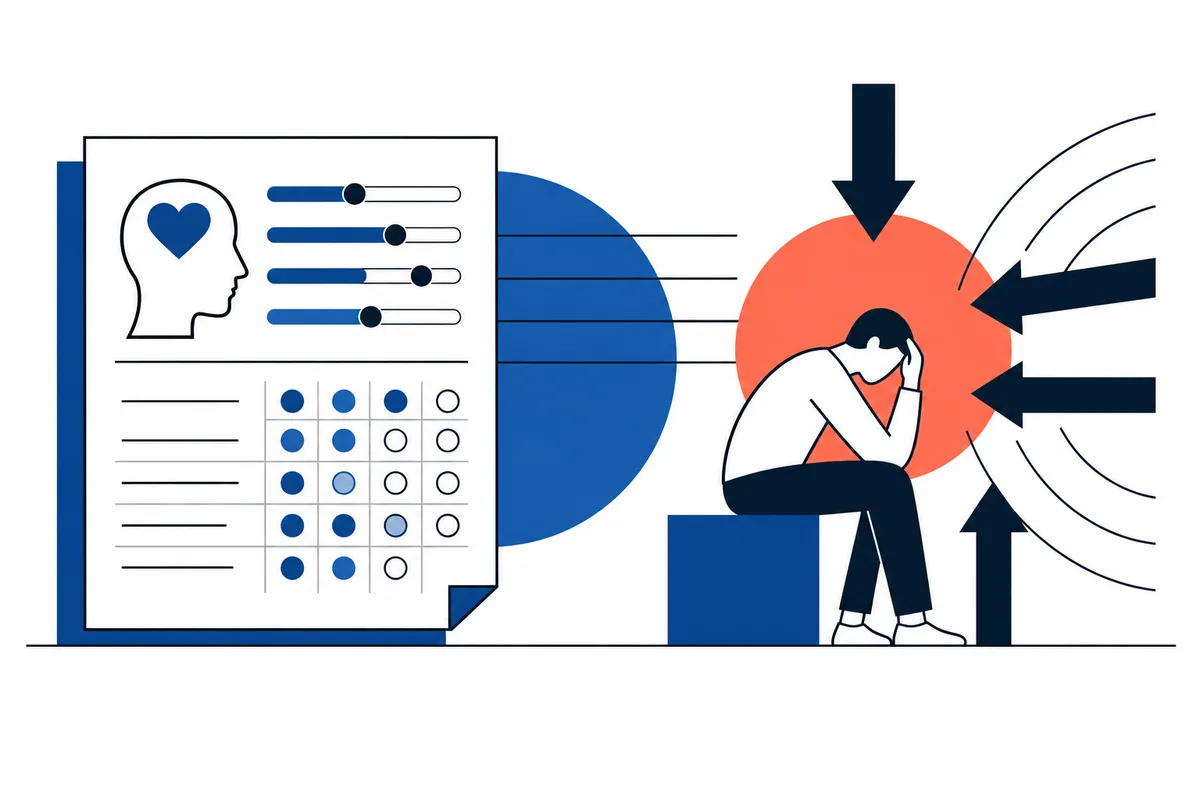
Emotional-intelligence scores are associated with reported job stress, and one prospective study found that earlier self-reported EI predicted later perceived stress among medical students. Neither finding establishes a dependable workplace forecast for an individual. Stress may affect some reports or test-taking moments, but whether it changes a particular EQ score depends on the measure and setting. Interpret a result by checking what it measured, when it was taken, and what changed at work.
A lower EQ result during a hard period has more than one possible meaning
A lower result after a difficult stretch at work can feel like an explanation: perhaps stress has exposed a weakness, or perhaps the test caught you on a bad day. Neither conclusion follows from the number alone. Research finds an association between emotional-intelligence (EI) scores and reported job stress, but it does not show which came first for one worker. “Stress” can mean perceived job strain or a short-lived reaction to a laboratory task. An EI assessment may ask about usual emotional behavior or test answers to emotion-related problems. These are separate measurements; a finding about one cannot automatically explain a change in another. In “A Meta-Analysis of the Relationships Between Emotional Intelligence and Employee Outcomes,” the workplace evidence links higher scores in several EI measurement streams with lower job-stress scores. This combined association is not an individual forecast or proof that EI prevents stress. The measurement distinction is central: “The Measurement of Emotional Intelligence: A Critical Review of the Literature and Recommendations for Researchers and Practitioners” describes self-report questionnaires as reports of typical behavior or self-rated ability, while ability tests sample performance on emotion-related problems. The review does not establish that stress changed a specific score. So keep three questions apart: do people with different EI scores also report different stress levels; does an earlier score predict later stress; and does one person’s score shift across a difficult period? Each requires different evidence. Before treating a lower result as a cause or forecast, identify the instrument, timing, and what changed at work.
Sources: A Meta-Analysis of the Relationships Between Emotional Intelligence and Employee Outcomes; The Measurement of Emotional Intelligence: A Critical Review of the Literature and Recommendations for Researchers and Practitioners
What does the workplace association establish?
The clearest workplace finding is an association: in the studies brought together by “A Meta-Analysis of the Relationships Between Emotional Intelligence and Employee Outcomes,” employees with higher emotional-intelligence (EI) scores also tended to report lower job stress. The analysis combined 31 independent samples, covering 14,377 participants. Its corrected overall correlation was −0.43. In everyday terms, the two measures moved in opposite directions across those samples: higher EI scores generally appeared alongside lower stress scores. That is meaningful evidence that EI and reported job stress are related in employee research. It is not, by itself, evidence that an EQ score can predict what will happen to one person at work. The result was not confined to one way of measuring EI. The meta-analysis reported negative corrected correlations for ability EI (−0.42), self-report EI (−0.45), and mixed EI (−0.37). “Ability” measures assess performance on emotion-related tasks; self-report measures ask people to describe their usual emotional tendencies or perceived abilities; mixed measures combine elements of emotional skills and broader competencies. The estimates are close enough to support a shared broad pattern, but they should not be mistaken for three versions of one interchangeable scale. The study grouped different instruments under each stream. A result from one measure therefore cannot simply be substituted for a result from another, especially when interpreting a particular person’s score. A meta-analysis estimates a pattern across studies; it does not turn that pattern into a cause-and-effect result. Correlation means that two measured variables vary together. It does not tell which came first or why they are connected. Lower perceived stress could partly reflect emotional skills that help someone notice, understand, or regulate reactions. At the same time, work circumstances may affect both a person’s stress reports and the situations in which those skills are used. The studies in the synthesis do not settle those possibilities for an individual worker. Nor does the overall correlation mean that a worker with a higher EI score will experience a predictable amount less stress. It describes an average relationship across the studies, not an individual forecast or a guarantee that developing a skill will reduce job pressure. The breadth of the synthesis is useful, though combining studies does not erase their differences. The authors brought together English-language published and unpublished studies from a period beginning in 1990 and extending into 2020. They separated results by EI stream, managerial status, and publication type. Even with those analyses, the paper notes that further moderator analysis was warranted; its discussion also points to organizational and social conditions such as role clarity and support. It does not provide a universal account of how jobs, stress measures, or working conditions shape the association. Those details matter because “job stress” can be assessed in different settings and with different instruments, while EI measures also vary in what they ask people to report or demonstrate. So the association establishes relevance, not direction. It gives researchers a reason to study emotional intelligence alongside job stress and gives readers grounds to ask what a specific EQ result represents. It does not establish that a score caused a stressful period, that stress changed the score, or that the score forecasts an individual’s future. Those are separate questions requiring evidence with suitable timing and measures. For now, the defensible reading is narrower: across the employee samples in this meta-analysis, higher EI scores tended to accompany lower reported job stress. The relationship is substantial enough to take seriously, and too limited to use as a personal prediction.
Sources: A Meta-Analysis of the Relationships Between Emotional Intelligence and Employee Outcomes
Can a score predict later stress?
One prospective study gives limited evidence that self-reported emotional intelligence came before later perceived stress: first-year medical students with higher scores on Schutte’s Emotional Intelligence Scale reported less stress around later examinations. This is a time-ordered association in one student setting, not a validated forecast for an employee. The study suggests that emotional-intelligence scores may contain information about later stress reports; it cannot tell an individual how much stress they will face at work.
In the 2017 study “Longitudinal Predictive Validity of Emotional Intelligence on First Year Medical Students Perceived Stress,” students at a private medical college in Pondicherry, India, completed the 33-item Schutte scale and the 10-item Perceived Stress Scale a week before mid-semester examinations. The researchers received 213 baseline responses. About five months later, before pre-university examinations, 138 students completed the stress scale again; 132 students with usable paired responses entered the follow-up comparison. The Schutte scale was a self-report measure of trait emotional intelligence: students described their usual emotional tendencies, rather than solving emotion problems under standardized performance conditions. The stress scale asked how stressful they had found the previous month. Emotional intelligence was measured at baseline, so the later analysis asked whether that earlier self-description statistically predicted subsequent perceived stress.
The authors reported that higher baseline emotional-intelligence scores predicted lower perceived stress at follow-up after accounting for gender. They randomly divided the data into training and test sets and reported student-level cross-validation. At the second time point, the model’s R² was 0.046, meaning the variables in that model accounted for about 4.6% of variation in reported stress. That is a detectable pattern, but it leaves most differences between students unexplained. The researchers also found no significant relationship between emotional-intelligence or stress scores and academic performance in their analyses. So the result concerns students’ own reports of stress, not exam success, observed workplace behavior, or an objective measure of strain.
Time order matters: a survey taken once cannot establish whether emotional intelligence came before stress, whether stress influenced a person’s self-description, or whether both reflected other conditions. Here, the baseline score preceded the later stress report, which makes a predictive interpretation more plausible than a same-day correlation alone. Yet prediction in a statistical model is not proof that the score caused the later outcome. Both measures were self-reports, and the study followed students through examination periods at one college. The later sample was smaller; although the authors’ dropout analysis found no baseline differences in emotional intelligence, stress, or academic performance between follow-up participants and those lost, they acknowledged that students more stressed at the second examination might have been more likely to leave. They also said the model omitted possible influences such as the number and quality of stressors and coping strategies.
The finding therefore deserves a narrow reading. It supports the possibility that self-perceived emotional tendencies are one contributor to how some people later experience a defined stressful period. It does not show that a general EQ result can estimate an employee’s future workload strain, distinguish personal skills from workplace conditions, or quantify the benefit of changing a score. For workplace decisions, the study is a reason to ask better questions about timing, the exact measure, and the stress being reported, not to treat an assessment as a forecast.
Why the test format changes the interpretation
Two questionnaires can both be called EQ tests and still ask different questions of the person taking them. The critical review, The Measurement of Emotional Intelligence: A Critical Review of the Literature and Recommendations for Researchers and Practitioners, separates trait measures from ability measures by how they collect a response. A trait or self-report questionnaire asks people to describe their typical behavior in emotion-related situations or rate their own capabilities. An ability test asks them to solve problems about emotions, with responses scored as performance. One records a person's account of their usual pattern; the other samples what they can do on particular tasks. Neither format, by itself, settles what a stressful period did to a score.
The distinction matters when someone completes a questionnaire after a difficult stretch at work. If items ask about recent behavior or confidence managing emotions, the answers necessarily depend in part on what the person notices and how they summarize their experience. A period of conflict may make a habit more visible, or make a person judge the same habit more harshly. Those are plausible routes for a current situation to affect self-description; they do not prove that a score has shifted, or show how large any shift would be. A response also may reflect an enduring view of typical behavior rather than that week's strain. The format alone cannot tell which explanation fits a particular result.
An ability measure changes the question. It presents emotion-related problems and records performance under the test's conditions. A demanding day could plausibly affect attention or effort while the person answers, but that possibility is not equivalent to a change in self-reported typical behavior. Nor should performance on selected problems be read as a direct record of how someone usually handles a tense handoff or receives difficult feedback. The critical review describes ability tests as measures of maximal performance and self-report measures as reports of tendencies or self-rated ability. Those labels clarify the response being collected; they do not make scores from different formats interchangeable or establish that any specific test predicts job stress.
That last point applies to the assessment itself. Evidence about a broad category cannot automatically support every instrument placed under its label. A test's questions, scoring, intended interpretation, and evidence need to match the claim being made about its result. The EQ Test Emotional Skills Profile is a 32-item educational self-reflection profile about recent behavior and emotional situations, organized around recognition, understanding, regulation, and responding to others. It is designed to help a person inspect habits and choose a development focus. Its result should not be translated into a standardized ability score or a forecast of stress tolerance: the assigned product information supplies no validated norms or established stress-prediction validity for it.
So when an EQ result coincides with a stressful period, first name the response format. A self-report result summarizes what the person says about their behavior or capability; an ability-test result summarizes performance on the tasks presented. Then ask what period the questions covered and what was happening at work. This keeps a reflection profile useful for noticing a behavior to examine without mistaking self-description for measured maximum ability, or either kind of result for proof that stress caused a score change.
Sources: The Measurement of Emotional Intelligence: A Critical Review of the Literature and Recommendations for Researchers and Practitioners; Emotional Skills Profile
Can stress change the score? What evidence can and cannot show
Yes, a person's state when answering could affect some responses, but evidence does not justify treating every stressful period as a source of distortion in every emotional-intelligence (EI) result. A laboratory mood experiment tested selected reports about work, not EQ tests or score changes over time. It found limited effects on particular items. Current strain is worth recording when interpreting a result, while whether it moved a specific assessment score remains unknown. “Self-report” describes a response method, not one standard kind of question. A questionnaire may ask about usual behavior, confidence in handling emotions, or a recent period. An ability test instead asks a person to solve emotion-related problems under test conditions. “The Measurement of Emotional Intelligence: A Critical Review of the Literature and Recommendations for Researchers and Practitioners” distinguishes self-report questionnaires about typical behavior and self-rated ability from ability measures that sample performance on emotion problems. The format changes what a possible state effect would mean. A rough week might color a judgment about usual responses; pressure during a demanding task might affect performance that day. These are plausible routes, not findings that stress necessarily changes a particular score. A direct test of mood and work reporting came from “The Influence of Affective State on Subjective-Report Measurements: Evidence From Experimental Manipulations of Mood.” Researchers brought 67 employees into a laboratory and induced neutral, positive, or negative moods with images and music. Participants answered 20 questions about work and related experiences using visual scales. Four items showed some influence from induced mood: perceived job overload, coworker support, satisfaction with personal development opportunities, and an agreeableness item. Most neutral-worded work questions showed little or no effect. The reported effects were small, with differences below four percent in means and below thirteen percent in standard deviations. That result argues against assuming current mood rewrites all subjective work reports. It does not establish that EQ self-reports are stable under strain. The study did not administer an EI instrument, compare EQ scores before and after a difficult period, or follow employees through ongoing job stress. Laboratory mood induction differs from sustained workload, conflict, or uncertainty at work. Some responses may be more sensitive than others, especially when a question explicitly asks for an evaluation such as whether there is “too much to do” or whether support feels adequate. The 2019 critical review helps explain why no general answer transfers automatically from one questionnaire to another. EI instruments differ in what they ask people to report or perform, and the review advises choosing a measure for its construct and purpose. An item about usual reactions to disagreement is different from one about how someone feels this week, even if both appear in self-report forms. Wording, reference period, and response situation can matter. Unless a study tests the exact instrument and interpretation, these points are reasons for care, not proof of a known amount of mood bias. Research on acute stress introduces another distinction. “Does Emotional Intelligence Buffer the Effects of Acute Stress? A Systematic Review” examines varied stressors and outcomes, including mood change during a challenge, physiological responses, and recovery afterward. Those findings concern responses to stress tasks; they do not establish that stress changes EQ scores. If an assessment was completed during a difficult period, note the timing alongside the score. Ask whether its items referred to usual behavior, recent behavior, or task performance. Do not automatically discard the result as contaminated or treat it as a clean measurement of stable ability. Without repeated evidence from that specific measure, the conclusion is modest: state may matter, but its influence on this score is unknown.
Sources: The Influence of Affective State on Subjective-Report Measurements: Evidence From Experimental Manipulations of Mood; The Measurement of Emotional Intelligence: A Critical Review of the Literature and Recommendations for Researchers and Practitioners
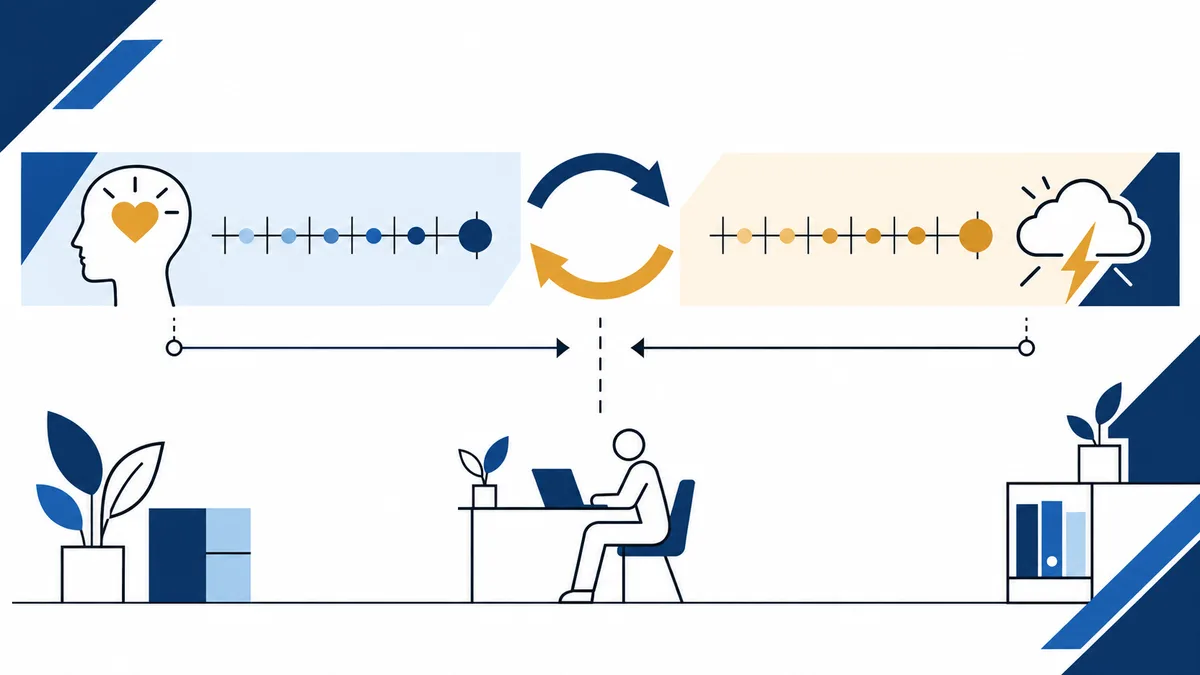
Why acute stress findings do not settle job stress
Research on acute stress does not show that emotional intelligence provides a universal buffer. The systematic review Does Emotional Intelligence Buffer the Effects of Acute Stress? A Systematic Review included 45 experimental studies and found that results varied with the kind of EI measure, the stressor, and the outcome. Trait EI, usually assessed by asking people how they perceive their typical emotional tendencies, was associated with less mood deterioration in some settings: sport competition, physical discomfort, and cognitive tasks. The pattern did not extend consistently to public speaking. Ability EI, assessed through performance on emotion-related problems, often had no significant relationship with subjective or physiological reactivity; in some studies, higher ability scores were linked to less adaptive responses. Taken together, the review describes mixed support for stress buffering, not a general protective effect that can be carried from one task or measure to every workplace.
The outcome matters as much as the stressor. A participant may report feeling more distressed, show a change in mood, or have a measurable physiological response such as altered heart rate or cortisol. These are related aspects of a stress response, but they are not interchangeable readings of one hidden quantity. The review notes that a higher heart rate can accompany fear or excitement, while a self-report captures a person's experience in context. Many of the studies measured only one part of the response, and only a minority combined subjective and physiological measures. A finding about mood therefore cannot be restated as a finding about bodily arousal, and neither directly establishes how much ongoing job stress someone perceives. The review excluded studies that measured general work or life stress without an experimentally induced stressor, which makes its boundary especially important here: it examined reactions after a challenge, not whether EI predicts a sustained period of workplace pressure.
Recovery after the challenge offers a different result from having a smaller initial reaction. The review found indications that both trait and ability EI were associated with faster recovery in some studies, even though evidence for reduced reactivity was inconsistent. A stronger initial response is not automatically proof of poorer emotional skill: the review describes disagreement among stress researchers about whether lower or higher reactivity is most adaptive in a given situation. The relevant question can be whether a response settles after the demand passes, as well as what happened during it. That observation still cannot be converted into a claim that someone with higher EI will experience less job stress over a month or handle every difficult conversation better. Acute experiments often involved students or other adult samples rather than employees facing continuing workload, and the review rated most studies weak or moderate in quality, with only four rated strong. A laboratory speech, memory task, or brief discomfort has a clear beginning and end; unclear responsibilities, repeated interruptions, and limited support may persist. Claims about workplace stress should therefore name the measured outcome and time scale. Evidence about short-term reactivity or recovery can suggest a mechanism worth studying, but it does not settle the separate question of a worker's ongoing stress or provide an individual forecast.
Sources: Does Emotional Intelligence Buffer the Effects of Acute Stress? A Systematic Review
What a score leaves out about the work
A score describes a response to a particular assessment. It cannot show whether the work itself made the situation difficult. A handoff can become tense because the person receiving it is already frustrated, because the deadline leaves no time to clarify, or because neither colleague knows who owns the next step. Emotional awareness and regulation may shape how someone handles that exchange, but the score cannot identify which part of the problem is carrying the strain. The meta-analysis, “A Meta-Analysis of the Relationships Between Emotional Intelligence and Employee Outcomes,” presents job stress as arising amid both organizational and individual factors. Its discussion names role clarity, organizational support, social relationships, and knowledge sharing alongside employees’ perceptions and emotions. The meta-analysis’s overall association between EI and job stress cannot tell a reader whether a given person is strained mainly by their response, by their conditions, or by the interaction between them. That distinction matters because emotional skill is exercised inside constraints. Someone may notice irritation early and still have little authority to reset an impossible deadline. A colleague may listen carefully yet lack the information needed to resolve a dispute. A person can state a boundary clearly, but the team may have no agreed process for deciding which work gets delayed. In each case, the behavior is observable; the score is only one possible prompt for examining it. Treating the result as a complete account of the stress would turn a partial view into a judgment about the person. Consider an illustrative handoff: a task moves between colleagues, but the written note names the next deliverable without identifying who owns it or when it is due. The receiving colleague asks for clarification while also handling competing priorities. The reply is short. One interpretation is that the person who replied needs to pause, name their frustration, and ask a more useful question. Another is that the handoff process leaves ownership unclear and invites conflict whenever time is tight. Both may be true. A self-reflection score cannot decide between them. A concrete review can make the question more useful. What was said or left unsaid? Which part of the task was unclear? Who could change that? Did the same kind of friction appear when ownership and timing were explicit? They separate a skill the individual might practice, such as checking their interpretation before responding, from a work condition that could be changed, such as assigning one owner and a deadline at the handoff. If clarity changes the exchange, that is practical evidence about this process, not proof that the person’s EQ score predicts stress. The distinction also prevents emotional intelligence from becoming a label for accepting every demand gracefully. A worker’s ability to recognize emotion, regulate a response, or understand another person can help in a difficult conversation. It does not establish that the workload is manageable or that speaking up is safe. “Does Emotional Intelligence Buffer the Effects of Acute Stress? A Systematic Review” concerns induced responses and recovery, not months of work conditions. It also notes that self-reported perceived stress and physiological measures do not consistently track one another. A felt sense of strain and a body’s measured response answer different questions; neither by itself identifies a workplace cause. For an individual using an EQ result, pair reflection with one specific interaction and the demands around it. Note the behavior that could be practiced, such as asking who owns a next step before frustration rises. Then ask whether workload, role clarity, support, or control offers an actionable explanation. It is a way to keep an educational development result in proportion and to avoid making an organizational condition look like a personal defect. If the work condition is the source that can be changed, address it as work design. If a recurring response is the useful focus, choose that behavior for practice. Either conclusion requires looking beyond the number.
Sources: A Meta-Analysis of the Relationships Between Emotional Intelligence and Employee Outcomes; Does Emotional Intelligence Buffer the Effects of Acute Stress? A Systematic Review
When a repeat check-in is useful
A second check-in helps answer a modest question: does this pattern still fit after pressure changes, or when the same work challenge returns? Record the assessment, date, instructions, and period. Results from different questionnaires cannot be read as a simple change in one quality. “The Measurement of Emotional Intelligence: A Critical Review of the Literature and Recommendations for Researchers and Practitioners” distinguishes self-reports of typical behavior from tests of performance on emotion problems. Keep the format consistent.
Choose one behavior to revisit, such as pausing to clarify tense feedback before replying. Note the situation and your response; do not turn one exchange into a score. If the report changes while behavior seems steady, or behavior changes while the report does not, you have a question to examine. A difference alone cannot show whether stress, demands, practice, or another factor explains it. This is a reflection rule, not a validated retest protocol or meaningful-change threshold.
The private 32-item Emotional Skills Profile prompts reflection on recent behavior and emotional situations; it has no validated norms or established ability-test validity. Explore it at /assessment for a personal development question. Use the result to choose one behavior to notice or practice, then decide whether it helps you understand your work. Keep it out of decisions about another person’s hiring, promotion, performance, or diagnosis.
Sources: The Measurement of Emotional Intelligence: A Critical Review of the Literature and Recommendations for Researchers and Practitioners; Emotional Skills Profile
Questions readers ask
Does emotional intelligence predict workplace stress?
Research links higher EI scores with lower reported job stress, and one prospective study found that earlier self-reported EI predicted later perceived stress among medical students. That evidence does not establish a dependable forecast for an individual employee.
Can stress change an EQ test score?
It is plausible that a person's state affects some self-reports or performance during testing, but the available studies do not establish that stress changes every EQ score. The answer depends on the measure, its questions, and the testing context.
Sources
- A Meta-Analysis of the Relationships Between Emotional Intelligence and Employee Outcomes
Supports the reported association between several EI measurement streams and job stress across 31 employee samples, and discusses contextual factors.
- Longitudinal Predictive Validity of Emotional Intelligence on First Year Medical Students Perceived Stress
Supports a time-ordered association between baseline self-reported EI and later perceived stress around examinations in one medical-student cohort.
- The Measurement of Emotional Intelligence: A Critical Review of the Literature and Recommendations for Researchers and Practitioners
Supports the distinction between self-reports of typical behavior or perceived ability and ability tests of performance on emotion-related problems.
- Emotional Skills Profile
Supports the current assessment's identity as a private 32-item educational self-reflection profile for emotional skills.
- The Influence of Affective State on Subjective-Report Measurements: Evidence From Experimental Manipulations of Mood
Supports limited, item-specific mood effects on selected subjective work reports; the experiment did not test EQ scores.
- Does Emotional Intelligence Buffer the Effects of Acute Stress? A Systematic Review
Supports the distinction between acute-stress reactivity, recovery, and ongoing job stress, with findings that vary by measure and outcome.
Apply it to the real situation
Turn an EQ result into one behavior to notice
From this guide: A result can suggest a development question, but it cannot identify which work conditions or interactions shaped your stress.
The private 32-item Emotional Skills Profile is designed for self-reflection on recent behavior and emotional situations. Use it to choose one behavior to notice or practice, then consider how that behavior appears in a specific work interaction. The profile has no validated norms or established ability-test validity, so treat the result as a starting point for reflection rather than a stress forecast.