
No. Emotional intelligence at work does not require constant calm or hiding every feeling. It means using emotional information to choose a proportionate response, while recognizing that the task and workplace shape which responses are available.
Does emotional intelligence mean managing every emotion at work?
No. Emotional intelligence does not require you to reduce every feeling or hide it. A feeling, its outward display, and the action you choose are related but distinct. At work, skill means noticing what an emotion may be telling you and deciding how to respond in the situation; a calm face by itself does not show that this has happened.
Suppose a colleague challenges a decision that you believe will put a project at risk. Frustration may signal that something important is being missed. You could show that frustration immediately, pause before answering, or name the concern in a measured way. The useful question is not whether you felt upset. It is whether your response helps address the issue without making the disagreement harder to resolve. If you answer only to prove you are right, the meeting may become a contest; if you ignore the warning because you want to seem composed, the project risk remains. Naming the concern clearly can preserve the information in the feeling without letting the first impulse decide the exchange.
Sometimes an immediate display can interrupt a task or make a tense exchange less safe, so a brief pause may be wise. But the pause is a choice about timing, not proof that the feeling has disappeared. Emotional skill leaves room for the feeling while giving you some say over what happens next.
What changes when a person regulates a feeling?
Regulation can change the feeling itself, its visible expression, or the situation that is producing it. In the process model discussed by “Antecedent- and response-focused emotion regulation: divergent consequences for experience, expression, and physiology,” reappraisal means changing how you interpret an event before its emotional response is fully underway. Expressive suppression means inhibiting outward signs after the response has begun. These names describe when and how a strategy operates; they are not grades for the person using it.
The controlled experiment in that paper makes the distinction unusually clear. Researchers assigned 120 participants to watch a disgusting film while using reappraisal, expressive suppression, or no instructed strategy. Both instructed groups showed less expressive behavior than the control group. Yet the groups did not have the same internal response: participants instructed to reappraise reported less disgust, while those instructed to suppress did not report that reduction and showed increased sympathetic activation. In this task, a less visible reaction did not mean a less intense experience.
That difference matters because an observer sees expression more readily than felt emotion. A person who keeps their face still may have reconsidered the situation, may be holding back a response, or may simply be focused on the task. The visible result alone cannot tell a colleague which process occurred. Nor does the experiment show that every person who suppresses an emotion will experience the same physiological response; it reports a group result under a particular instruction and stimulus. The experiment therefore separates two questions that everyday judgments often collapse: how much emotion a person experiences and how much of it is observable to someone else. Neither measure can stand in for the other.
The same distinction helps make sense of a disagreement at work. Imagine receiving feedback that a proposal has a serious flaw. Reappraisal might involve asking whether the criticism identifies a risk you had not considered, which could change both your interpretation and your frustration. Suppression might involve keeping an angry reply off your face while you listen. Either move could be useful in the moment. The first may alter what the situation means to you; the second may shape what others see while leaving your appraisal untouched. This is an illustration of the distinction, not evidence about how a real meeting will unfold.
There are moments when containing an expression buys time: a heated reaction might derail a safety briefing, confuse a handoff, or prevent anyone from hearing the concern. The experiment does not make that short-term choice automatically wrong. It does show why outward restraint should not be mistaken for resolving the emotion or its cause. After the immediate task, a person may still need to ask what the feeling registered and whether the underlying disagreement deserves attention.
The study cannot settle which strategy is best in a workplace exchange. Participants watched one brief film under laboratory instructions; they were not navigating a relationship, a deadline, unequal authority, or an ongoing work problem. Reappraisal may be hard or inappropriate when the interpretation is accurate and the situation needs to change. Suppression may be practical for a short interval, though the controlled task offers no evidence that it repairs the underlying issue. The defensible conclusion is narrower: feeling, expression, and action can move separately, so emotional intelligence cannot be judged from calm appearance alone.

What can an EQ measure tell us about regulation?
The 2026 meta-analysis “The Relationship Between Emotional Intelligence and Emotion Regulation: A Meta-Analysis” pooled 111 studies and 911 effects examining links between emotional-intelligence measures and 20 emotion-regulation processes. Its central result is a measurement distinction: ability-based EI tests and self-report EI did not show the same pattern of association with regulation. The results therefore do not support treating every EQ result as evidence for one broad capacity to manage emotion.
For ability-based tests, the meta-analysis found a positive association only with direct situation modification among the adaptive regulation processes it examined. Direct situation modification means changing an emotion-producing situation itself—for example, acting on a solvable source of pressure—rather than only changing one’s interpretation or outward display. This is a specific relationship in the pooled evidence, not a finding that ability-tested people regulate well across all situations. It also does not mean that other processes are absent from their behavior; the review reports which associations appeared in the studies, not an exhaustive inventory of what any person can do.
Self-report EI showed broader positive and negative associations across regulation processes. That breadth may matter: people’s reported emotional habits could relate to the ways they say they respond when upset. But method complicates the comparison. Many regulation processes in the underlying studies were themselves measured by self-report, so both sides of an association may partly reflect a respondent’s self-perception, response style, or willingness to describe particular habits. This shared method could make relationships between self-report measures appear broader than links involving performance-based ability tests. It is a plausible measurement explanation, not proof that the reported habits are unreal or that self-report tells us nothing.
The meta-analysis also reports that measurement type moderated the associations. That means the observed relationship changed depending on how EI was assessed; it is not sound to detach an association from the kind of measure that produced it and call the result simply “EQ predicts regulation.” A self-report connection may describe perceived or typical patterns, while a performance test addresses responses to emotion problems under its own assessment conditions. Neither result, on its own, establishes how a reader will react when a colleague challenges a decision in a particular meeting.
The distinction matters especially when a broad label hides unlike processes. The review considered 20 regulation processes, not a single behavior called “control.” A measure tied to changing a situation asks something different from a measure tied to managing an internal response or its expression. If a summary combines those processes, an association with one does not automatically travel to the others. The ability-test result is therefore informative precisely because it was selective: its positive link was with direct situation modification, rather than a blanket positive relation across adaptive strategies. The self-report pattern was wider, but width alone cannot tell us whether one method is more useful for a person’s practical question.
The unit of this synthesis also matters. A meta-analysis estimates patterns in the evidence it combines; it does not follow one reader through a future disagreement. Even a reliable association across studies leaves open how much the relationship changes with a task, a manager’s authority, time pressure, or the meaning of the emotion to that person. Those are questions about a particular episode, not quantities supplied by a pooled correlation. The finding can guide what to examine in a measure, but it cannot turn a group-level relationship into an individual forecast.
These are correlations assembled across studies, not forecasts of a specific person’s next response and not evidence that an EQ score caused a regulation strategy. Other features of the samples, measures, and situations may contribute to the observed links. The meta-analysis supports a narrower judgment: measurement type matters when interpreting regulation findings, and self-reported breadth should be read with its shared-method overlap in view. To understand a real work reaction, the pooled pattern cannot replace attention to the situation in which it occurred.
Sources: The Relationship Between Emotional Intelligence and Emotion Regulation: A Meta-Analysis
Why can the same person respond differently on different days?
A general result describes a pattern at the level its measure captures; it does not record every work moment. “Frontline managers’ task-related emotion regulation, emotional intelligence, and daily stress” followed 83 frontline managers across 10 working days, examining task-related negative emotions, reappraisal, suppression, expression, EI abilities, and daily stress. The diary design puts work tasks and days into view, allowing the question to shift from “What is this person generally like?” to “What was happening during this task, and how did the response vary?”
The study’s abstract reports that emotional responses and regulation related to personal, stable, and situational factors. In practical terms, a person may bring a relatively enduring tendency to work while still responding differently across tasks or days. A demanding handoff, an ambiguous instruction, or a routine check-in can place different demands on attention and emotion. Those examples illustrate why tasks are worth distinguishing; they are not events observed or reported by the study. The diary evidence supports considering variation around a person’s pattern, rather than assuming one profile describes each episode equally well.
Repeated observations add a dimension that a one-time general result cannot supply: whether a person’s response moves with the work being done. In a diary study, each workday gives the researchers an opportunity to examine emotion and regulation alongside that day’s reported tasks and stress. The design does not turn a diary entry into an objective reading of every interaction, and the abstract does not provide detailed estimates for each factor. Still, its repeated, task-related framing makes within-person variation part of the question, rather than treating it as noise around a single stable score.
Suppose someone says they usually pause before responding to criticism, yet one exchange ends in a sharp reply. As an illustration, a useful follow-up would ask what the task required, what stressors were present that day, and what the person noticed before answering. That inquiry does not decide in advance whether the cause was an individual habit, workload, or a feature of the exchange. It locates the question at the level the diary design makes visible: a response in a specific work setting, recorded alongside other days and tasks.
For someone trying to learn from a result, this changes the follow-up. Instead of asking only whether a score is high or low, identify one recurring kind of moment and compare what the task demanded with the response that followed. Was the person trying to solve the problem, contain a reaction, or meet an expectation about how the role should look? The diary study does not validate this reflection as a protocol; it offers a reason to preserve the moment’s task and day in view when interpreting a general pattern.
The sample was small and limited to frontline managers, and the accessible evidence supports only the study’s broad abstract-level account; it cannot establish how all workers behave or quantify what will happen in another occupation. Its contribution is more modest and useful: workplace emotion was studied across repeated days and tasks, with stable and situational factors both relevant. An overall EQ result may help frame reflection, but it cannot substitute for asking what happened in the particular moment a person wants to understand.
Sources: Frontline managers’ task-related emotion regulation, emotional intelligence, and daily stress
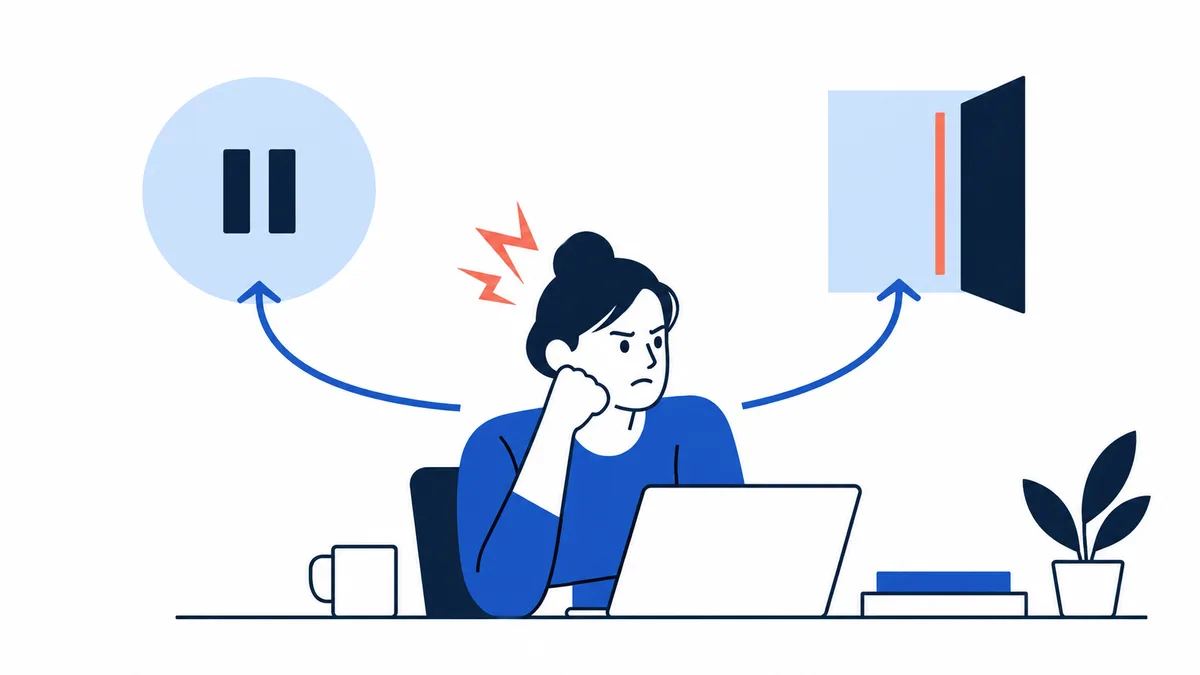
When is managing expression a job demand?
Emotional labor is the regulation of feeling or expression in response to a job’s emotional demands. The phrase names work shaped by a role expectation: a worker may be expected to sound reassuring, remain courteous, or communicate urgency in a way others can act on. Emotional intelligence concerns a person’s capacities and habits for noticing, understanding, and responding to emotion. The two can meet in the same exchange, but they answer different questions. One concerns what the work asks a person to display; the other concerns how the person recognizes and handles emotion.
“The State of the Heart: Emotional Labor as Emotion Regulation Reviewed and Revised” treats emotional labor through emotion regulation and proposes a multilevel, dynamic account. That framing matters because a display is produced within an interaction and a job setting, not in isolation. A request to use a steady, clear tone while explaining a time-sensitive procedure may serve the immediate task: the listener needs to understand what to do. The worker can still notice irritation or worry and decide what to do with it. The outward display is shaped by the role, while awareness and choice describe distinct parts of emotional skill. The same behavior can therefore have different meanings across roles: a concise, neutral instruction during an emergency may help people coordinate, while an expectation to appear cheerful through every interaction serves a broader image standard. That contrast is an editorial illustration, not a finding tested by the review. It shows why the demand itself belongs in the analysis alongside the worker’s regulation.
Consider, as an illustration, two instructions given during a difficult exchange. “Please keep your tone measured while we confirm the handoff details” is bounded by a task and a moment. “Do not raise concerns here” reaches beyond the display and closes off relevant information. The difference is not simply whether a worker feels authentic. A useful question is whose need the display serves and whether the person has another route to raise the underlying issue. Clear delivery can help a task proceed; silencing a concern can leave a work problem unresolved. The role expectation also shapes the choices available. A person may be able to postpone a response until a private conversation, ask a colleague to clarify a procedure, or raise the concern through an established channel. If none is available, the display demand reaches beyond presentation and affects whether work-relevant information can enter the interaction. These possibilities describe how to inspect a demand; they are not effects quantified by the review.
The review by “The State of the Heart: Emotional Labor as Emotion Regulation Reviewed and Revised” is a conceptual review, and its proposed model is not a universal test of the effects of a display rule. It does not establish that every expectation to manage expression harms workers, or that spontaneous expression is always the best response. A role-specific display may make a bounded exchange clearer. Whether it is a reasonable demand depends on the task, its duration and scope, and what happens to the emotion or information that cannot be expressed in that moment. Emotional skill may help someone navigate that demand, but it does not make the demand itself a measure of their EQ. The framework organizes questions for research; it does not settle each one.
Sources: The State of the Heart: Emotional Labor as Emotion Regulation Reviewed and Revised

What does the workplace evidence actually cover?
Ecological momentary assessment (EMA) collects reports repeatedly in or near people’s everyday settings, often close to the moments being studied. Because the report is made near an event, EMA can reduce the delay involved in asking someone to reconstruct a week or month from memory. It can also place a reported feeling beside the situation in which it occurred. That timing makes EMA useful for studying emotional labor as it unfolds, while still leaving the account dependent on what participants report and on how researchers define and sample the moments. Repeated prompts can also make frequency and timing visible: researchers can ask whether a reported reaction clusters around certain interactions or varies across a shift. That is a design advantage, not a guarantee that every prompt captures the moment accurately. The review’s mapped studies still differ in how they sampled participants and measured emotional labor, which is one reason their results should not be treated as interchangeable observations.
The scoping review “Emotional labor as emotion regulation investigated with ecological momentary assessment – a scoping review” searched seven databases for English- and German-language research and mapped 12 publications comprising 13 EMA studies. These were service-employee settings. The review found varied methods and limited replication; it mapped the available research rather than calculating one pooled estimate of emotional labor’s effects. The number of publications and studies describes the evidence located by that search, not a census of every workplace study or a reliable average effect across jobs.
That coverage places a firm boundary around what the moment-level findings can answer. Service roles commonly include direct interaction with customers or clients and explicit expectations about displays. Evidence from those settings can help researchers ask how a display demand coincides with employees’ reports in particular moments. By itself, it cannot establish that the same expectation, pattern, or consequence applies to a software team, a laboratory, a classroom, or an office meeting. Those settings may contain emotional demands, but the review does not supply comparable EMA evidence for them.
The review’s language limits matter for interpretation too: English- and German-language inclusion may miss work published in other languages, and service-only coverage narrows the settings represented. Its scoping design is suited to mapping studies and identifying gaps; it does not establish that a particular display rule causes a particular feeling or outcome. In practical terms, a manager should not turn service-sector expectations into a universal office rule such as “good employees always sound positive.” That conclusion outruns the reviewed evidence and skips the local question of what the task requires and how workers can surface a concern.
The small real-world evidence base does not make momentary observation useless. Repeated reports may capture variation that a single retrospective question obscures, and the review shows that researchers have used the method to study emotional labor in actual service work. Its contribution is to locate what has been examined and where evidence remains thin. Until comparable studies cover other occupations and workplace interactions, conclusions about the usual effects of emotion management beyond those service settings remain open. A laboratory task or a service display rule can suggest a question for another workplace; neither alone settles the answer there.
Can emotional skills improve without demanding constant calm?
The evidence supports a qualified yes: emotional competencies can change with workplace training, although the studies do not show that everyone improves by the same amount or that a test result produces the change. “Training emotional competencies at the workplace: a systematic review and metaanalysis” analyzed pre/post results from 50 studies and controlled comparisons from 27 trials. Across those different workplace interventions, the pooled standardized mean difference was 0.44 for pre/post change and 0.46 for controlled comparisons. These are average effects across studies, not a forecast for a particular employee or conversation.
The review also found that gains remained present beyond three months. That follow-up matters because it suggests the reported differences were not limited to an immediate post-session response. It does not establish that every program retained its effect for the same length of time, that a person used a skill in every relevant situation, or that the change lasted indefinitely. The result is evidence against treating every measured emotional competency as immovable; it is not evidence for a guaranteed personal transformation.
There is an important gap between training and taking an assessment. The reviewed studies examined interventions intended to develop emotional intelligence, empathy, or regulation. A private profile that asks about recent behavior and responses to scenarios serves a different role: it can give someone material to reflect on, but the training meta-analysis did not test whether completing an EQ assessment changes behavior. The pooled training effects therefore belong to the interventions studied. They should not be transferred to assessment feedback as if measurement itself were practice.
The estimates also combine varied programs, measures, and study designs. The review reports high heterogeneity, meaning the results differed substantially across the studies, and it identifies low overall methodological quality. A moderate pooled average can coexist with stronger effects in some settings and little detectable change in others. Differences in the skill taught, time available to practise, follow-up, and quality of comparison groups make it difficult to identify a single recipe from the average. The synthesis is useful for rejecting a simple fixed-trait assumption, while leaving the size and durability of change for any one person uncertain.
“Workplace Success Starts with Emotional Intelligence,” a Yale School of Medicine Q&A, offers a related way to think about what development requires: ability, motivation, and opportunity. The authors present this as a framework informed by a review of research, with organizations and leaders shaping whether people have opportunities to use emotional skills. It is an institutional account of a theory, not a workplace trial showing that a particular policy causes a particular result.
Taken together, the intervention review and Yale’s framework suggest a practical inference: learning a response and having room to use it are separate parts of the problem. Someone can practise recognizing frustration or asking a clarifying question, yet still have little opportunity to act if speaking up is punished or a process blocks discussion. Conversely, a workable setting does not supply practice by itself. This is the article’s synthesis of the training evidence and Yale’s framework, not a finding directly tested by either source. It points away from expecting constant calm: useful development can involve noticing an emotion, choosing what it signals, and acting within the real options a situation permits.
Average gains in workplace studies justify neither a promise that a given person will change nor the demand that workers regulate their way around unsafe or obstructive conditions. When a response repeatedly runs into a blocked channel, unclear authority, or unreasonable workload, the obstacle may call for clarification or organizational support alongside individual practice. Skill development has evidence behind it; personal responsibility does not erase the conditions under which a skill can be used.
Sources: Training emotional competencies at the workplace: a systematic review and metaanalysis; Workplace Success Starts with Emotional Intelligence
What should a self-reflection result lead you to do?
Choose one recurring work moment and write down four things: what happened, what you felt, what you did, and what followed. Keep the entry concrete—a delayed reply, a difficult handoff, or a disagreement about priorities—so you can see whether a response you want to change is yours to practise or depends on a condition at work. Note what you needed in that moment and what options were actually available. Would a pause have helped you ask a clearer question, or was the key information missing? Could you raise the issue safely with the person involved, or is another channel needed? If the pattern points to unclear expectations, workload, or limited authority, a proportionate next step may be to ask for clarification or support. The aim is to identify one choice you can make next time, not to judge the emotion as a failure.
The private 32-item Emotional Skills Profile is designed for educational self-reflection. Use it as a prompt for noticing habits and scenario judgments, then test an observation against a real moment; it is not a standardized ability score or prediction of workplace performance. Explore the Emotional Skills Profile at [/assessment](/assessment), or view the [/report](/report) page.
Sources: EQ Test Emotional Skills Profile
Questions readers ask
Does emotional intelligence mean hiding your emotions at work?
No. A pause or measured expression can help in some situations, but emotional skill is not the same as concealment. Consider what the feeling signals, what response fits the task, and whether workplace conditions allow that response.
Sources
- Antecedent- and response-focused emotion regulation: divergent consequences for experience, expression, and physiology
A controlled laboratory study supports the distinction between reappraisal and expressive suppression: both reduced expressive behavior during a disgusting film, while only reappraisal reduced reported disgust; suppression increased sympathetic activation.
- The Relationship Between Emotional Intelligence and Emotion Regulation: A Meta-Analysis
The 2026 meta-analysis reports associations between EI measurement types and 20 regulation processes across 111 studies and 911 effects; ability tests were positively associated only with direct situation modification, while self-report EI had broader positive and negative associations; measurement type moderated results.
- Frontline managers’ task-related emotion regulation, emotional intelligence, and daily stress
A daily study of 83 frontline managers across 10 working days found work-task negative emotions and regulation patterns related to stable, situational, and personal factors; it examined reappraisal, suppression, expression, daily stress and EI abilities.
- The State of the Heart: Emotional Labor as Emotion Regulation Reviewed and Revised
Grandey and Melloy review the emotional-labor evidence and propose a revised multilevel, dynamic account linking regulation to job demands and social interactions; it is a conceptual review, not a universal test of whether surface acting harms or deep acting helps.
- Emotional labor as emotion regulation investigated with ecological momentary assessment – a scoping review
The review mapped 12 publications comprising 13 EMA studies, all service-employee contexts, and found the field sparse and methodologically varied; moment-level evidence is not yet broad enough for sweeping rules about emotional labor across occupations.
- Training emotional competencies at the workplace: a systematic review and metaanalysis
The 2024 workplace intervention review analyzed pre/post change in 50 studies and controlled comparisons in 27, finding moderate average effects; high heterogeneity and low study quality limit confidence about any one program, person, or transfer to a particular exchange.
- Workplace Success Starts with Emotional Intelligence
Yale Center for Emotional Intelligence researchers’ workplace framing distinguishes ability, motivation and organizational opportunity, supporting a cautious account in which skill alone does not determine whether a person can act on an emotion at work.
- EQ Test Emotional Skills Profile
The live destination is the private 32-item Emotional Skills Profile for educational self-reflection across emotional skills; article product copy can invite observation and development without claiming standardized ability, norms, prediction or employment use.
Apply it to the real situation
Turn an emotional pattern into one practical next step
From this guide: A recurring work reaction may suggest a behavior to observe, while the task and workplace conditions shape what response is possible.
The private 32-item Emotional Skills Profile offers educational reflection across emotional skills and can help you select a behavior to examine. Use the result as a prompt, then consider what happened in the actual exchange and whether the work setting allowed a useful choice.