
Sometimes. Research has found that some emotional-intelligence measure families improve prediction beyond cognitive ability, but the result depends on the measure and performance outcome. Later analysis challenges whether mixed measures add distinct information, while ability-based findings vary with emotional demands at work. An EQ result is most useful when its method captures a behavior relevant to the work. These findings do not make EQ a universal second intelligence score or justify employment rankings.
What does “adding information” mean in this comparison?
When someone asks whether emotional intelligence adds information beyond cognitive ability at work, “adds” has a specific statistical meaning. Researchers first account for cognitive ability, then test whether an emotional-intelligence (EI) measure improves prediction of an outcome. That improvement is called incremental validity. It shows contribution in that model, not that EI is separate, practically useful, or suitable for an individual decision. The outcome matters as much as the predictor. “Job performance” may refer to a supervisor’s overall rating, task performance, organizational citizenship behavior (helpful conduct that supports the organization), or a narrower behavior. They capture different parts of work, so an increment for one criterion cannot automatically be carried over to another. The 2011 meta-analysis “The relation between emotional intelligence and job performance: A meta-analysis” offers evidence for a qualified yes. It grouped EI studies into three broad streams and reported corrected correlations with job performance ranging from .24 to .30. In its incremental-validity analysis, self- and peer-report measures based on the four-branch model and mixed competency measures showed the largest added contribution beyond cognitive ability and the Five Factor Model, a common framework for personality traits. These are findings about families of measures across the studies combined, not a guarantee that every questionnaire carrying an EQ label contributes the same information. That distinction is easy to lose when the result is compressed into “EQ predicts performance beyond IQ.” The result depends on what the EI measure asks, which baseline variables are included, and how performance is defined. A self-report about usual emotional behavior, a test of emotion-related problem solving, and a broad competency questionnaire can produce different kinds of evidence. An increment may partly reflect content already captured by other predictors, or concern a different outcome. For a workplace decision, begin by naming the missing information: what recurring emotional demand is not represented by the cognitive measure? Then identify the outcome that would show whether that demand matters. Those details define the scope of the claim before anyone interprets its practical meaning. The central question is not whether EQ adds something in the abstract, but whether this method adds relevant information for this outcome. That is the boundary the broader evidence needs to test.
Sources: The relation between emotional intelligence and job performance: A meta-analysis
Which EQ measure is being compared with cognitive ability?
An ability test of emotion reasoning, a self-report of typical behavior, and a mixed competency questionnaire do not measure the same thing. Comparing them under one EQ label can make an apparent increment hard to interpret. Identify what the emotional measure asks a person to do and what its score represents. Cognitive ability tests ask people to solve problems or process information; these EQ approaches target emotional information, perceived tendencies, or broader competencies.
An ability-based approach presents emotion-related problems and evaluates responses using a scoring method. The model described by the Swiss Center for Affective Sciences organizes emotional abilities around perceiving emotions, using emotion to support thought, understanding how emotions relate and change, and managing emotion. Its overview describes the Mayer-Salovey-Caruso Emotional Intelligence Test as an instrument developed to assess these branches. This approach aims to capture performance on emotion problems. It does not simply ask whether someone believes they are empathic or usually stay calm. The comparison with cognitive ability is between different kinds of performance, even where both assessments have questions with more or less effective answers.
A self-report takes a different route. The Swiss Center’s account of trait approaches describes people rating statements about their usual qualities or behavior. The Trait Emotional Intelligence Questionnaire, for example, asks respondents to indicate agreement with statements concerning emotional expression, social understanding, or related tendencies. A score summarizes a person’s view of typical patterns; it does not directly observe how they solve an emotion problem. In a study, a self-report may relate to how people describe their conduct, while an ability task tests answers to emotion-related material. Neither method should be substituted for the other.
Some measures combine several claims about emotional competence. The Swiss Center describes the Emotional Competence Inventory as a 360-degree approach in which peers rate qualities, illustrating that an EI result can also come from other people’s judgments. Mixed competency questionnaires may combine emotional content with self-beliefs or broader claims about behavior. Their breadth makes the label less precise: a score may reflect emotional skills and how a respondent or observer evaluates everyday conduct. It should not be treated as a pure measure of emotion reasoning.
Even within ability testing, the number and arrangement of abilities are not settled by every analysis. The 2024 study “How many emotional intelligence abilities are there? An examination of four measures of emotional intelligence” reanalyzed item-level archival data from four ability tests, with samples of 503, 5,000, 1,000, and 2,000. Its authors describe disagreement over whether ability EI has four, three, two, or one underlying ability and propose possible revisions. The study examines factor structure, or how test items group together; it does not test whether EI predicts job performance beyond cognitive ability. It cautions against assuming all ability tests have an identical structure, while leaving workplace prediction open.
When reading an incremental-validity result, name the measure family, comparison, and outcome. A self-report increment beyond cognitive ability answers a different question from an ability-test increment; a peer rating differs again. Method also affects the next step. A private report about recent behavior may help someone choose what to notice and practice. That is a development use, not a measure of maximum emotional ability. An EQ label alone cannot tell a reader what information was added; the task, respondent, and scoring target must be clear before the finding can guide a work decision.
Sources: Current models; How many emotional intelligence abilities are there? An examination of four measures of emotional intelligence
Why do some summaries say yes?
The 2011 meta-analysis, “The relation between emotional intelligence and job performance: A meta-analysis,” gives a qualified reason to answer yes. Across the studies it combined, self-report or peer-report measures based on the four-branch model and mixed competency measures showed the largest incremental validity beyond cognitive ability and the Five Factor Model, which includes Big Five traits. Incremental validity means that adding a predictor improves statistical prediction after other predictors are already included. The finding concerns broad measure families and the performance outcomes represented there, not every instrument carrying an EQ label. The authors organized the evidence into three streams. Ability-based models used objective test items; the second stream included self- or peer-reports organized around the four-branch model; the third grouped “mixed models” of emotional competencies. The abstract says the analysis included 65 percent more studies than an earlier meta-analysis, with over twice the sample size, and used updated estimates for personality and cognitive ability. This matters because the headline conclusion was not drawn from one test or one workplace. It was a synthesis across varied measures and studies, with EI streams compared against cognitive ability and personality in relation to job performance. The paper reports corrected correlations from .24 to .30 between the three EI streams and job performance. A correlation describes how two variables vary together; it does not by itself show that one causes the other or tell us how accurately a score predicts a particular person’s future performance. These correlations describe the association before focusing on what EI adds after other predictors enter the model. A relationship with performance is not the same result as unique information beyond cognitive ability. For that second question, the abstract reports that streams two and three had the largest incremental validity beyond cognitive ability and the Five Factor Model. It also reports that dominance analysis found substantial relative importance for all three EI streams when intelligence and the Five Factor Model were present. Relative importance is a way to compare predictors’ contributions across a model; it is related to, but not identical with, the question of how much prediction improves when a particular variable is added last. Together, these analyses suggest EI measures were not redundant with the other predictors in this pooled evidence. They do not establish that every included EI score contributes equally, or that the self/peer and mixed streams measure a single distinct ability. The meta-analysis also reports that the three streams differed in how they correlated with cognitive ability and the personality traits. A self-report about usual emotional behavior may carry information about a person’s beliefs or habits; an objective emotion-problem test asks about performance on a task. If their prediction differs, the reason may lie in what each method captures, in how job performance was measured, or in the samples represented. The abstract does not let us isolate those explanations for each instrument. So the positive result supports a careful claim: some EI measure families improved prediction in the studies analyzed, beyond the cognitive and personality predictors included there. It does not show that an EQ score acts as a general second intelligence, predicts every form of success, or should guide an individual employment decision. The useful follow-up is specific: which measure produced the increment, beyond which baseline predictors, and for what performance criterion? Without those details, “EQ adds information” sounds more universal than the evidence allows.
Sources: The relation between emotional intelligence and job performance: A meta-analysis
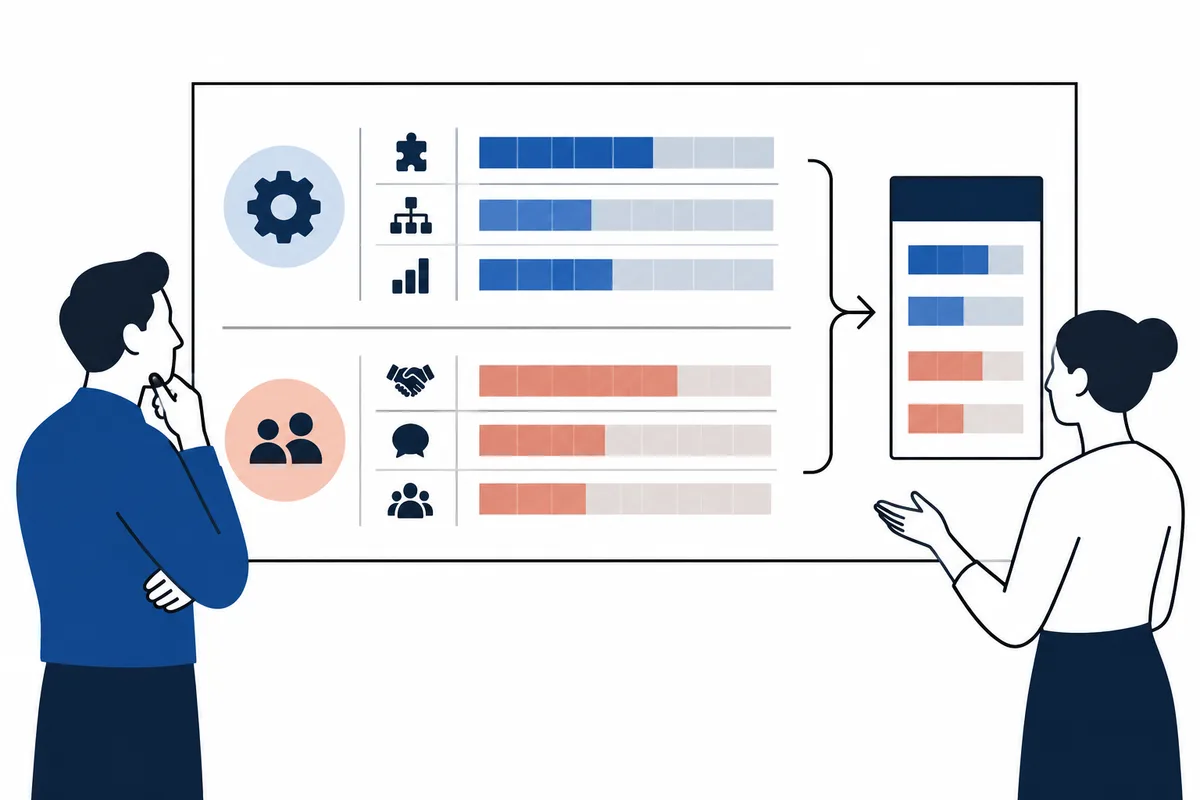
Why can two credible meta-analyses reach different conclusions?
The disagreement becomes clearer when mixed emotional-intelligence measures are separated from a distinct ability to reason about emotion. A broad self-report score can be associated with work performance and still draw on familiar content such as confidence, personality, cognitive ability, and a person’s own view of how well they perform. The two conclusions therefore answer related but different questions: does an EI measure predict performance in a combined model, and does mixed EI contribute something unique once overlapping characteristics are considered?
In “The relation between emotional intelligence and job performance: A meta-analysis,” O’Boyle and colleagues grouped studies into three streams: ability-based objective tests, self- or peer-reports organized around the four-branch ability model, and mixed emotional-competency measures. Their publisher abstract says the streams had corrected correlations from .24 to .30 with job performance. It also reports that the self/peer-report four-branch stream and mixed stream showed the largest incremental validity beyond cognitive ability and the Five Factor Model, a common set of broad personality dimensions. This is a substantive result: across the studies combined, those EI streams improved prediction within the models the authors examined. It is not a finding that every EQ questionnaire adds the same information, or that the added information is necessarily a separate emotional capacity. The abstract describes families of instruments and broad job-performance outcomes; it cannot settle what a particular score means for one employee.
“Why does self-reported emotional intelligence predict job performance? A meta-analytic investigation of mixed EI,” published in 2015, tested a more pointed interpretation of mixed EI. Its abstract reports that mixed-EI content overlapped with ability EI, self-efficacy, self-rated performance, conscientiousness, emotional stability, extraversion, and general mental ability; the reported multiple correlation for that set was .79. The authors’ updated meta-analytic association between mixed EI and supervisor-rated job performance was ρ = .29. After controlling for the listed covariates, the relationship was β = −.02, which the abstract describes as nil. In plain terms, the unadjusted association was noticeable, but the analysis found little remaining relationship once a broad set of related measures and characteristics had been taken into account. That is a serious challenge to reading mixed-EI prediction as proof of a distinct contribution.
These estimates do not directly cancel each other. The 2011 analysis compared three measurement streams and reported incremental validity beyond cognitive ability and the Five Factor Model; the 2015 investigation focused on mixed EI and tested overlap with a wider set of covariates, including self-efficacy and self-rated performance. The latter’s outcome in the reported estimate was supervisor-rated job performance. The difference in questions and controls matters: adding a variable to one baseline model does not guarantee that it remains informative after a broader set of related variables enters another model. Nor does the 2015 result disprove every 2011 stream. Its critique bears most directly on mixed measures, not automatically on ability-based emotion tests or self/peer reports tied to an ability framework.
“Construct overlap” means that two measures capture some of the same underlying content. For example, a questionnaire asking whether someone stays confident under pressure may partly reflect self-efficacy, the belief that one can handle a task. If that questionnaire correlates with a supervisor’s performance rating, the association may be useful for describing a pattern. But if confidence and related personality tendencies already account for that association, the EQ label alone does not establish that the score measures a new emotional skill. Conversely, removing shared variance statistically can also make the remaining question narrower: whether the unique part of a broad measure relates to the selected criterion. It does not make every shared behavior irrelevant to work.
The fair reading is conditional. The 2011 meta-analysis gives reason to investigate incremental prediction for particular EI measure families. The later mixed-EI analysis shows why that increment needs a construct check: a broad score may carry predictive signal partly because it combines content that other measures already capture. A reported association and a distinct emotional ability are separate claims. When a broad EQ score appears to add information, ask what its items or ratings actually summarize, which baseline measures were included, and whether the added part concerns the behavior the work outcome is meant to represent. That is a more useful interpretation than treating either meta-analysis as a final verdict on emotional intelligence as a whole.
Sources: The relation between emotional intelligence and job performance: A meta-analysis; Why does self-reported emotional intelligence predict job performance? A meta-analytic investigation of mixed EI
When might emotional demands make a difference?
The evidence gives a reason to examine job demands: *Emotional Intelligence: An Integrative Meta-Analysis and Cascading Model* reports that ability-based emotional intelligence (EI) was positively associated with job performance in high emotional-labor jobs and negatively associated with performance in low emotional-labor jobs. This is a moderator finding: the observed relationship varied with the work context. It does not establish that emotional skill causes better performance in one kind of role, or that it harms performance in another. It does make a universal “EQ adds value at work” claim difficult to defend. Emotional labor means managing or displaying emotion as a recurring part of a job. It can involve keeping a steady, respectful tone during a tense customer exchange, showing concern while resolving a complaint, or regulating frustration when giving difficult feedback. These demands are about what the role repeatedly asks someone to do; they are not a personality label for people in customer-facing work. A job title alone is a poor substitute for examining the actual interactions and the way performance is judged. The meta-analysis places the result within an ability-based model that distinguishes perceiving emotion, understanding it, and regulating it. The authors propose a sequence in which perception supports understanding, which in turn supports conscious regulation and performance. Their analysis reports support for the broader cascading model, while also noting inconsistent ability-EI relationships across emotional-labor contexts. The abstract does not give a single effect estimate that would tell a reader how large the difference is for a particular occupation. The finding is best read as evidence that context may change the relevance of measured abilities, not as a ready-made prediction for an individual worker. Why might the pattern vary? One plausible interpretation is that recognizing an emotional cue and choosing how to respond has more direct connection to a criterion in work that regularly requires emotion management. For instance, if a role includes recovering a conversation after a customer becomes upset, a measure of emotion reasoning may concern behavior that the role calls for. That does not mean every calm interaction demonstrates high EI, or that one test result captures the whole exchange. It means the proposed link is easier to explain when the work demand and the measured ability concern similar behavior. This mechanism is an interpretation of the pattern, not a separately established causal result from the meta-analysis. The comparison looks different when a role’s central performance criterion is technical accuracy. A measure of emotion reasoning may still be relevant to coordination, feedback, or resolving disagreement; technical work is not free of social demands. But if the outcome under study is whether a calculation is correct, the emotional-labor finding alone gives little reason to expect an EI score to add much. To make that claim, evidence would need to connect a specified EI measure to the specified outcome in the setting being considered. A practical comparison should therefore look past labels such as “high pressure,” “people-facing,” or “technical.” Ask how often the work involves charged exchanges, whether someone must regulate the emotion they display, and whether that behavior appears in the performance outcome being discussed. For individual reflection, name a recurring demand before interpreting a result, such as hearing a complaint without becoming defensive. Then identify an observable behavior that would help meet it. The evidence supports examining emotional demands and relevant outcomes, not assuming a universal EQ advantage.
Sources: Emotional Intelligence: An Integrative Meta-Analysis and Cascading Model
Does EQ compensate when cognitive demands are lower?
One employee study found some support for a compensatory relationship between emotional intelligence (EI) and cognitive intelligence, but only for particular outcomes. It does not show that EQ generally substitutes for cognitive ability. In “Emotional Intelligence, Cognitive Intelligence, and Job Performance,” Côté and Miners tested whether EI would be more positively associated with job performance as cognitive intelligence decreased. Employees completed tests of both abilities, and supervisors assessed task performance and organizational citizenship behavior. The authors reported support for the model for task performance and citizenship behavior directed toward the organization, but not for citizenship behavior directed toward individuals. The outcome split matters: the result changes with what counts as performance.
A compensatory relationship is an interaction: the association between one measure and an outcome varies depending on another measure. Here, the authors hypothesized that the EI-performance association would become more positive at lower levels of cognitive intelligence. That differs from saying EI predicts every employee’s performance, replaces cognitive ability, or offsets a low cognitive score. It also differs from showing a fixed increase in prediction across a workforce. The study asked whether the relationship changes across cognitive-ability levels; its conclusion is bounded by that question and its chosen outcomes.
The outcomes explain why “job performance” can be too broad a label. Task performance concerns doing assigned work. Organizational citizenship behavior describes discretionary conduct that contributes beyond formal tasks; the study separated actions directed at the organization from those directed at coworkers. The compensatory model received support for task performance and organization-directed citizenship, but not individual-directed citizenship. The findings therefore do not establish that employees with lower cognitive ability use EI to help colleagues more, or that emotional skills compensate in every form of cooperation. The abstract provides neither effect sizes nor enough detail to translate the interaction into a practical difference for a particular role.
This uneven pattern is more informative than saying EQ matters most when cognitive demands are low. The researchers tested EI and cognitive intelligence and relied on supervisor assessments, rather than isolating one emotional behavior in a particular job situation. A supervisor-rated task outcome can combine many demands; citizenship ratings address different conduct. As an interpretation, the results make the target criterion important: compare a proposed emotional skill with the work outcome it could plausibly affect. The study does not establish why the association varied or which skill a reader should practice.
For someone considering an EQ result, the study offers a narrow prompt, not a formula for combining scores. Ask what the cognitive measure captures, what emotional method was used, and which outcome was assessed. Then return to observable work: is there a recurring task or interaction where noticing emotion, understanding a reaction, or regulating a response is part of doing the work well? This is an inference from the distinction among study outcomes, not a finding about a personal-development profile. A private reflection result can help someone choose a behavior to observe; it cannot inherit evidence about ability measures or supervisor-rated performance. The compensatory idea remains a bounded possibility to investigate, not a rule for interpreting an individual’s EQ and cognitive scores together.
Sources: Emotional Intelligence, Cognitive Intelligence, and Job Performance

What does added prediction not establish about a person?
A group-level increase in prediction does not prove that a score can accurately rank individuals, explain a specific workplace conflict, or support hiring and promotion decisions. “Incremental validity” means that adding a measure improves prediction in a particular statistical model after another predictor is already included. It describes what happened across the analyzed data; it does not show whether acting on the score will improve work.
The outcome matters as much as the predictor. A study may use a supervisor’s overall performance rating, a measure of task performance, or a narrower category such as helping behavior. Those criteria capture different things. A supervisor’s overall rating reflects a judgment across a period; recorded output reflects completed work under its conditions; an observed response to disagreement captures one behavior in one setting. None automatically stands in for the others. If an emotional-intelligence score predicts a broad rating, that finding cannot be restated as proof that it predicts the quality of a particular conversation.
The 2015 meta-analysis, “Why does self-reported emotional intelligence predict job performance? A meta-analytic investigation of mixed EI,” makes the distinction concrete. It combined prior research on mixed emotional-intelligence measures and reported a meta-analytic correlation of ρ = .29 between those measures and supervisor-rated job performance. The authors also found that mixed-EI content overlapped with several established measures, including ability EI, self-efficacy, self-rated performance, personality traits, and general mental ability; together, these covariates had a multiple R of .79. After controlling for them, the mixed-EI relationship with supervisor ratings was β = −.02. This challenges claims of distinct contribution from mixed EI, but does not establish that every emotional skill lacks value or that every EI measure behaves alike.
Even a real increment in a group analysis would leave a further question: does it help with the decision at hand? Prediction and practical utility are related but different. A predictor can be associated with an outcome without showing that using its score improves a decision enough to justify the consequences. Moving from a research result to an individual ranking requires evidence about the specific instrument, its score meaning, the population, and the intended decision. The meta-analysis above does not validate a new questionnaire or supply a universal EQ scale that can be used to compare employees.
That boundary becomes especially important when a score can affect someone’s livelihood. The Society for Industrial and Organizational Psychology’s “Considerations and Recommendations for the Validation and Use of AI-Based Assessments for Employee Selection” is specifically about AI-based hiring and promotion assessments. Its principles are useful here as a boundary on inference, not as EQ-specific validation: the document says the intended use and interpretation determine what validity evidence is relevant, and that proposed outcomes should be job-related and measured with reliable, representative, unbiased criteria. A result about broad job-performance associations therefore cannot, on its own, authorize using an EQ score to select, promote, or rank a person. The evidence would need to fit that specific instrument, the population being assessed, and the employment use under consideration. Development and selection have different purposes; selection calls for evidence designed for its consequences.
For a person reflecting on their own work, the practical question is narrower and more useful: what behavior do I want to understand or practice? A score can prompt that question, but it cannot explain a conflict without looking at the actual exchange and its conditions. Broad evidence about prediction is a reason to ask what was measured, against which outcome, and for what purpose. It is not permission to turn a group-level association into a verdict about an individual or their future at work.
Sources: Considerations and Recommendations for the Validation and Use of AI-Based Assessments for Employee Selection; Why does self-reported emotional intelligence predict job performance? A meta-analytic investigation of mixed EI
How can a person use an EQ result at work?
For individual development, treat an EQ result as a hypothesis about a behavior to notice. Test it against a specific recent exchange, then choose one small practice. The result is a starting point for attention, not a verdict about why a conversation went badly or how well someone will perform. A useful question is concrete: what did I do when the emotional temperature rose, and what could I try next time? For example, imagine receiving difficult feedback and noticing an impulse to explain your intent before checking what the other person meant. That is an illustration, not a reported case. A next attempt might begin with one clarifying question: “Which part of the handoff created the most difficulty?” Then listen to the answer before explaining. Afterward, notice whether the exchange made the concern and next step clearer. The point is to observe a behavior and its immediate effect; a single conversation cannot establish that a new habit has formed or that an assessment caused a change. The 32-item Emotional Skills Profile is a private educational reflection tool. Its recent-behavior questions and authored scenarios can help a person consider emotional habits and possible development priorities. The profile has no validated norms or established ability-test validity, so its result cannot show how someone compares with a workforce or predict a work outcome. Use it to select a question for reflection, then bring that question to actual experience. A person who wants to understand a pattern more clearly can explore the profile at /assessment. Choose one behavior, try an alternative in a relevant conversation, and reflect on what happened.
Sources: Emotional Skills Profile
The answer depends on the missing information
Emotional intelligence can add information beyond cognitive ability when a defined measure captures an emotional behavior that matters to the work, and the outcome being predicted reflects that demand. The evidence does not support treating EQ as a universal second intelligence score. The 2011 meta-analysis, “The relation between emotional intelligence and job performance: A meta-analysis,” found incremental prediction for some self/peer-report and mixed measure families. Later analysis complicates what that increment means for mixed measures, while ability-based findings vary with job emotional labor. Together, those results support a conditional answer: method, role demand, and outcome have to line up. Stronger evidence could change the conclusion: an instrument-specific study testing added prediction against a clearly job-relevant criterion in the setting where the measure would be used. Until then, keep the questions separate. Cognitive ability addresses cognitive demands; an EQ measure can inform only the emotional content its method captures. For personal development, a private profile can prompt reflection on one recent exchange and one behavior to try next. That makes the result a starting point for practice, without turning a score into a forecast of who will succeed at work.
Sources: The relation between emotional intelligence and job performance: A meta-analysis; Why does self-reported emotional intelligence predict job performance? A meta-analytic investigation of mixed EI; Emotional Intelligence: An Integrative Meta-Analysis and Cascading Model
Questions readers ask
What does it mean for emotional intelligence to add information beyond cognitive ability?
It means an emotional-intelligence measure improves prediction after cognitive ability is already included in the statistical model. That result depends on the measure and the performance outcome being studied.
Do all EQ tests measure the same abilities?
No. Ability-based tests, self-reports of typical behavior, and mixed competency questionnaires measure different things. An EQ label alone does not identify what a score represents.
Can an EQ score predict who will succeed at work?
The evidence described here does not support treating EQ as a universal predictor or employment score. For personal development, a result can prompt reflection on a behavior to notice and practice.
Sources
- The relation between emotional intelligence and job performance: A meta-analysis
Supports the reported performance correlations and incremental-validity findings for broad emotional-intelligence measure families.
- Emotional Intelligence: An Integrative Meta-Analysis and Cascading Model
Supports the finding that ability-based EI associations varied between high- and low-emotional-labor jobs.
- Why does self-reported emotional intelligence predict job performance? A meta-analytic investigation of mixed EI
Supports the reported overlap between mixed EI and other constructs, and its near-zero controlled association with supervisor ratings.
- Emotional Intelligence, Cognitive Intelligence, and Job Performance
Supports the reported compensatory pattern for task and organization-directed citizenship performance, but not individual-directed citizenship.
- How many emotional intelligence abilities are there? An examination of four measures of emotional intelligence
Supports the existence of competing factor-structure accounts in item-level analyses of four ability tests.
- Current models
Supports the conceptual distinction between ability, trait self-report, and observer-rated emotional-competency approaches.
- Considerations and Recommendations for the Validation and Use of AI-Based Assessments for Employee Selection
Supports the selection-specific boundary that validity evidence should match intended use and job-relevant outcomes.
- Emotional Skills Profile
Assigned product facts describe a private 32-item educational reflection tool without validated norms or established ability-test validity.
Apply it to the real situation
Turn an EQ result into one behavior to practice
From this guide: The research points to a specific question for personal development: which emotional behavior would help in a recurring work situation?
A broad research finding cannot tell you which behavior to notice in your own conversations. The private 32-item Emotional Skills Profile offers a structured prompt for reflecting on emotional habits and possible development priorities. Use it to choose one behavior to observe in a recent exchange and consider one alternative to practice. It is an educational reflection tool, not an ability ranking or work-performance forecast.