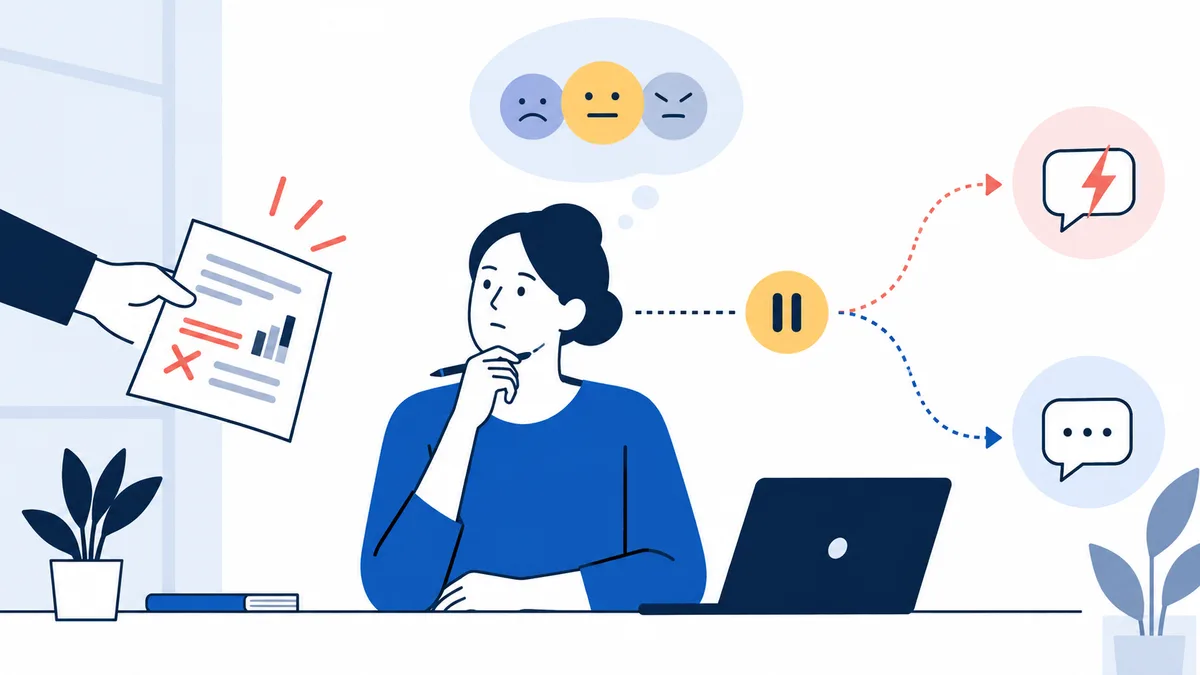
A brief label may help you notice your first reaction to critical feedback, but evidence from image tasks does not establish that it creates a pause or improves an employee’s reply. Different tasks produce different findings: labeling an image and naming your own feeling before another strategy are not interchangeable. Treat a label as optional noticing, then turn to the feedback itself and decide what would help you understand or respond.
What does a feeling label actually do in the moment?
Emotion labeling means putting a word to an emotion, though studies use that phrase for different tasks. In one common task, a person labels the emotional content of an image. That differs from silently noticing a feeling when a manager says, “The handoff missed two requirements.”
In a 2007 functional MRI experiment, Lieberman and colleagues compared affect labeling with other ways of processing negative emotional images. The PubMed abstract reports diminished amygdala and other limbic responses during labeling, alongside increased activity in the right ventrolateral prefrontal cortex. The researchers proposed that this pattern may help explain reduced emotional reactivity. The accessible abstract does not report a participant count, so the finding is best described as a difference in brain response during a laboratory image task. Participants categorized the images by emotional content rather than describing a reaction to feedback. The comparison supports a claim about what happened during that task, not a general rule about how people should handle strong feelings.
This makes it plausible that labeling can alter processing of an emotional stimulus. It does not measure conversational judgment. An employee might notice, “I feel embarrassed,” after hearing a correction, then turn attention back to the example. That is a possible use of the idea; the experiment did not test this conversation or whether the label creates useful space.
Can naming your own feeling get in the way of regulating it?
Naming one’s own feeling before using another strategy did not always help in the immediate laboratory tasks studied. Nook, Satpute, and Ochsner tested participants’ reactions to aversive images. In Study 1, 80 participants were randomly assigned to conditions involving viewing images, naming the emotion they felt, reappraising the images, or naming and then reappraising. Those who named before reappraising reported feeling worse than those who reappraised without first naming.
Reappraisal means reinterpreting a situation’s meaning to change its emotional impact. In Study 2, 60 participants completed conditions within themselves; naming before reappraisal again impeded regulation, as did naming before mindful acceptance. Mindful acceptance means noticing an experience without trying to change it. Outcomes were self-reported negative affect after images, not critical feedback or reply quality.
The authors suggest that selecting a specific emotion word may reinforce the appraisal attached to it, making immediate reinterpretation harder; they present this as a possible account. They also distinguish their procedure—generating and saying one’s own feeling—from affect-labeling tasks that pair images with supplied labels. These are different sequences and should not be read as contradictory verdicts on one procedure. A person who quietly notices a word without immediately trying to reappraise or accept the feeling is not necessarily reproducing the experimental sequence. At the same time, the studies do not isolate that silent pause as a treatment, so it should remain a personal option rather than a promised technique.
For a worker, the useful distinction is between a short cue to notice a reaction and naming an emotion as the first step in a deliberate regulation strategy. The experiments caution against assuming that the latter automatically calms a person; they do not determine which sequence is best in a meeting.
Sources: Emotion Naming Impedes Both Cognitive Reappraisal and Mindful Acceptance Strategies of Emotion Regulation; Putting feelings into words: affect labeling disrupts amygdala activity in response to affective stimuli
What does the wider research say about precise emotion words?
Emotion differentiation is the ability to distinguish among one’s emotional experiences over time. It concerns a repeated pattern, not the effect of choosing one word after one comment. More precise vocabulary could, in theory, help someone consider what response fits; irritation and embarrassment, for example, may prompt different questions. That possibility is not proof that a specific label improves regulation.
A systematic review by Claire Whiting and Erik Nook examines 31 studies on emotion differentiation and regulation. Its abstract reports inconsistent findings: some studies linked finer differentiation with fewer regulation difficulties or more adaptive strategy use, while others found no association or the opposite. The authors point to differences in measurement. The Princeton research-lab record lists the review as submitted, so it remains a preprint-level account.
The review concerns associations across studies, not a test of labeling before criticism. Nor do the image experiments establish the value of a stable vocabulary. The review’s unit of analysis is also different from the experiment: it compares relationships between a repeated individual capacity and regulation measures across studies, rather than testing a brief sequence in a single episode. A correlation in that literature cannot show whether differentiation precedes regulation, follows it, or reflects other factors. Together, these sources leave a clear distinction: one task can change measured processing, and broader associations remain mixed; neither tells an employee which interpretation of feedback is accurate. Feedback may be specific and fair, vague, or itself emotionally charged. A feeling word alone cannot resolve those differences: “embarrassed” describes a reaction, while “which two requirements were missed?” asks for information about the work. Keeping those questions separate is useful even when the emotion is hard to name.
Sources: A systematic review of research on emotion differentiation and emotion regulation; Emotion Naming Impedes Both Cognitive Reappraisal and Mindful Acceptance Strategies of Emotion Regulation
So what should you do before replying?
Use a short label only if it helps you notice your reaction. Then return to the content: what example did the other person give, and what remains unclear? This separates awareness from the response choice; it is a practical application, not a tested protocol.
After hearing that a report needs substantial revision, an employee might notice, “I’m tense,” and ask, “Could you point me to the section that missed the brief?” If the feeling is uncertain, “I’m reacting strongly” avoids forcing a precise category. The next step is an observable question about the work, not a judgment about the emotion. If the example reveals a concrete gap, the employee can ask what a satisfactory revision would include. If the feedback remains broad, asking for one instance can make the discussion actionable without arguing over whether the initial reaction was justified. These are ordinary communication options, not outcomes evaluated by the cited experiments.
If more time is needed, say so and set a return point: “I want to consider this carefully. Can we continue at 2 p.m.?” That gives the other person a clear expectation and lets the employee review the feedback before replying. A return time is especially useful when an immediate answer would be a guess or a defensive explanation: it turns “I need a moment” into a workable next step. On returning, the employee can summarize the requested change and check that both people mean the same thing. In practice, success can be judged by whether the follow-up identifies a specific example, expected change, or remaining disagreement—not by whether the employee found the perfect emotion word.
Sources: Emotion Naming Impedes Both Cognitive Reappraisal and Mindful Acceptance Strategies of Emotion Regulation; Putting feelings into words: affect labeling disrupts amygdala activity in response to affective stimuli; A systematic review of research on emotion differentiation and emotion regulation
Questions readers ask
Does naming an emotion reduce its intensity?
It can change responses in some image-labeling tasks. In two other image experiments, naming a feeling before reappraisal or mindful acceptance impeded immediate self-reported regulation. The tasks differ.
Should I tell my manager how I feel after critical feedback?
You do not have to disclose a private label. You can ask for an example, clarify the expected change, or request time and set a point to continue.
Can an EQ profile tell me whether emotion labeling works for me?
The Emotional Skills Profile is an educational reflection tool for considering recent habits and scenario judgments. It cannot establish whether a label will improve a particular feedback conversation.
Sources
- Putting feelings into words: affect labeling disrupts amygdala activity in response to affective stimuli
The PubMed abstract reports lower amygdala and limbic responses and higher right ventrolateral prefrontal activity during affect labeling of negative images.
- Emotion Naming Impedes Both Cognitive Reappraisal and Mindful Acceptance Strategies of Emotion Regulation
Two aversive-image experiments with 80 and 60 participants found naming before reappraisal, and in Study 2 mindful acceptance, impeded immediate self-reported regulation.
- A systematic review of research on emotion differentiation and emotion regulation
The submitted review abstract covers 31 studies and reports inconsistent positive, null, and opposite associations, with measurement heterogeneity.
Apply it to the real situation
See which emotional habits you want to practice
From this guide: A single feedback exchange cannot show whether a reaction is recurring or what skill you want to work on next.
The private 32-item Emotional Skills Profile gives you a structured way to reflect on recent emotional habits and judgments in authored scenarios. Use the result to choose a development question, such as how you notice a reaction or ask for clarification. It is an educational reflection tool, not a normed ability score or a prediction of how you will respond in your next meeting.