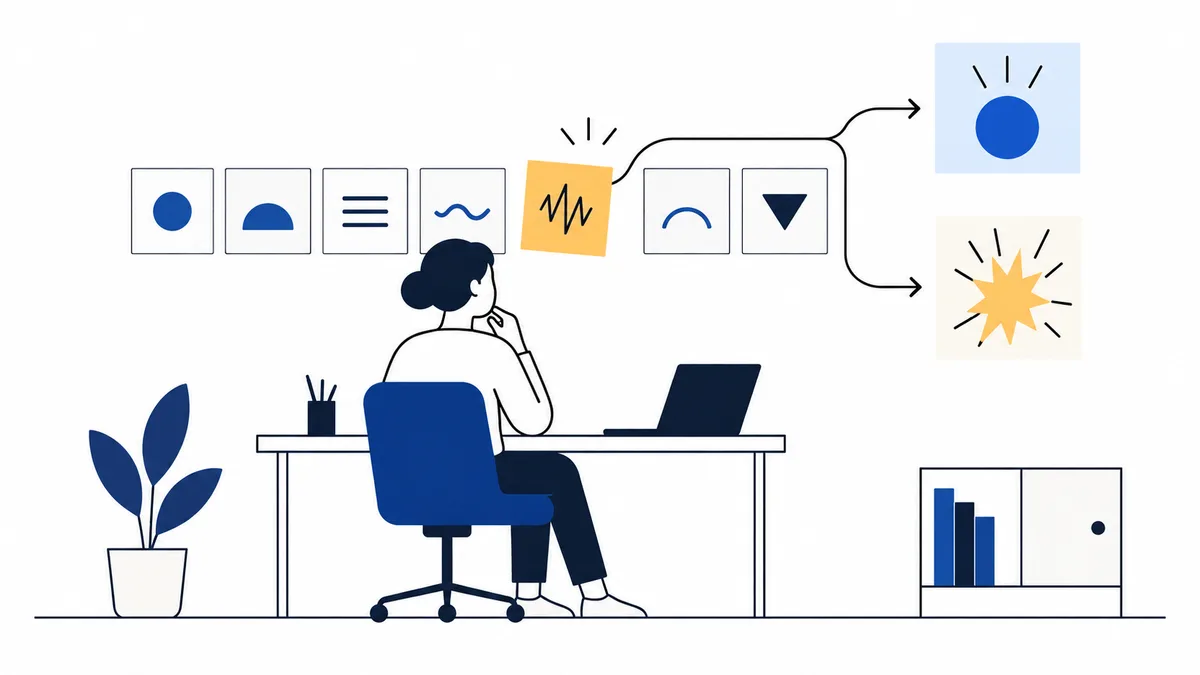
Naming a feeling can change what someone reports feeling, but it is not a dependable way to calm down. Experiments find mixed effects, and a label can get in the way when it comes before another regulation strategy. At work, try a tentative private label only if it clarifies a next move. Evidence does not show that a particular emotion word improves workplace conversations.
Does naming a feeling at work help—or can it backfire?
Naming a feeling can change what someone reports feeling, but it is not a dependable way to calm down. In Affect labeling: The role of timing and intensity, two experiments asked participants to name feelings while viewing aversive pictures. Among 63 participants in the first, labeling reduced reported distress. In the second, with 79 participants, the result depended on picture intensity: labeling reduced distress for highly aversive images and increased it for lower-intensity ones. These were picture-task ratings, not workplace conversations.
A different result appears in Emotion Naming Impedes Both Cognitive Reappraisal and Mindful Acceptance Strategies of Emotion Regulation. Across two aversive-image experiments, naming alone did not reliably change unpleasant affect. When participants reappraised an image or practiced mindful acceptance, reported unpleasant affect was lower if they used that strategy without first naming the emotion. The sequence mattered in this task; it does not show that every pause to identify a feeling interferes.
Together, the studies suggest that a label may shift a response, with effects depending on intensity or what comes next. At work, try a tentative private label only if it clarifies a next move, such as asking for a fact. If it narrows attention without guiding action, return to the work issue. The evidence does not show that a particular emotion word improves feedback conversations.
Sources: Affect labeling: The role of timing and intensity; Emotion Naming Impedes Both Cognitive Reappraisal and Mindful Acceptance Strategies of Emotion Regulation
What counts as emotion labeling in this question?
Emotion labeling, also called affect labeling, means putting an emotional experience into words: “I feel frustrated,” for example. In experiments, participants may name a feeling while viewing an image. That is different from explaining what caused a feeling, changing how one interprets an event, allowing a feeling to be present, or describing it at length. The question here is what the naming step itself does, and whether its effect changes when another response follows. It is a small action within regulation, not a synonym for the whole process.
That distinction matters in Emotion Naming Impedes Both Cognitive Reappraisal and Mindful Acceptance Strategies of Emotion Regulation. Across two experiments using aversive images, participants either named their feelings, tried a regulation strategy, or did both. The study distinguishes naming from reappraisal: reappraisal means reconsidering what an event means, such as finding a less threatening interpretation. Mindful acceptance means allowing an emotional experience to be present without trying to change it. Naming before these strategies could interfere with the reported reduction in unpleasant affect. Their result concerns brief laboratory tasks and self-reported feelings; it does not show that every person should avoid naming emotions in daily life. It does show why “name it to tame it” is too broad a description of the evidence.
Affect labeling is also easy to confuse with emotion differentiation. Differentiation refers to making finer distinctions among feelings across repeated reports, rather than finding one word for a feeling in a single moment. The review Putting Feelings Into Words: Affect Labeling as Implicit Emotion Regulation discusses labeling as a process studied across different tasks, including matching emotional words with emotional material. Such findings cannot simply be transferred to a private pause during a tense work exchange. Nor do they establish what happens when one person names another person’s state. Keeping the actions separate lets the evidence answer a narrower question: whether this brief naming step helps, hinders, or leaves the next response unchanged under the conditions actually studied.
Sources: Emotion Naming Impedes Both Cognitive Reappraisal and Mindful Acceptance Strategies of Emotion Regulation; Putting Feelings Into Words: Affect Labeling as Implicit Emotion Regulation
When does a label change the feeling itself?
In “Affect labeling: The role of timing and intensity,” participants viewed aversive pictures and selected words describing their feelings. In the first experiment, 63 participants reported less distress after labeling than during passive viewing. It concerns self-reported distress in a picture task; it does not show that naming an emotion helps someone give clearer feedback or make a better work decision. The study’s second experiment makes a blanket calming claim harder to defend. Among 79 participants, labeling while viewing highly negative pictures was followed by lower reported distress than passive viewing. With lower-intensity negative pictures, the direction reversed: participants reported more distress after labeling. The researchers classified image intensity using ratings of arousal and valence. These materials supply no threshold for classifying a workplace feeling’s intensity. Nor does a brief distress rating tell us whether judgment or behavior improved. The result is conditional: the same labeling task coincided with different reports depending on the stimulus set. “Emotion Naming Impedes Both Cognitive Reappraisal and Mindful Acceptance Strategies of Emotion Regulation” tested aversive-image tasks. In its first study, 80 participants looked, named the dominant emotion, reinterpreted the image, or named and then reinterpreted it. Naming alone did not significantly change unpleasant-affect ratings relative to looking again. Reinterpretation reduced ratings more when used without first naming than when the steps were combined. A second experiment extended the comparison to mindful acceptance; its analyzed sample included 60 participants. Adding a naming step before the assigned strategy did not improve participants’ reported affect. These were brief, instructed image-viewing trials, not workplace conversations. Still, they show why “name it to tame it” is too broad: what happens next can matter. Public-speaking research offers a more applied comparison, but it answers a different question. “Affect labeling enhances exposure effectiveness for public speaking anxiety” compared exposure exercises with and without prompted labeling among 100 participants reporting substantial public-speaking anxiety; 92% were students. The labeling group showed steeper declines in heart rate and skin-conductance responses during recovery after speeches, while the authors found no corresponding group benefits on their self-report measures. It tested structured public-speaking exposure, not routine workplace feedback. The difference between physiological recovery and self-reported anxiety matters: one measure cannot stand in for every outcome a worker cares about. Together, the studies support a narrow conclusion. Labeling can accompany a change in reported distress, and in a specific exposure program it accompanied changes in some physiological measures. Other controlled tasks found no reliable calming effect from naming alone, while the picture-intensity experiment found opposite directions across its stimulus conditions. None establishes that feeling calmer means communicating more accurately or solving the underlying issue. At work, try a tentative label only if it helps identify what needs attention; it is no guaranteed route to calm or better judgment.
Sources: Affect labeling: The role of timing and intensity; Emotion Naming Impedes Both Cognitive Reappraisal and Mindful Acceptance Strategies of Emotion Regulation; Affect labeling enhances exposure effectiveness for public speaking anxiety
What might language be doing, and what remains a hypothesis?
Brain scans can make emotion labeling sound like a simple handoff: name a feeling, recruit the thinking brain, quiet the emotional brain. The evidence is more specific. In [Putting Feelings Into Words](https://pubmed.ncbi.nlm.nih.gov/17576282/), a 2007 functional magnetic resonance imaging (fMRI) experiment, participants labeled emotional expressions in pictures while researchers measured brain activity. Labeling was associated with lower activity in the amygdala and other limbic regions, greater activity in the right ventrolateral prefrontal cortex, and an inverse relationship between that prefrontal activity and amygdala response. The authors proposed a possible pathway involving the right ventrolateral and medial prefrontal cortex. This is an activity pattern during a laboratory task; it does not show that a person hands control from one brain system to another, or that a named feeling will improve a meeting. One interpretation is that a word sorts a diffuse experience into a category and changes what a person attends to. “I feel disappointed” may direct attention toward an unmet expectation; “I feel worried” may point toward uncertainty. But the fMRI pattern cannot tell us whether categorizing, attention, language production, or another part of the task accounts for the difference. A competing possibility is that naming makes an initial interpretation more definite. In [Emotion Naming Impedes Both Cognitive Reappraisal and Mindful Acceptance Strategies of Emotion Regulation](https://scan.psych.columbia.edu/papers/Nook_et_al_2021.pdf), two experiments used aversive pictures and self-reported feelings. The researchers suggested that choosing a category might “crystallize” an experience, making it harder to change through reappraisal or acceptance. These explanations were not mechanisms directly measured by the experiments. The results show that naming before a deliberate strategy can be unhelpful in that task; they do not establish that every private label fixes an interpretation. The accounts need not cancel each other out. A tentative word may organize a vague reaction when someone has not identified what matters. A confident label may narrow attention when the cause is uncertain or the next step is clear. This is an editorial inference from experiments using different tasks, not a tested workplace rule. In a tense exchange, “I might be frustrated because the deadline changed” leaves room to check both feeling and cause. “I am angry because they disrespected me” fuses a feeling with an explanation that may need evidence. Sometimes a direct question, pause, or boundary is more useful than finding a finer word. Brain research offers possible explanations for why naming can affect emotional responses, not a script for when to do it. A worker can test the distinction against the next action: did the word clarify what to ask, verify, or change?
Sources: Putting Feelings Into Words; Emotion Naming Impedes Both Cognitive Reappraisal and Mindful Acceptance Strategies of Emotion Regulation; Putting Feelings Into Words: Affect Labeling as Implicit Emotion Regulation
Why can naming get in the way of a second strategy?
A label and a regulation strategy do different jobs. Naming puts an experience into a category; cognitive reappraisal changes how a person interprets the event that prompted it. Mindful acceptance changes how they relate to the feeling, allowing it to be present without trying to remove it. Inserting a naming step first may alter the attention or effort available for the next step. That is one possible explanation, not a demonstrated account. In “Emotion Naming Impedes Both Cognitive Reappraisal and Mindful Acceptance Strategies of Emotion Regulation,” participants viewed aversive images and rated their unpleasant affect. Study 1 randomly assigned 80 participants to view, name their emotion, reappraise, or name and then reappraise. The reappraisal group reported a larger decrease in unpleasant affect than the group that named first. Naming alone did not reliably change affect compared with viewing images again. These were ratings after a controlled image task, not measures of what participants said or did in a difficult conversation. Study 2 used a within-person design with 60 participants, controlled the time spent naming and regulating, and tested reinterpretation and mindful acceptance. It replicated the finding that naming before a strategy reduced its effect on reported unpleasant affect. This addresses one concern from Study 1: perhaps the naming step simply left less time to reappraise. The result therefore cannot be explained only by that timing difference, although the task still involved brief instructions and negative images rather than an unfolding work problem. The authors propose that selecting an emotion word could “crystallize” an initial interpretation, making it harder to modify; they also consider whether naming may use effort that could otherwise go toward regulation. Both remain hypotheses. The study did not establish that a word locks a person into one reading or show which mechanism accounts for the ratings. The evidence supports a narrower point: in these tasks, doing the strategy without first naming produced a greater reduction in reported unpleasant affect. This does not show that every pause to name a feeling is unhelpful. It tests a particular sequence: label first, then deliberately reinterpret or accept. Other research has found that labeling can reduce distress in some image tasks, so the contrast matters. A label might help someone notice a vague response; the Nook study suggests naming need not be a required step once a useful strategy is clear. At work, if the next move is to check what was meant, allow discomfort long enough to listen, or ask for a concrete fact, a person can try that directly. The laboratory result does not establish that this improves a meeting; it does show that naming is not a universal gateway to regulation.
Sources: Emotion Naming Impedes Both Cognitive Reappraisal and Mindful Acceptance Strategies of Emotion Regulation; Putting Feelings Into Words: Affect Labeling as Implicit Emotion Regulation
Does a more precise word automatically improve regulation?
No causal rule is established. Saying “I feel anxious” once during a tense exchange is momentary affect labeling. Emotion differentiation, or emotional granularity, describes a broader pattern: how distinctly someone reports different feelings across repeated occasions. That measure cannot show whether choosing a sharper word in one meeting improves regulation. Word knowledge differs too. Knowing what “resentful” means does not show that someone used it accurately or that it changed what happened next.
The two experience-sampling studies in “Differentiate to Regulate: Low Negative Emotion Differentiation Is Associated With Ineffective Use but Not Selection of Emotion-Regulation Strategies” followed 200 participants in one study and 101 in another, collecting repeated reports in daily life and around an emotional event. Differentiation had few links with which strategies participants selected. Strategy use was more strongly associated with increased negative emotion among people with lower differentiation: this pattern appeared for all strategies in the first study and four of six in the second. The result concerns an association with strategy effectiveness, not proof that teaching precise labels improves it. The first sample was Belgian students starting university, and the reports were observational; rising distress could prompt both regulation attempts and higher negative emotion.
“A systematic review of research on emotion differentiation and emotion regulation” examined 31 studies and found inconsistent results: some linked differentiation with fewer regulation difficulties or more adaptive strategy use, while others found null or opposite patterns. The review identifies substantial differences in measurement. Repeated ratings of several emotions, a single-word prompt, a regulation questionnaire, and a record of strategy choice are not interchangeable measures. Their results answer related questions, not one simple test of a labeling technique.
Word knowledge may matter in its own right, though the evidence remains associational. “Links Between Emotion Word, Usage, Understanding, Accuracy, and Emotion Dysregulation: An Integrative Analysis” combined six studies. Participants reported their use and understanding of emotion words, completed word-definition tasks, and answered questionnaires. Greater reported understanding and more accurate definitions were associated with less self-reported difficulty regulating emotion, even in models accounting for self-reported differentiation. The studies did not assign vocabulary training, so they cannot show that learning words causes easier regulation or improves work conversations.
Precision can still serve as a private question: does this word help distinguish what needs attention? “Frustrated” might prompt a check on a blocked task; “worried” might suggest asking for information. These are practical possibilities, not tested outcomes. A tentative word is enough if it points to a need, fact to check, or next step. There is no need to find the perfect label before acting; if the search keeps attention fixed on the feeling, move to the work issue or response you can choose.
Sources: Differentiate to Regulate: Low Negative Emotion Differentiation Is Associated With Ineffective Use but Not Selection of Emotion-Regulation Strategies; A systematic review of research on emotion differentiation and emotion regulation; Links Between Emotion Word, Usage, Understanding, Accuracy, and Emotion Dysregulation: An Integrative Analysis
Which evidence travels furthest toward a work setting?
Evidence gets closer to work as the task moves from viewing a picture to facing a social performance or regulating emotion amid job demands. But closeness is not proof of transfer: these studies measure different outcomes, and none tests whether naming a feeling improves an ordinary feedback conversation.
Picture-viewing experiments isolate a brief labeling act, but say little about what someone says next or whether a work problem changes. A more applied step appears in “Affect labeling enhances exposure effectiveness for public speaking anxiety.” In this randomized study, 100 participants with public-speaking anxiety completed exposure with or without labeling. The labeling group showed a greater reduction in physiological activation, especially among those who used more labels; researchers found no effect on self-reported fear. The task involved repeated short speeches before an audience, not naming a feeling before routine criticism. The split between bodily response and reported fear also cautions against treating one improved measure as proof of feeling calmer overall.
“Interpersonal emotion regulation strategies: Enabling flexibility in high-stress work environments” comes from a workplace rather than a laboratory task. Drawing on participant observation and semi-structured interviews with police officers, it describes workers choosing among strategies as circumstances unfold, with context, co-regulation, and third-party interference shaping those choices. This supports a practical point: what helps can depend on the situation and other people present. The study does not test affect labeling or show that a label improves a meeting. Qualitative observation can illuminate regulation in a particular job; it cannot establish a causal result for a different tactic.
A third kind of evidence comes from “Exploration of user interface mechanisms with affect labeling to enhance online discussion.” Its authors presented possible emotion-labeling features for news discussions, then asked 18 interviewees in focus groups about usability and acceptability. The study concerns reactions to interface designs, not whether a prompt changes conduct in a workplace disagreement. Together, these sources make a cautious decision aid reasonable, not proven: privately try a tentative label when it points toward a question, pause, or boundary. Judge it by whether it clarifies that next move. Workplace evidence makes flexibility relevant; it does not establish the benefit of any particular label.
Sources: Affect labeling enhances exposure effectiveness for public speaking anxiety; Interpersonal emotion regulation strategies: Enabling flexibility in high-stress work environments; Exploration of user interface mechanisms with affect labeling to enhance online discussion
What changes when the label is spoken to a coworker?
Privately naming your own feeling and telling another person what they feel are different acts. “I feel frustrated” reports an experience you can observe in yourself. “You are angry” assigns an inner state to someone else. It may be inaccurate or hard to challenge when spoken by someone with more influence. Workplace research makes the setting matter, though it does not test this exact exchange. In “Interpersonal emotion regulation strategies: Enabling flexibility in high-stress work environments,” researchers used participant observation and in-depth, semi-structured interviews with police officers. They describe workers choosing among emotion-regulation strategies as circumstances unfold, with context, co-regulation and third-party interference shaping those choices. The study does not test coworker labeling, but it shows why context and role matter: a check-in between peers may feel different when one person evaluates the other. A study about online discussion offers a useful comparison, with a different limit. “Exploration of user interface mechanisms with affect labeling to enhance online discussion” examined four proposed interface prompts for naming feelings about news articles. In focus groups, 18 interviewees discussed the designs’ acceptability and usability. This is evidence about interface acceptability, not workplace feedback or conflict. It still shows that a prompt’s form and setting matter. Consider an illustrative disagreement over a delayed handoff. Saying “You’re annoyed that I changed the deadline” may be wrong and can pull the discussion toward whether the label fits. A lower-assumption opening names what is observable and asks about the issue: “The deadline changed after our check-in. What part of that creates a problem for your work?” If a check-in seems welcome, leave room for correction: “I may be reading this wrong; is frustration part of it, or is another concern more important?” Use a direct emotion label for another person only when it serves a relevant, welcome conversation and remains easy to correct. Otherwise, describe the exchange, ask what needs attention, or discuss the work decision itself. This is a cautious application of evidence about context and prompt acceptability, not a proven script for workplace disagreement.
Sources: Interpersonal emotion regulation strategies: Enabling flexibility in high-stress work environments; Exploration of user interface mechanisms with affect labeling to enhance online discussion; Emotion Regulation and the Workplace
How can you tell whether a self-label is helping?
Treat a label as useful only when it changes what you can do next. “I feel tense” might prompt a pause; “I feel dismissed” might point to a moment that needs clarification. The word describes an experience; it does not prove why the feeling arose. If naming it sends you through the exchange again without helping you choose a response, set it aside and address the work question. Try a brief action test. Name your feeling tentatively: “I may be frustrated.” Ask what observable event supports that description. Was a deadline changed without notice, or did you hear a comment as criticism? Keep the event separate from your reading of it. Then ask what the feeling might signal, without assuming its cause. You may need a missing fact, time to think, a boundary, or a repair conversation. Choose one step and notice whether the label made it clearer. This test is an editorial synthesis, not a validated workplace protocol. In “Affect labeling: The role of timing and intensity,” picture-viewing experiments found that reported distress varied with task and image intensity. Experiments comparing naming alone with naming before reappraisal or mindful acceptance caution against making a label a required first step. These laboratory findings do not establish that this action test improves a meeting or feedback exchange. Sometimes the useful step has little to do with further emotional analysis. If responsibility is unclear, ask who owns the next decision. If information is missing, request it. An unsustainable workload or unfair treatment may call for a practical change or boundary. “Interpersonal emotion regulation strategies: Enabling flexibility in high-stress work environments” describes how context shaped regulation among police officers; it did not test this labeling exercise. Keep the label if it helps you act. Drop it if it narrows your attention or delays the conversation.
Sources: Affect labeling: The role of timing and intensity; Emotion Naming Impedes Both Cognitive Reappraisal and Mindful Acceptance Strategies of Emotion Regulation; Interpersonal emotion regulation strategies: Enabling flexibility in high-stress work environments
What should you try after the next difficult exchange?
After a difficult exchange, separate what happened from the word you might use for your feeling. “The deadline changed after I had planned the handoff” is an observable event; “I feel frustrated” describes your response. Keeping those statements distinct leaves room to decide what the work now requires. If the feeling-word helps, use it as a prompt for one next move. Frustration might lead you to ask when the deadline changed and what can still be delivered. Worry might lead you to request time to check a detail before committing. These are illustrative choices, not fixed meanings of emotions: the same word can point to different concerns, and the label alone does not identify the cause. If naming the feeling sends you into repeated analysis without clarifying the issue, set the label aside. Ask for missing information, request a pause, state a boundary, or return to the task. The research does not establish a workplace script. “Affect labeling: The role of timing and intensity” reports that distress effects varied across picture-viewing conditions, while “Putting Feelings Into Words: Affect Labeling as Implicit Emotion Regulation” describes brain activity during a laboratory task. “Name It to Tame It? Two Experiments Evaluating the Effect of Emotion Labeling on Emotion Regulation” found that naming alone did not reliably reduce unpleasant affect in its image experiments; naming before another strategy could be less helpful in that sequence. These findings make a tentative, optional label more defensible than a rule to name every feeling before responding. A practical test is whether the word helps you choose what to say or do next. If it does, act on that information and check what changes. If it does not, move to the concrete question. You could open the next conversation with: “I’m frustrated about the changed deadline; can we agree on what is still realistic?”
Sources: Affect labeling: The role of timing and intensity; Emotion Naming Impedes Both Cognitive Reappraisal and Mindful Acceptance Strategies of Emotion Regulation
Questions readers ask
Does naming an emotion always calm you down?
No. Experiments report mixed results: labeling reduced reported distress in some picture-viewing conditions, while other experiments found no reliable change from naming alone.
Can naming a feeling make another regulation strategy less effective?
In image-task experiments, participants reported less unpleasant affect after reappraisal or mindful acceptance when they used the strategy without naming first. That finding concerns specific laboratory tasks, not every pause to name a feeling.
Should I tell a coworker what they are feeling?
A private self-label and assigning an emotion to someone else are different acts. When a coworker's feeling is uncertain, describe the observable exchange or ask what concern needs attention, leaving room for correction.
Sources
- Affect labeling: The role of timing and intensity
Supports the reported distress findings across two picture-viewing experiments and the limits of transferring them to workplace conversations.
- Emotion Naming Impedes Both Cognitive Reappraisal and Mindful Acceptance Strategies of Emotion Regulation
Supports the image-task findings on naming alone and naming before reappraisal or mindful acceptance.
- Affect labeling enhances exposure effectiveness for public speaking anxiety
Supports the bounded comparison involving affect labeling during structured public-speaking anxiety exposure.
- Putting Feelings Into Words
Supports the reported neural activity patterns during a laboratory affect-labeling task.
- Putting Feelings Into Words: Affect Labeling as Implicit Emotion Regulation
Supports the distinction between affect labeling and other processes discussed in the review.
- Differentiate to Regulate: Low Negative Emotion Differentiation Is Associated With Ineffective Use but Not Selection of Emotion-Regulation Strategies
Supports experience-sampling findings on emotion differentiation, strategy selection, and associations with strategy use.
- A systematic review of research on emotion differentiation and emotion regulation
Supports the review's account of inconsistent findings and varied measurement across 31 studies.
- Links Between Emotion Word, Usage, Understanding, Accuracy, and Emotion Dysregulation: An Integrative Analysis
Supports reported associations between emotion-word understanding or accuracy and self-reported regulation difficulty.
- Interpersonal emotion regulation strategies: Enabling flexibility in high-stress work environments
Supports the qualitative account of context and flexibility in emotion regulation among police officers.
- Exploration of user interface mechanisms with affect labeling to enhance online discussion
Supports the bounded description of focus-group work on affect-labeling interface design acceptability.
- Emotion Regulation and the Workplace
Supports the general workplace context for emotion regulation and its distinction from direct evidence about coworker labeling.
Apply it to the real situation
Notice which emotional habits shape your next move
From this guide: If you want to reflect on recurring responses beyond one difficult exchange, consider what you tend to notice, regulate, and do in emotional situations.
This article offers a way to decide whether naming a feeling helps with a particular next step. For a broader personal reflection, the private 32-item Emotional Skills Profile looks at recent behavior and emotional situations, then offers practical development guidance. It is an educational reflection tool, not a standardized ability measure or a prediction of workplace outcomes.