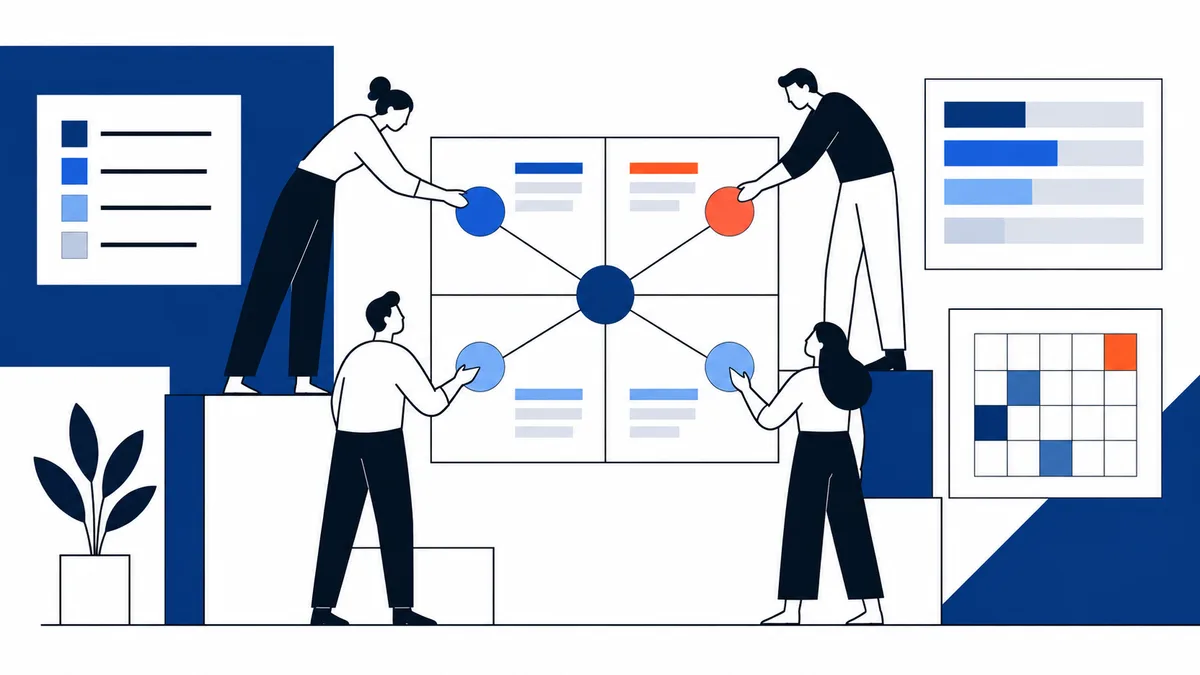
Collective emotional intelligence is a team-level pattern of shared emotional norms and interaction expectations. A team can measure it responsibly when the questions refer to the team, responses support a group interpretation, and the result guides development rather than employment decisions. An average of individual EQ responses describes member attributes; it does not by itself show how the team handles emotion together.
The score only belongs to the team if the question does
When a workplace questionnaire returns a single “team EQ” result, what does the number describe? Does it summarize members’ views of their own emotional habits, or their perceptions of how the group handles tension and repair? That distinction matters before anyone interprets a score or chooses a development activity. A result can describe a team only when the question and evidence support a team-level reading. “Team Emotional Intelligence in Working Contexts: Development and Validation of the Team-Trait Meta Mood Scale (T-TMMS)” sets out two approaches. One measures people individually and combines their responses at a higher level. The other asks members about the team as a whole. In developing T-TMMS, the researchers changed the reference in survey items from an individual’s own feelings to the team. Their example, “In this team we are able to describe our feelings,” makes the target explicit. The measure captures members’ shared perceptions of attention to feelings, clarity about emotions, and repair of negative moods. It is evidence for a team-referent approach, not a reason to relabel any average as collective ability. The Consortium for Research on Emotional Intelligence in Organizations’ “Team Emotional Intelligence” framework also treats team EI as norms that shape interaction. It distinguishes norms concerning members, the team, and relationships beyond it. These sources place the question in patterns of working together: what happens when someone raises a concern, how a group addresses tension, or whether an exchange can be repaired. A questionnaire records perceptions. It cannot by itself establish objective capacity or predict performance. Start with the decision the team hopes to improve. For personal reflection, ask members about their own tendencies and keep the result individual. To understand a shared norm, ask about the team and examine whether responses can reasonably be interpreted together. For a specific interaction problem, connect perceptions to what the team does in that work episode. Choosing the target first keeps a useful development conversation from turning a member average into a claim about collective behavior.
Sources: Team Emotional Intelligence in Working Contexts: Development and Validation of the Team-Trait Meta Mood Scale (T-TMMS); Team Emotional Intelligence
What is collective emotional intelligence in a work group?
Collective emotional intelligence is a pattern of shared expectations and norms that shapes how a team notices emotion, makes sense of it, and responds while doing its work. The Team Emotional Intelligence (TEI) framework summarized by the Consortium for Research on Emotional Intelligence in Organizations (CREIO) places the construct in a team’s patterns of interaction, not inside each member or in a simple sum of personal EQ scores. Norms guide emotional experience and behavior as members work together.
CREIO describes three levels at which those norms operate: relationships among members, the team as a whole, and the team’s relationships beyond its boundaries. At the member level, a group may make room to understand colleagues and address conduct that breaks its standards. At the team level, members may review how they work, support expression, build optimism, or solve problems proactively. Across the boundary, they may understand the team’s setting and maintain external relationships. These are categories in the framework, not proof that every team has each norm or that every norm can be captured by a questionnaire.
The distinction matters because individual skill meets a social setting. A person may notice tension and want to raise it, while team routines make speaking up possible, awkward, or costly. That response says something about interaction and expectations; it does not settle what the person can do in every setting. A team habit can shape responses without making that habit permanent or defining its members.
The study “Team Emotional Intelligence in Working Contexts: Development and Validation of the Team-Trait Meta Mood Scale (T-TMMS)” describes team EI as emerging through interaction. Its scale measures members’ perceptions of whether their team attends to feelings, understands emotions, and repairs negative moods. The team referent lets researchers ask about a shared pattern while collecting individual reports. Those reports remain perceptions; a questionnaire does not directly observe every exchange.
For a practical inquiry, start with a work moment rather than an abstract label. When someone raises a risk, can the group hear the concern, clarify what is at stake, and decide how to respond? After a tense disagreement, does anyone return to the issue and repair the working relationship? These questions make a proposed norm visible enough to discuss and give a measure a clear target. A useful team measure names the behavior or expectation at issue, such as raising a concern or repairing a strained exchange, instead of implying that one general score captures every way a group handles emotion.
Sources: Team Emotional Intelligence; Team Emotional Intelligence in Working Contexts: Development and Validation of the Team-Trait Meta Mood Scale (T-TMMS)
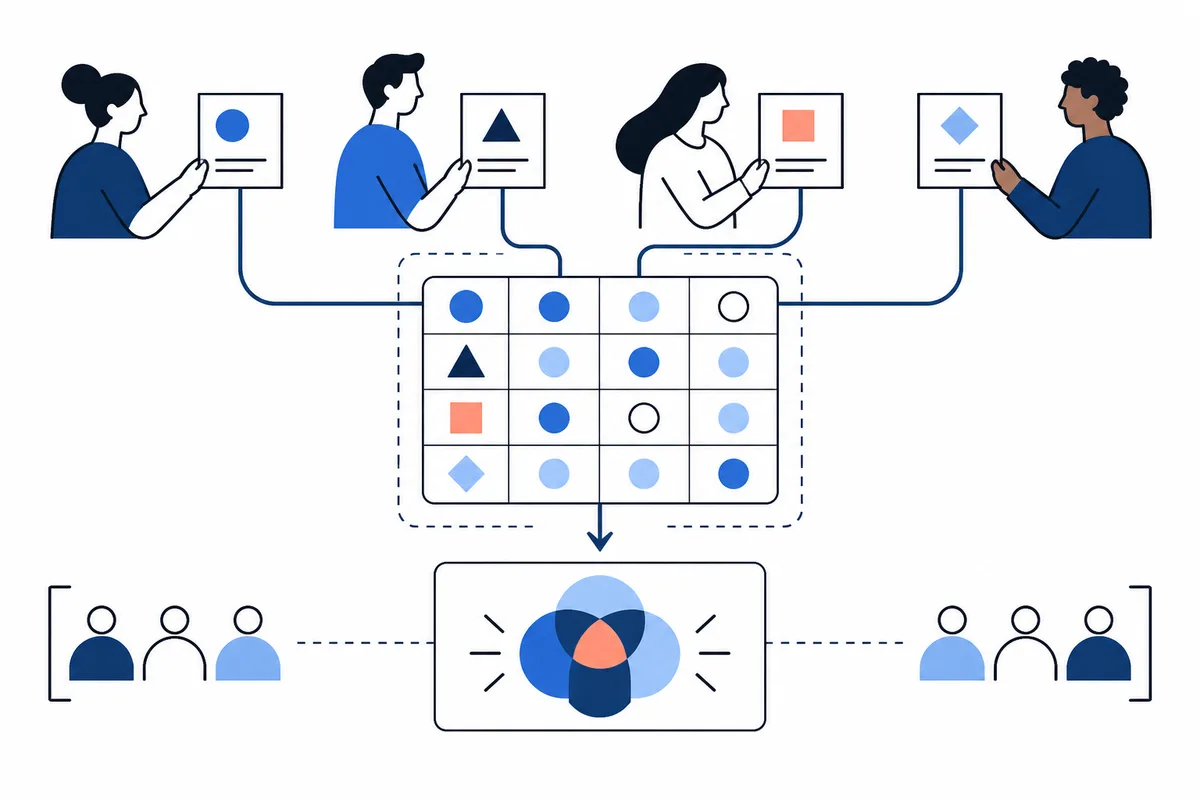
Which team are you measuring: members, shared norms, or interaction?
The word “team” can describe three different targets. An individual-referent questionnaire asks each person about their own habits or perceived abilities: for example, whether they notice their feelings while working with colleagues. A team-referent questionnaire changes the subject of the item. It asks what members think happens in the group, such as whether “in this team” people can describe their feelings. Structured observation takes a third route: someone records what occurs in a selected meeting, handoff, or disagreement.
The distinction is visible in the scale-development study “Team Emotional Intelligence in Working Contexts: Development and Validation of the Team-Trait Meta Mood Scale (T-TMMS).” Its authors describe an individual-referent approach, in which individual responses are aggregated to a higher level, and a team-based approach, which asks members about the team as a whole. The T-TMMS used a change of reference from self-evaluation to team perception and assessed leaders’ views of whether their team attends to feelings, understands them, and repairs negative moods. The cross-sectional study involved cooperative leadership teams in Spain, so it demonstrates one framing rather than settling which fits every workplace.
Self-report means a person’s account of their usual behavior or perception. It is useful for asking what a member believes they do or how team norms feel from inside. But a response about one’s own skill is not a neutral record of what happened between colleagues. The critical review “The Measurement of Emotional Intelligence: A Critical Review of the Literature and Recommendations for Researchers and Practitioners” distinguishes typical-behavior or perceived-ability reports from tests of emotion-related problem solving. Changing the referent changes the claim: “I handle disagreement well” describes a person’s view of their own tendency; “we make room to raise disagreement” describes a perception of a shared norm.
Observation can add a check against the survey account. During a difficult handoff, an observer might record whether a concern was raised and acknowledged. That describes one episode, not every meeting, and it does not become an EQ score because it concerns emotion. Pairing a group question with a narrow work indicator can show where perceptions and conduct diverge. A quiet meeting alone cannot tell whether people felt heard, chose not to speak, or had no concern to raise.
So start with the question the team needs answered. Individual development calls for feedback attached to the person; shared norms call for team-referent questions and evidence that answers support a group interpretation; a process concern calls for observation of a defined work episode. Wording, response method, and unit of analysis together determine what the resulting evidence can responsibly say.
Sources: Team Emotional Intelligence in Working Contexts: Development and Validation of the Team-Trait Meta Mood Scale (T-TMMS); The Measurement of Emotional Intelligence: A Critical Review of the Literature and Recommendations for Researchers and Practitioners
Why can two teams have the same average and still differ?
Suppose two teams complete the same self-rating questionnaire and end with a similar average. One team’s members may describe their emotional habits in broadly similar terms. In the other, some may feel able to raise tension and work through it, while others experience the group as a place where concerns stay quiet. This is an illustration, not a reported study result. The average hides that difference: it compresses responses into one value, leaving out their spread and whether people describe a common experience.
An average can be a legitimate answer to one question and a poor answer to another. If the question is about team composition, combining member attributes may be intentional. An additive model treats the group result as the sum or average of characteristics members bring. It can describe resources across a team, especially where people carry out separate tasks. It still says little about what happens between them when disagreement becomes uncomfortable. A high member average cannot establish that people share an expectation that concerns will be heard or that the team can repair a strained exchange.
A shared-norm interpretation makes a different claim: the team has expectations shaped through interaction. To support that claim, responses need to refer to the team, and the analysis needs to consider whether members’ accounts can be read together. A team-referent item asks what happens in the team as a whole; a personal item asks about the respondent. Similar average values do not make their meanings interchangeable. Nor does a team-referent average prove consistent behavior in every meeting. It summarizes perceptions, which may differ by role, access to discussion, or situations encountered.
The study “Team Emotional Intelligence in Working Contexts: Development and Validation of the Team-Trait Meta Mood Scale (T-TMMS)” describes individual-referent aggregation and a team-based approach. Its authors suggest that combining member EI may fit some lower-interdependence tasks, while team-referent perceptions may matter more when leadership work depends on interaction. They present this as a distinction between models and task conditions, not a universal rule. The study developed a team-referent questionnaire with leadership teams in one cooperative organization in the Basque Country. Its cross-sectional self-report design limits how broadly its findings can be carried.
Before reporting a team average, state what it represents. If it summarizes members’ individual tendencies, call it a member profile. If it describes a shared norm, use a team-level model and retain information about how much members agree. A similar mean can accompany different experiences; that variation may be the most useful signal to examine before choosing a shared practice.
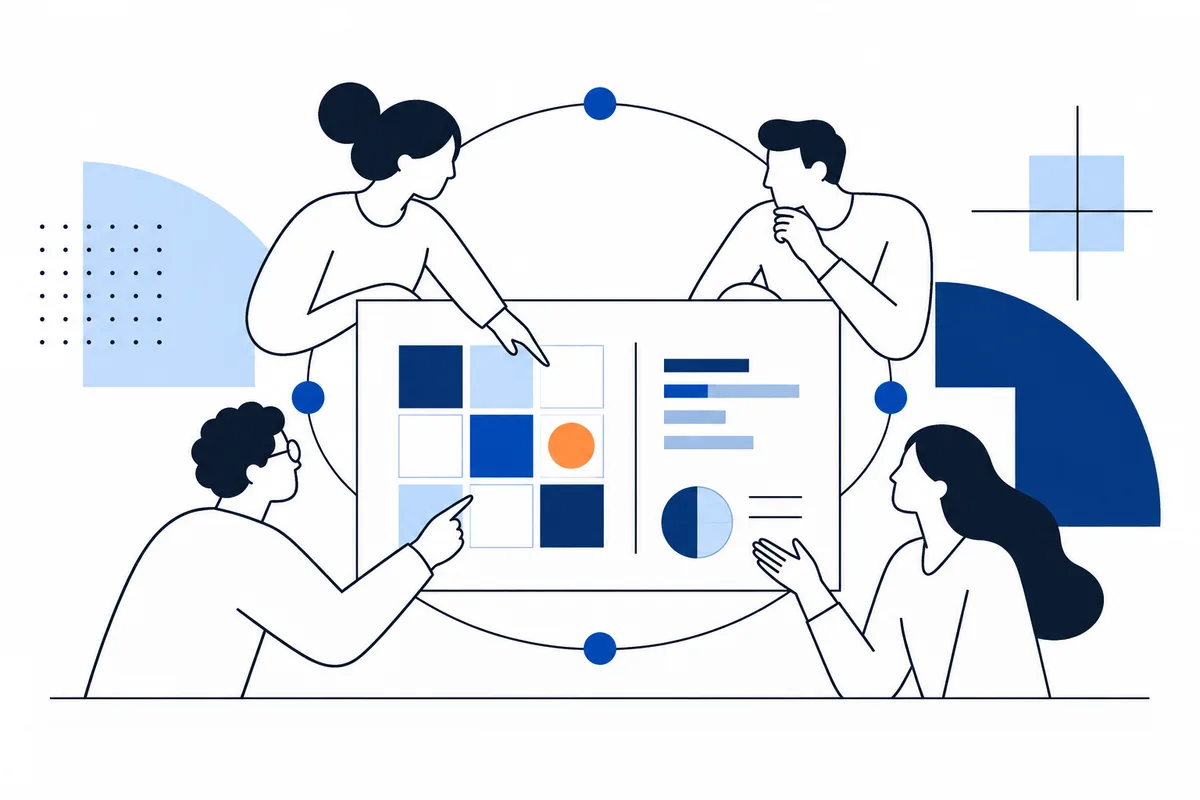
When can responses be summarized as a team result?
A team should not receive a single emotional-intelligence result simply because its members completed the same questionnaire. Before averaging, interpreters need evidence that responses support a team-level claim. “Team Emotional Intelligence: Emotional Processes as a Link Between Managers and Workers” describes three checks used before combining individual responses: within-group agreement, the share of rating variance associated with team membership, and the reliability of differences between team means. Each addresses a different question. The first, rwg, estimates how closely members’ ratings within a team align beyond what might be expected from a chosen response distribution. Agreement matters because a group average is easier to interpret as a shared perception when members report similar experiences. But alignment alone cannot show that teams differ from one another. ICC1, an intraclass correlation, estimates the proportion of response variance linked to team membership. ICC2 asks how reliably the observed team means distinguish teams from one another. A team can show close agreement internally while means barely differ across the wider sample; these indices are not interchangeable stamps of quality. In that 2021 study, researchers reported rwg, ICC1, and ICC2 values for cohesion and the emotional state they called “passion,” then judged the combined evidence sufficient to aggregate those responses. This is an example of how to justify a team summary. Suggested cutoffs cited by the paper are guidance, not universal pass marks; sampling and the question being asked affect what an index can establish. Copying a threshold cannot make a different measure a validated team assessment. “Team Emotional Intelligence in Working Contexts: Development and Validation of the Team-Trait Meta Mood Scale (T-TMMS)” makes the referent explicit: members answer about “this team” and its emotional experience. Its authors also say within-team agreement should be examined before treating responses as a group characteristic. Together, the papers support a careful rule: aggregation needs both a defensible meaning for the group score and evidence that the data fit that meaning. Team-referent wording alone does not guarantee agreement or justify one number. For an informal retrospective, nobody needs to turn discussion into a psychometrics exercise. Ask whether people experienced a specific interaction similarly and keep differing accounts visible. A research-grade claim that a score represents a team calls for the additional evidence described above. When agreement is weak, preserve the spread and ask whose experience differs, in what role or situation, and what the team has not made possible to discuss. That disagreement may be the most useful result; averaging it away would answer a simpler question than the team actually has.
Sources: Team Emotional Intelligence: Emotional Processes as a Link Between Managers and Workers; Team Emotional Intelligence in Working Contexts: Development and Validation of the Team-Trait Meta Mood Scale (T-TMMS)
What do existing team-EI measures actually show?
Existing team-EI measures show that researchers have made different choices about what counts as emotional intelligence at group level. The Consortium for Research on Emotional Intelligence in Organizations’ Team Emotional Intelligence (TEI) summary describes norms guiding emotional experience and behavior. Its nine norms span interactions with members, the team, and people outside it. Examples include understanding members, addressing behavior that breaks norms, reviewing the team, supporting expression, and managing external relationships. This is a theory map, not evidence that every team displays all nine norms or that one questionnaire captures them equally well.
A different design appears in “Team Emotional Intelligence in Working Contexts: Development and Validation of the Team-Trait Meta Mood Scale (T-TMMS).” The 2020 study developed a team-referent questionnaire for leadership teams: respondents considered whether their team attends to members’ feelings, understands emotions within the group, and tries to repair negative moods. The final scale has three factors: Attention, Clarity, and Repair. The study reports analyses of factor structure, internal consistency, temporal stability, and convergent validity for this instrument. Those results describe evidence for this version in its study setting; they do not validate other scales using its labels or shortened or translated versions without their own evidence.
The T-TMMS paper compares its team-referent approach with the Workgroup Emotional Intelligence Profile (WEIP), which combines individual-referent responses to describe a group. One approach asks about members’ own emotional tendencies at work; the other asks what they perceive about emotional processes in the team. Neither question is a universal substitute for the other. T-TMMS was studied with leadership teams in Spain’s Mondragon Cooperative Corporation. Its abstract gives 1,746 participants, while its methods give 1,764, so the count is inconsistent and should not be repeated as settled. The cross-sectional findings remain tied to that population and design.
For a team considering a questionnaire, the useful comparison is not a contest between names. Read the items and ask whose behavior they describe: a member’s, a shared team process, or a norm involving the team and its surroundings. Check whether the evidence concerns the same version, language, kind of group, and interpretation you intend to use. A framework can identify candidate behaviors; a validation study can show how one measure performed with one sample. Neither alone establishes an objective team ability score or guaranteed outcome. The measure’s referent and evidence should match the claim the team plans to make.
Sources: Team Emotional Intelligence; Team Emotional Intelligence in Working Contexts: Development and Validation of the Team-Trait Meta Mood Scale (T-TMMS)
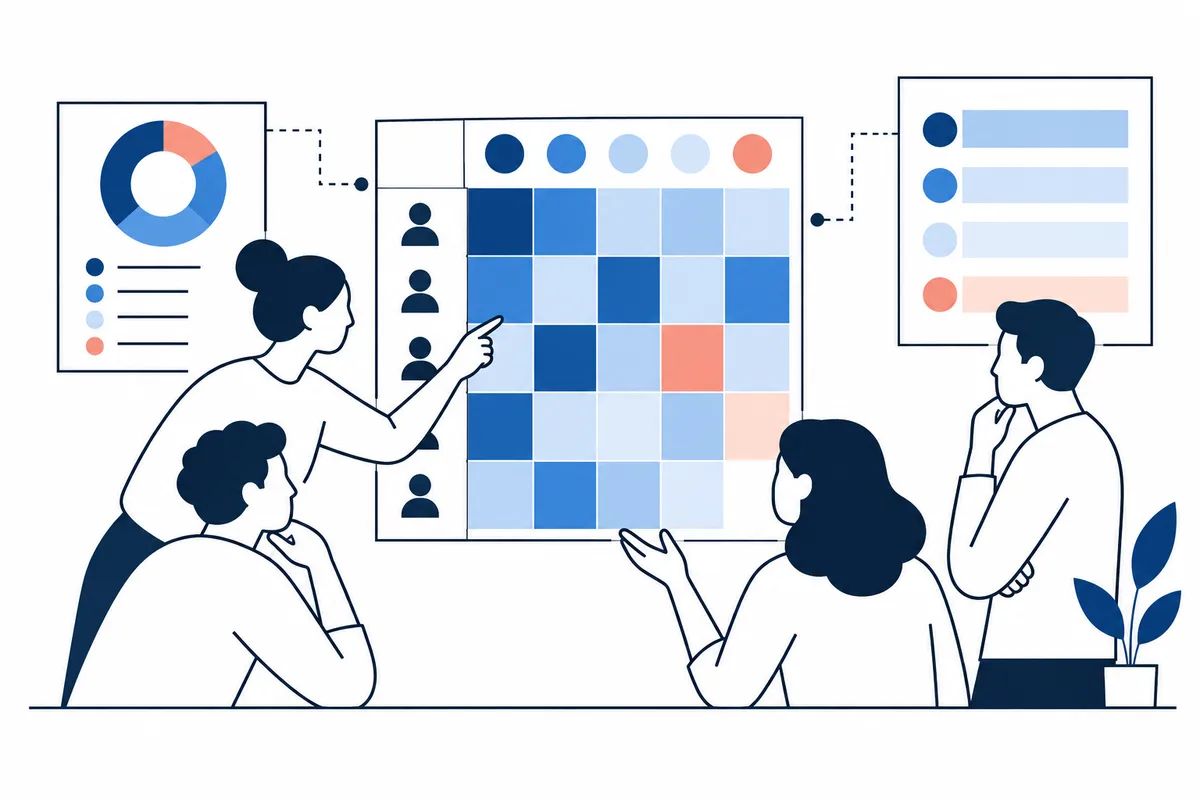
Do team-EI findings show that higher scores improve performance?
Some studies report associations between team EI and outcomes such as conflict, cohesion, or performance, but this does not show that a score caused the outcome or that raising it would improve another team’s results. A relationship means measures varied together in a sample; it does not show that changing one changes the other.
The abstract of “The effect of team emotional intelligence on team process and effectiveness” reports data from 79 teams in South Korean companies. In that sample, team EI was negatively related to task and relationship conflict and positively related to team performance, innovation, and cohesion. The authors also report that team EI moderated how task conflict related to effectiveness and relationship conflict to cohesion. The findings connect emotional processes with collaborative outcomes, but do not establish that higher EI produced them or that the pattern holds across occupations. They are associations in the studied companies, not a guarantee for teams using a questionnaire.
“Team Emotional Intelligence in Working Contexts: Development and Validation of the Team-Trait Meta Mood Scale (T-TMMS)”. Its cross-sectional study examined 152 leadership teams in the Mondragon Cooperative Corporation in Spain. The researchers report a three-factor structure for Attention, Clarity, and Repair, and investigated links between team EI and organizational performance. Data were self-reports collected at one period. The authors call for replication in other organizational settings, longitudinal research, and more objective measures to verify TEI’s impact. Evidence about what a scale measures and evidence that the measured construct causes an outcome are separate tests.
Other conditions could help explain why favorable team perceptions and outcomes appear together. Leadership may shape both how members handle tension and how work is organized. Task interdependence, resources, tenure, or whose concerns get heard could also matter. These are plausible alternatives, not findings established by the two studies. The research does not settle whether team EI contributes to effective work, effective conditions support the measured behaviors, or both reflect other team features.
The defensible conclusion is that team EI has been measured and associated with work outcomes, so a team-level question is researchable. The evidence here does not show that increasing a questionnaire score improves performance. A team can use a measure developmentally to examine a shared practice, then observe relevant work behavior over time. Claims that a score predicts performance across settings, or that raising it causes improvement, need studies designed to test those claims.
Sources: The effect of team emotional intelligence on team process and effectiveness; Team Emotional Intelligence in Working Contexts: Development and Validation of the Team-Trait Meta Mood Scale (T-TMMS)
How can a team collect answers without changing them?
Before asking a team to rate its emotional habits, explain what question the answers will inform and who will see them. In “Team Emotional Intelligence in Working Contexts: Development and Validation of the Team-Trait Meta Mood Scale (T-TMMS),” managers completed surveys voluntarily; researchers described the purpose, guaranteed confidentiality, and requested informed consent. The authors still noted self-report bias as a limitation. A privacy promise cannot make every answer candid or make a measure fit its purpose. It does let respondents judge the request.
The risk sharpens when a supervisor or potential employer may see results. “The Measurement of Emotional Intelligence: A Critical Review of the Literature and Recommendations for Researchers and Practitioners” says self-report respondents may present themselves in socially desirable ways, particularly when an important audience has access; the review considers this less likely in self-development or research settings. An invitation to reflect on a team practice asks for a different answer than a score that could affect someone’s standing. Do not promise anonymity if the process cannot provide it. State whether responses are confidential, who can access identifiable answers, how results will be summarized, and which decisions are out of scope.
Employment use requires a separate standard. The U.S. Office of Personnel Management explains that validity evidence depends on how an assessment is used in an employment decision; its guidance concerns U.S. federal selection practice. A developmental questionnaire cannot be repurposed as a hiring, promotion, or ranking score by convenience. Before collection, ask whether wording makes sense across roles, languages, and tenure, and whether members have comparable opportunity to observe or influence the behavior being rated. These checks clarify whose perceptions the responses capture; they do not prove that a difference causes bias. Tell participants the purpose, access rules, and limits before they answer, and keep the result developmental and tied to a clear question.
Sources: Team Emotional Intelligence in Working Contexts: Development and Validation of the Team-Trait Meta Mood Scale (T-TMMS); The Measurement of Emotional Intelligence: A Critical Review of the Literature and Recommendations for Researchers and Practitioners; Assessment Strategy
What should a team do when its members disagree?
When responses diverge, resist the tidy team average. “Team Emotional Intelligence: Emotional Processes as a Link Between Managers and Workers” describes checking within-group agreement before treating ratings as a team-level measure. Agreement helps show whether members share a perception; it does not explain why they agree or disagree. “Team Emotional Intelligence in Working Contexts: Development and Validation of the Team-Trait Meta Mood Scale (T-TMMS)” also uses questions about shared team experience. Variation is evidence to examine, not noise to erase. Start with the work episode behind the answers. Did everyone have the same chance to raise a concern? Were members thinking of different exchanges? Does the question fit the team’s actual work? Keep individual responses private and invite members to describe differences without defending a score. If members identify the same difficulty, agree on one practice to examine, such as revisiting a concern after disagreement. If accounts differ, first learn what each person encountered. Then observe a later interaction: was the concern raised, heard, and revisited? It does not prove a score changed or caused better work; it checks whether the practice appeared in that episode.
Sources: Team Emotional Intelligence: Emotional Processes as a Link Between Managers and Workers; Team Emotional Intelligence in Working Contexts: Development and Validation of the Team-Trait Meta Mood Scale (T-TMMS)
What is a responsible next step?
Begin with one interaction the team wants to understand. That question points to a team process. If a person instead wants to reflect on their own habits in tense conversations, an individual measure is the better fit. In “Team Emotional Intelligence in Working Contexts: Development and Validation of the Team-Trait Meta Mood Scale (T-TMMS),” the researchers changed item wording from a self-reference to a team reference, asking about perceptions of “this team.”
Next, choose evidence proportionate to the claim. That boundary keeps personal reflection separate from claims about collective behavior. A facilitated discussion about one recent work episode can help a team identify a practice to try. A formal team score needs an instrument designed for that referent and evidence that member responses can be interpreted together. If people describe sharply different experiences, preserve that difference and ask whose view is missing before calculating or presenting an overall result. The Team Emotional Intelligence Consortium’s framework describes norms at member, team, and cross-boundary levels; use that as a prompt to specify which relationship or behavior is in scope, rather than as proof that a particular team possesses a fixed ability. Agree on one observable next step, such as whether a raised concern is acknowledged and revisited, and discuss what happened after a later interaction. For personal reflection, EQ Test’s 32-item Emotional Skills Profile offers an individual educational profile; it does not measure collective EI or produce a team result. Keep the question at the level the evidence can answer, then let the next work interaction guide what to examine further.
Sources: Team Emotional Intelligence in Working Contexts: Development and Validation of the Team-Trait Meta Mood Scale (T-TMMS); Team Emotional Intelligence
Questions readers ask
Is collective emotional intelligence the same as the average EQ of team members?
No. An average of individual-referent responses describes member attributes or composition. A team-referent measure asks members about their perceptions of shared team norms. These answer different questions.
When is it reasonable to report one team result?
When the measure is intended to describe the team, evidence supports that interpretation, and member responses can reasonably be summarized together. If responses diverge, retain that variation and investigate it before reporting a single value.
Can a team-EI score show that a team will perform better?
Some studies report associations between team EI and work outcomes, but those findings do not show that a score caused the outcomes or that raising it will improve another team’s performance.
Sources
- Team Emotional Intelligence in Working Contexts: Development and Validation of the Team-Trait Meta Mood Scale (T-TMMS)
Supports the distinction between individual-referent aggregation and team-referent perceptions, and describes the T-TMMS dimensions and study limitations.
- Team Emotional Intelligence
Supports the framework description of team emotional-intelligence norms across member, team, and cross-boundary relationships.
- Team Emotional Intelligence: Emotional Processes as a Link Between Managers and Workers
Supports the distinction among within-team agreement, variance associated with team membership, and reliability of team-mean differences.
- The Measurement of Emotional Intelligence: A Critical Review of the Literature and Recommendations for Researchers and Practitioners
Supports distinctions among ability, trait, and mixed EI measures and the limits of self-report responses.
- The effect of team emotional intelligence on team process and effectiveness
The accessible abstract reports associations between team EI and conflict, performance, innovation, and cohesion in 79 South Korean company teams.
- Assessment Strategy
Supports the point that validity evidence for an employment assessment depends on its intended employment use.
Apply it to the real situation
See your own emotional habits at work
From this guide: A team-level question can reveal a shared norm, while your own habits in feedback, disagreement, or repair remain personal.
If you want to reflect on your own emotional habits in work situations, the Emotional Skills Profile offers a private, individual development profile. Its 32 items focus on emotional skills and practical reflection. It does not measure collective emotional intelligence or create a team score. Use it to consider one personal behavior you may want to examine in your next difficult conversation.