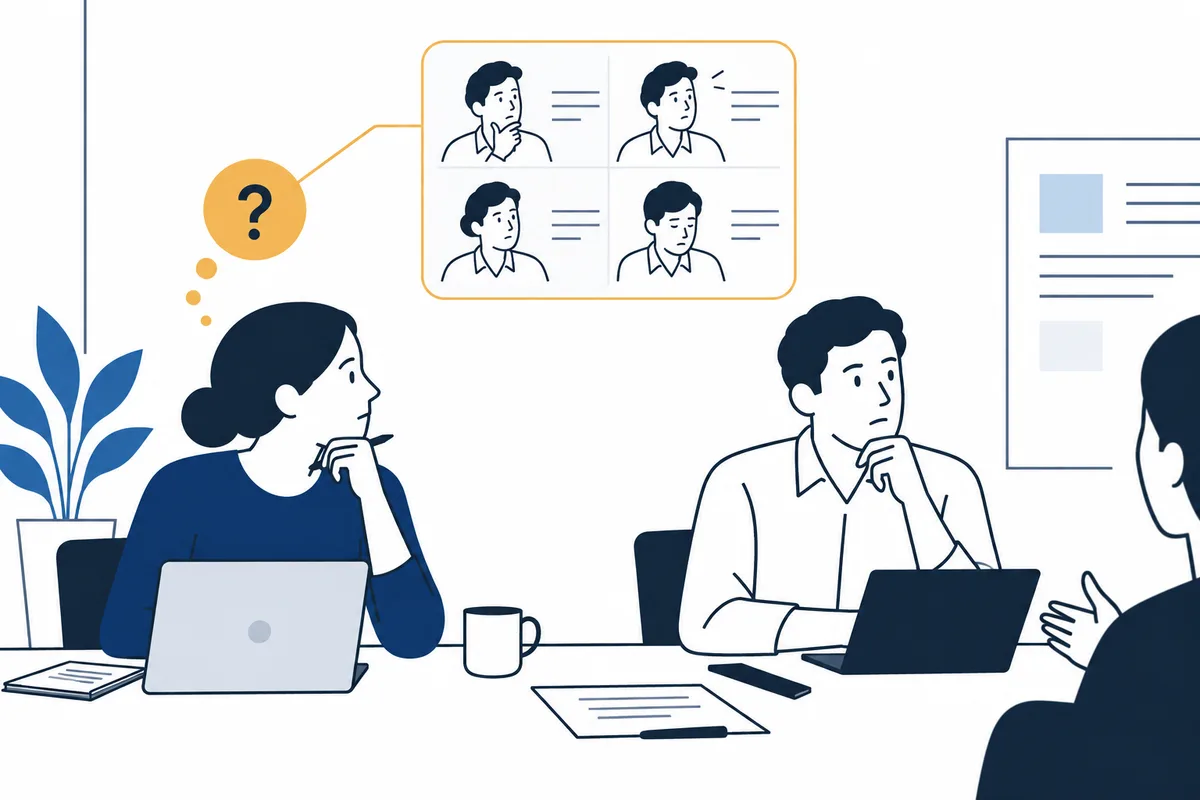
Describe the cue you observed before deciding what it means. If your next move depends on the emotion you inferred, ask an open, relevant question about the shared work moment and let the coworker correct or decline. If it does not, address the work issue and leave the emotion unassigned. A reply adds information about that exchange; it may not explain the person’s full inner state.
How can I check a first impression before acting?
Before acting on a coworker’s apparent emotion, separate what happened from what you think it means. “They paused after I proposed the change” is observable; “they are annoyed with me” is an interpretation. Ask whether your next move actually depends on that interpretation. If the work decision can proceed using what the person said, proceed on those facts. If you would challenge, reassure, or change course because you believe you know how they feel, get more information first—usually by asking about the proposal or moment rather than announcing an emotion for them. This is a practical inference from research on how people read cues and gain perspective, not a tested meeting script. It also keeps the check proportionate: you need enough information to choose the next work step, not a complete account of someone’s inner life. If a decision is urgent, make the proportionate work decision from the facts available and leave the coworker’s unconfirmed feeling unknown. A coworker may also be unable or unwilling to answer in the moment; that does not prevent the group from clarifying the proposal, its risks, or the next step.
A cue is visible; its meaning depends on the scene
A pause, a change in tone, or a tightened expression can be noticed directly. The emotion attached to it cannot. Calling a face “angry,” “uncertain,” or “relieved” is already an act of emotion labeling: the observer has mapped visible behavior onto a category. That label may be a useful first hypothesis, but the cue alone does not establish what the person feels or why.
Consider an illustrative meeting moment: a coworker pauses and furrows their brow after a proposal. Those details are observations. “They dislike the proposal” is one possible attribution; the pause could instead reflect concentration, an attempt to recall a constraint, concern about timing, or something unrelated to the exchange. These are possibilities, not claims about what any particular coworker is thinking. The important distinction is between the event you could describe to another attendee and the private state you inferred from it.
The study [“Interactions between faces and visual context in emotion perception: A meta-analysis”](https://pmc.ncbi.nlm.nih.gov/articles/PMC12426097/) pooled 1,020 effect sizes from 37 articles involving 3,198 nonclinical participants. Both faces and visual context had large effects on emotion labels (average effect sizes g_av greater than 1.23). The relative influence of each varied with how clear the facial cue was and whether the face and surrounding scene conveyed congruent information. In other words, observers used both the face and the scene when assigning an emotion label; a face did not function as a self-contained readout.
“Context” here means information available in the scene around the face, not special access to the person’s thoughts. In a meeting, that can include the proposal under discussion, the sequence of turns, and whether the coworker has named a practical concern. These details help distinguish what the visible response is responding to; they do not prove an emotional cause. A furrowed brow after a cost estimate might fit concern about the budget, while the same brow after a long pause could accompany effortful concentration. Even a plausible scene-based interpretation remains an interpretation until the coworker supplies more information.
That result helps explain why the same pause or expression can look different across meetings. A furrowed brow during a difficult proposal may be read through the proposal’s stakes, the timing of the response, and what was said immediately before it. If a coworker has just raised a concrete risk, concern about that risk is a more grounded possibility than a personal judgment about you. If they have not spoken yet, the same expression offers less information about the work issue. Context can narrow plausible readings, but it can also feed projection: an observer who expects resistance may treat an ambiguous face as confirmation.
The meta-analysis studied emotion labeling under research conditions, not whether an observer can identify a specific colleague’s private feeling in a live meeting. Its pooled result therefore supports a modest practical judgment: interpret a visible cue alongside the surrounding exchange, and keep the emotion label provisional. It does not supply a reliable decoding rule for translating a brow, pause, or tone into one person’s state. When your response depends on the label, ask about the relevant work moment and let the answer add information.
Sources: Interactions between faces and visual context in emotion perception: A meta-analysis
A test score does not settle a live meeting
A score on an emotion-recognition task cannot tell you whether a coworker is feeling a particular emotion now. The task and the meeting ask different questions. In a recognition task, a person labels an expression or vocal cue presented under set conditions. In an empathic-accuracy judgment, an observer tries to track what a particular person is thinking or feeling while that person describes an experience. The second judgment depends on a target person, the content and timing of their account, and the observer’s interpretation of it; it is not simply another label for a face. A strong result on posed or recorded cues may say something about performance on that task, but it does not supply the missing information about what a colleague means by a pause in this discussion. That distinction matters when someone is about to challenge, reassure, or redirect a coworker on the strength of an emotional guess.
The 2023 study [“Emotion recognition accuracy only weakly predicts empathic accuracy in a standard paradigm and in real life interactions”](https://www.frontiersin.org/journals/psychology/articles/10.3389/fpsyg.2023.1154236/full) examined 101 Swedish professionals from helping professions and other occupations. Participants completed an emotion-recognition task using recorded material across audio, video, and audiovisual presentations, then made empathic-accuracy ratings about narrators’ thoughts and feelings as those narrators recounted experiences. Keeping the stages separate helps explain what a score can and cannot answer: recognizing an emotion in a clip concerns the signal presented to the participant, whereas empathic accuracy concerns correspondence between an observer’s judgments and a narrator’s reported inner experience over a recorded account. Neither stage reproduces the reciprocal, changing conversation in which a meeting response takes its meaning. The researchers also compared task performance with diary reports from a subsample of 61 participants about emotions they perceived in their partners during everyday interactions. The study therefore put recognition performance beside a more contextual judgment and a small window onto reported real-life perceptions; it did not test whether a colleague in a live meeting was angry, worried, or receptive at one particular moment.
The diary analysis deserves precise reporting. Of 20 possible correlations between recognition performance and diary ratings, two were statistically significant: video recognition of negative emotion correlated with fewer perceived negative emotions in a partner (r = −.255), while audio recognition of positive emotion correlated with perceived positive emotions in a partner (r = .287). Those directions differ, and neither correlation is a direct test of whether a reader can identify a coworker’s present feeling. The authors noted that two significant findings among 20 comparisons could have occurred by chance. It would therefore overstate the evidence to say the diary data showed no connection at all; it would also overstate it to turn either association into a dependable rule for reading another person. They are exploratory signals within this study, with the authors’ chance explanation still live. The mixed signs also resist a simple reading in which higher recognition scores uniformly mean more accurate perceptions of other people. The study’s own comparison is a reminder to inspect which recognition modality and which kind of empathic judgment are being related before describing a result; pooling them into a single claim about “reading people” would erase the very distinctions the researchers tested.
For a meeting, the practical implication is narrow: an assessment result cannot resolve the meaning of one colleague’s response. Recognition of recorded audio or video and ratings about narrated experiences leave open what the colleague is responding to here—the proposal, its timing, a constraint, or something else. If the next work move hinges on that interpretation, the test score cannot substitute for information from the exchange itself. Ask about the proposal or the moment, and let the coworker’s answer—not a general task result—shape what you do next.
Why imagining the coworker’s view can feel more certain than it is
When a coworker’s reaction is ambiguous, it is tempting to replay the exchange from their side until one explanation feels convincing. But producing a plausible account of someone else’s perspective is not the same as receiving information that only they have. A story about why they paused may fit the proposal and the conversation; its fit does not verify that it matches their thoughts or feelings. The difference is between generating a hypothesis and checking it. Mental effort can make the hypothesis more detailed without making the coworker’s private experience more available to you. Imagining can shape what you notice, but it cannot check whether your account fits.
The university research portal abstract for the 2018 paper [“Perspective Mistaking: Accurately Understanding the Mind of Another Requires Getting Perspective, Not Taking Perspective”](https://cris.bgu.ac.il/en/publications/perspective-mistaking-accurately-understanding-the-mind-of-anothe-2/) summarizes 25 experiments involving judgments about emotion, deception, preferences, and attitudes. Across those experiments, instructions to take another person’s perspective did not consistently improve accuracy. They sometimes increased participants’ confidence, even when accuracy did not reliably improve. The abstract does not give the study-by-study methods or effect sizes, so the finding should stay at that level: across varied tasks, perspective-taking instructions were not a dependable route to more accurate judgments. The range of tasks is useful because it tests the broad intuition across more than one kind of judgment, rather than establishing a result for a single emotion-label exercise alone. Yet the abstract’s summary cannot tell us which particular task drove each confidence change or how large any effect was; a more detailed account than the source record provides would be speculation. It does not establish that every attempt to imagine another person’s view is useless, or test a specific meeting technique.
That confidence gap matters in an ordinary work disagreement. Silently deciding that a coworker’s clipped response reflects embarrassment, irritation, or concern may help you consider possibilities, but conviction is not evidence that you selected the right one. The final experiment in the paper’s abstract points to a different source of information: in that experiment, conversational perspective-getting improved accuracy. Asking the other person can reveal something your private simulation cannot. It still does not guarantee a complete explanation; the person might answer about the proposal, offer only what they want to share, or correct the premise of the question. The useful role for perspective-taking is to prepare a considerate, open question or to keep more than one explanation in view. For example, considering that a terse reply might concern a deadline rather than your proposal can keep you from responding defensively; it still leaves the actual reason unknown. The experiment’s conversational result supports the value of getting another person’s perspective in that studied setting, while the abstract does not establish a script, guarantee disclosure, or show that every workplace question will improve accuracy. Confirmation comes from the exchange, not from how vivid the imagined account feels.
What asking adds—and what it cannot guarantee
A question can improve a prediction when the other person’s answer supplies information that the observer did not have. It does not help simply because a question was asked: the answer has to bear on the thing being predicted. The three experiments reported in “The Benefits and Obstacles to Perspective Getting” make that distinction visible. Asking for another person’s perspective improved predictions in two tasks—product prices and attitudes—but did not improve predictions in a money-distribution task. The result is therefore conditional across domains. Perspective-getting gave observers useful information in some settings, while the same broad approach did not add predictive accuracy in every setting tested.
That pattern matters more than treating asking as a universal correction for a mistaken impression. In a work conversation, the question and the decision need to meet. If the uncertainty is whether a proposal misses a deadline constraint, asking what concern the colleague sees may reveal information directly relevant to the decision. If the uncertainty is whether the colleague feels irritated, a reply about the proposal may clarify the objection without settling the emotion. The experiments concern laboratory prediction tasks, not emotion judgments in meetings, so applying their contrast to workplace conversations is an inference: the likely value of asking depends on whether the response carries information relevant to the particular inference at stake.
The coworker also controls what they can and want to say. They may not know exactly what shaped their reaction, may prefer not to disclose a personal feeling at work, or may answer the practical issue rather than the emotional question. Those are ordinary possibilities to account for in choosing a next step; they were not reported as findings of the three experiments. A useful check therefore leaves room for an answer that corrects the premise, names a work concern, or gives no personal account. The question can open access to another perspective, but it cannot make that perspective complete or ensure that it resolves a complicated disagreement.
The difference between the tasks also cautions against assuming that all answers function alike. A price estimate can be checked against a later market outcome, while a person’s attitude or allocation choice is tied to a particular question and setting. The plan’s source record supports the reported contrast in prediction results; it does not establish why asking failed in the money task or identify a workplace condition that would reproduce either outcome. For the meeting reader, the warranted takeaway is narrower: ask about the uncertainty that matters to the work decision, then judge whether the answer actually addresses it.
Treat the reply as new first-person information and use it at the scale it supports. If the colleague says the estimate omits a dependency, examine the dependency; if they say they need time, agree when to return to the decision. Their report is more direct evidence of their account than your private guess, yet it need not describe every influence on the moment. Asking improves the basis for a response when the answer is relevant; it does not turn one exchange into certainty about the person or guarantee agreement on what to do.
Keep the inference at the scale of one exchange
“Emotions in the Workplace” organizes research at several levels, including within-person change over time, interactions between people, group patterns, and enduring differences between people. The levels are not interchangeable. A pause is an event in a particular moment; a colleague’s answer belongs to an exchange between two people; a recurring pattern across a group concerns the group; and a claim about someone’s stable disposition reaches beyond any single meeting. The review supplies this way to sort the scale of a claim. Applying it here is an editorial judgment about careful inference, not a finding about the coworker in a particular meeting.
For a single impression, keep the record close to what an attendee could verify: “After the delivery estimate, a participant paused, then asked whether testing was included.” The first clause records timing and behavior; the question identifies the stated work issue. A note such as “resists change” jumps from one event to an enduring person-level judgment. “The team is tense” jumps again, from one exchange to a group climate. Neither larger conclusion follows from the pause alone. Even if a colleague says they are frustrated, that account describes their report in this exchange; it does not by itself establish a stable disposition or explain the group’s wider pattern.
The distinction also changes how an answer should be recorded. “They said the estimate leaves out testing” is a report of what was said in the exchange. “They always resist change” makes a claim across occasions, and “the group is tense” describes a collective pattern. Each step outward needs information at that broader level: more than one relevant moment for a recurring individual pattern, and evidence about the group rather than one person’s response for a group claim. The review’s categories help identify those shifts in scale; they do not certify any particular note or inference.
This boundary is useful when deciding what to do with the information. Address the testing assumption in the meeting if it affects the estimate. If a broader concern matters, ask about it directly and gather relevant examples across time rather than turning today’s moment into a diagnosis of the colleague or team. Repeated patterns observed independently may justify a broader work conversation, but one impression cannot establish them. Keep the conclusion tied to the event and the issue the colleague actually named; let any wider claim wait for wider evidence.
Sources: Emotions in the Workplace
When privacy and power change the question
Choose the setting by asking what needs to be known and who needs to know it. If a concern could change the group’s decision—an omitted dependency, an unrealistic date, a risk to the handoff—raise that work issue in the meeting while it is still useful. Keep the question about the proposal or next step. The group can examine the facts without asking anyone to explain a personal feeling in front of colleagues.
For example, if a coworker pauses before approving a plan, the meeting may need to know whether the schedule accounts for testing. “What would need to be true for this date to work?” invites a practical objection the group can act on. It does not require the coworker to say whether they feel frustrated, anxious, or unconvinced. If the answer is simply that testing is missing, the decision has gained relevant information even though the original emotional impression remains unresolved.
A private follow-up is more suitable when the question concerns the person’s experience, the issue is sensitive, or the colleague may find it difficult to answer freely in front of someone with authority. “Read the Room Before Your Next Meeting” recommends checking a cue-based hypothesis privately; “How to check in with your colleague and ask if they’re okay” advises choosing a considerate time and place and opening with an observable concern. These are practitioner recommendations about approach, not studies showing that privacy causes a more accurate answer. In this setting, privacy is a way to make a personal answer easier to decline and to avoid making emotional disclosure part of the group’s work decision.
Urgency still matters. If the team cannot decide until it hears the concern, postponing every question may leave a preventable work problem unspoken. Ask neutrally about the issue now, and make any personal follow-up optional: “Is there a risk in the proposal we should account for? We can also talk afterward if there’s more you’d rather raise privately.” This separates the group’s need for decision-relevant information from the colleague’s choice about sharing how the moment felt. The distinction is not simply public versus private: it is whether the answer belongs to the shared decision or to the colleague’s own account. A factual question can be asked in front of the group when everyone needs the same information; a personal question deserves more choice about timing and audience. Authority sharpens that choice because a manager’s invitation may feel harder to refuse than a peer’s, even when no pressure is intended. That is a reason to keep the immediate request narrow and make follow-up genuinely optional, not a claim that the setting determines what someone will say.
Sources: Read the Room Before Your Next Meeting; How to check in with your colleague and ask if they’re okay
How can you ask without planting an emotion label?
Anchor the question to something both people can identify: the proposal, the pause before a decision, or the concern that has not yet been discussed. Then ask what the coworker thinks or what the work issue might be, leaving room for an answer you did not anticipate. This wording approach is a practical application of the article’s evidence about checking an impression; it is not a tested formula. Its purpose is modest: find out whether there is a relevant concern before letting an emotion guess determine what you do.
In an illustrative meeting exchange, a proposal reaches the group and a coworker pauses before responding. “You’re annoyed, right?” supplies both an emotion and a preferred yes-or-no shape. The coworker must first accept or reject the label; if they reject it, the work question may still be hidden, and if they agree, the conversation can become about defending or explaining the feeling rather than examining the proposal. Even a polite tone cannot remove the assumption built into the wording.
A more open version is, “I noticed we paused on the delivery proposal. What concerns or questions should we work through before deciding?” It names a shared moment, gives the colleague the floor, and points toward information the group can use. They might identify a missing dependency, say they need time to review, explain that they see no issue, or offer personal context. Each answer is available without first accepting the speaker’s guess. The question does not prove what caused the pause; it lets the coworker define what, if anything, needs attention. The question also gives a useful amount of silence: ask it once, then let the coworker choose where to begin. Rushing to add “because you seemed uncomfortable” can quietly reintroduce the interpretation after an open first clause. Naming the concrete decision keeps the exchange answerable: the colleague can point to a deadline, a missing review, a disagreement with the proposal, or no concern at all. Those replies differ in what the team should do, while none requires the observer to infer a feeling from the pause.
Open wording still needs a boundary. “How are you feeling?” can be too broad for a meeting and can invite personal disclosure that the decision does not require. Ask only for what bears on the work: “Is there something about the handoff we should account for?” If the colleague answers with the work issue, follow that. If they choose to share a feeling, listen without treating the label as a complete explanation. If they pass or give no detail, use the facts already available and leave the private state unassigned. Relevance is the check on openness. A question can be grammatically open and still feel intrusive if it asks for private context unrelated to the decision. “What’s going on with you?” gives no clear work boundary; “What should we check in the handoff?” does. If the colleague volunteers a personal explanation, do not convert it into a new certainty about their motives or ask for more than the work requires. The aim is to make correction possible and leave the next move tied to what the person actually chooses to say.
Let the reply change the next move
After asking, listen for the part of the reply that bears on the shared work. The colleague may confirm that something is wrong, correct the interpretation, or offer no answer about the feeling. Each response calls for a different move. The point is not to get agreement with the first impression; it is to let the available information change what happens next.
In an illustrative planning meeting, a coworker goes quiet when the team reviews a launch handoff. You ask, “What should we check before we settle this handoff?” They reply, “I’m worried the support team hasn’t been told about the new timing.” That answer gives the team a risk to clarify: who owns the notification, and when will it go out? You can address that concern even if you never learn whether the silence came from worry, frustration, or concentration. The reply has changed the work plan, while the feeling remains the coworker’s to name or leave unnamed.
Suppose instead the coworker says, “I’m not worried about timing. I tried to mention that the overnight review is missing, but we moved on.” Accept the correction without explaining why your original reading seemed plausible. The useful response is to return to the overlooked point: ask what the review requires, make space for the details, and revise the handoff if needed. A quick “Thanks for correcting me; let’s go back to the review” repairs the conversational miss and directs attention to the contribution that was not heard. Do not turn the correction into another guess about what the coworker must have felt.
They may also say, “I’d rather not get into it,” or simply decline to elaborate. Let that boundary stand. If the group still has enough information to decide, proceed on the known facts and make clear what assumption the decision uses. If it does not, ask a narrower work question such as whether there is a specific risk the group needs to account for; the person can answer that without explaining a private emotion. Silence or refusal is not confirmation of the original interpretation. Do not press for disclosure as the price of moving forward.
A reply can be partial, and the person may describe the moment differently later. Make the smallest work adjustment the information warrants, then reopen the discussion if a new, relevant concern appears. A correction about one handoff updates your understanding of that handoff; it does not settle how the coworker generally feels about the project or you. The observable skill is in accepting new information, following the issue the person actually raised, and leaving the rest unresolved when the work does not require more. If a decision must be made before the concern is fully understood, state what is known, who will check the open point, and when the team will revisit it. That keeps uncertainty attached to the decision rather than turning it into a story about the colleague.
Choose one practice for the next meeting
Before your next meeting, notice one cue and ask yourself whether the work decision depends on what you think it means. If it does, ask about the shared moment or the practical concern in neutral language, then let the reply guide the next step. If it does not, act on the known work facts and leave the coworker’s feeling unassigned. That is enough practice for one meeting; you do not need to extract a personal explanation. You might write down the observable moment in a few words beforehand—“the handoff question was skipped”—so the question stays tied to the work rather than to a label. Afterward, note what the person actually said and what action followed; leave any unanswered emotion out of the record. Keep the note private and brief.
If you want to reflect on your own recurring habits, the private 32-item [Emotional Skills Profile](/assessment) offers recent-behavior prompts and authored-scenario judgments. It has no validated norms or established ability-test validity, and it cannot determine whether you read a coworker’s live emotion correctly. Use it as a starting point for self-reflection, not as a score of meeting-specific empathic accuracy.
Questions readers ask
How can I check whether my first impression of a coworker’s emotion is right?
Separate the observable cue from the emotion you inferred. If your next move depends on that inference, ask an open question about the relevant work moment and let the coworker answer in their own terms.
Should I ask a coworker if they are angry?
Usually, start with the shared moment or work issue rather than supplying an emotion label. For example, ask what concerns or questions the group should work through before deciding.
Can an emotion-recognition test tell me whether I read a coworker accurately?
An emotion-recognition score does not establish what a particular coworker feels in a live meeting. Research finds only weak links between emotion-recognition performance and empathic accuracy in the studied settings; two diary correlations were significant, though the authors said they could be chance findings.
What if my coworker corrects me or does not answer?
Accept a correction and follow the work issue the coworker actually raises. If they do not answer, do not treat silence as confirmation; proceed using the known work facts and leave the emotion unresolved.
Sources
- Interactions between faces and visual context in emotion perception: A meta-analysis
In a meta-analysis of 1,020 effect sizes from 37 articles and 3,198 nonclinical participants, both faces and visual context had large effects on emotion labeling (g_av > 1.23); cue clarity and emotional congruence moderated their relative influence. This supports the claim that a facial cue is interpreted in context, not in isolation.
- Emotion recognition accuracy only weakly predicts empathic accuracy in a standard paradigm and in real life interactions
Original study of 101 Swedish professionals compared emotion recognition from video/audio stimuli with empathic-accuracy judgments about recorded narrators; only weak support appeared for audio-only feelings. In a diary subsample of 61, two of 20 possible correlations were significant: video negative-emotion recognition with fewer perceived partner negative emotions (r=-.255), and audio positive-emotion recognition with perceived partner positive emotions (r=.287). Authors state these two findings could be chance. It does not establish accuracy for coworkers in live meetings.
- Perspective Mistaking: Accurately Understanding the Mind of Another Requires Getting Perspective, Not Taking Perspective
The university research portal abstract for the peer-reviewed 2018 paper reports 25 experiments across emotion, deception, preference, and attitude judgments. Instructions to take perspective produced no consistent accuracy improvement and sometimes increased confidence; its final experiment found conversational perspective-getting improved accuracy. The abstract does not supply study-by-study methods or effect sizes, so claims stay at this aggregate level and do not establish a validated workplace script.
- The Benefits and Obstacles to Perspective Getting
Three experiments tested asking for another person’s perspective in money distribution, product-price, and attitude-prediction tasks. Asking improved prediction in two tasks but not the money-distribution task. These laboratory outcomes show perspective-getting can add information without guaranteeing accuracy in every domain or emotional meeting.
- Read the Room Before Your Next Meeting
Workplace guidance recommends noticing a specific cue, treating the interpretation as a hypothesis, and checking privately with the colleague. This is practitioner guidance, not a controlled test of the advice or wording.
- How to check in with your colleague and ask if they’re okay
Workplace advice recommends choosing a considerate time and place and opening with an observable concern when checking on a colleague. It concerns a broader wellbeing check-in, not evidence that a particular emotion question works in a meeting.
- Emotions in the Workplace
This review organizes workplace emotion research across within-person, between-person, interpersonal, group, and organizational levels. It supports keeping a single meeting interpretation local rather than inferring stable coworker or team properties from one exchange.
Apply it to the real situation
Reflect on the emotional habits you bring to work
From this guide: A meeting can prompt you to notice how you interpret emotional situations and choose what to do next.
The private 32-item Emotional Skills Profile offers recent-behavior prompts and judgments about authored scenarios. It can help you reflect on your own habits and identify a behavior to consider practicing. It does not assess whether you read a coworker accurately in a particular meeting. Explore the profile if you want a structured starting point for your own development.