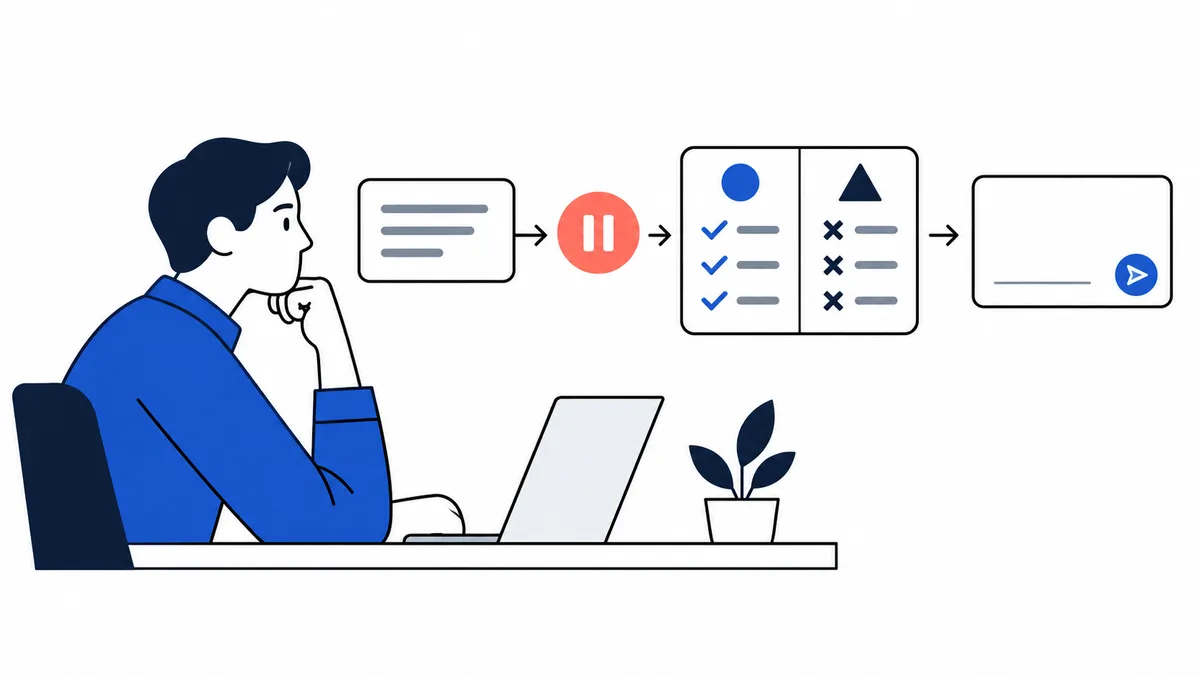
Separate the message’s observable request or criticism from the motive you infer. Notice the feeling and the words that triggered it, then consider one plausible alternative. Ask about missing work information only when its answer could change your next step. Respond to explicit feedback directly; address recurring observable conduct as a pattern.
How can you check the assumption before replying?
A colleague writes, “Please send the revised figures today.” You feel irritated and read the message as proof they think you are unreliable. Before replying to that accusation, separate the request from your interpretation. Name the feeling and the words that triggered it. Consider one alternative: perhaps the deadline is urgent, while the terse wording says little about their view of you. This possibility does not erase your reaction. Research offers no universal rule that brief messages are misread. “Hypernegative Interpretation of Negatively Perceived Email at Work” found that recipients rated selected emails more negatively than observers did. “’I get u’. People correctly interpret the tone of text messages and emails” found close alignment between senders’ and receivers’ emotional-tone ratings in sampled exchanges. Neither study reveals this colleague’s motive. Address explicit feedback directly. If missing work information would change your next step, ask for it; if similar conduct recurs, address the pattern. A pause makes room to check, not to pretend you feel fine.
Sources: Hypernegative Interpretation of Negatively Perceived Email at Work; “I get u”. People correctly interpret the tone of text messages and emails
What is in the message, and what are you adding to it?
Start with the part of the message you could quote without explaining what it “really means.” In “Please fix this today,” the sender names an action and a deadline. It does not state why the change is needed or what the sender thinks of you. It may still land as abrupt. That feeling describes your experience of the wording; it does not supply the missing explanation. Imagine the requested fix concerns a slide in a shared presentation. A slide needs revision, and the sender wants it done today. A reply such as “I know I made a mistake, but I had three other deadlines” answers a larger accusation: that you were careless or are being blamed unfairly. Context can matter, but this sentence alone does not establish those ideas. Notice whether your reply answers an actual claim or a judgment you supplied. This is not a demand to dismiss your reaction. Irritation or worry may flag an unrealistic deadline, an unclear request, or accumulated friction. The feeling makes the exchange salient; look for information that could distinguish interpretations. Is a specific correction identified? Does “today” conflict with another agreed priority? If the task is clear, a defense may divert the exchange. If a necessary detail is missing, address that gap. Before composing the reply, separate “What is explicitly requested?” from “What am I inferring about the sender’s view of me?” Keep the first answer close to the words; treat the second as a hypothesis. Then ask what evidence would change your reading. A stated reason, prior conversation, or pattern of unequal treatment could change the reading; none is contained in this sentence by itself. Research offers a reason for this care without proving that your interpretation is wrong. In “Hypernegative Interpretation of Negatively Perceived Email at Work,” participants supplied coworker emails they already perceived negatively. Receivers rated those messages more negatively than observers did, while receiver ratings had only weak relationships with message features such as negative wording. The sample cannot estimate how often ordinary messages are misread. A different question was asked in “‘I get u’. People correctly interpret the tone of text messages and emails”: across two studies, recipients’ ratings of emotional valence aligned closely with senders’ intended ratings in sampled informal texts and work or educational emails. That result concerns emotional direction, not every message’s full meaning or motive. Both findings can be true: tone may be readable while a recipient’s experience shapes interpretation. Keep the reply attached to evidence, rather than reaching a generous conclusion about the colleague. If you find yourself answering “You think I’m incompetent,” check whether that thought appeared in the message or entered while you read it. You can still address an unreasonable deadline or concrete criticism directly. Separating the two helps avoid arguing against an accusation nobody has yet made.
Sources: Hypernegative Interpretation of Negatively Perceived Email at Work; “I get u”. People correctly interpret the tone of text messages and emails
Why do two studies of terse messages seem to disagree?
They ask different questions. One studied messages recipients had already experienced negatively and compared their ratings with observers’; the other compared actual senders’ and receivers’ tone ratings in sampled exchanges. Neither establishes the sender’s motive in your message. Their results are compatible once selection and comparison groups are kept in view.
In “Hypernegative Interpretation of Negatively Perceived Email at Work,” participants identified coworker emails they had received and perceived negatively, supplied the messages, and described their perceptions. Receivers rated those emails more negatively than observers did, while receiver ratings had only weak relationships with message features such as negative wording and flaming. The effect occurred more in poor communication climates and among people in subordinate positions. Its starting point matters: the sample was built from emails already experienced as negative. In this selected set, the receiver’s experience could be more negative than an outsider’s reading. It does not tell us how often an ordinary brief message is misread, and an observer cannot supply the sender’s intention. Nor does the subordinate-position finding mean every person with less workplace power will read a message negatively; it describes a difference reported within this study’s setting.
“I get u”. People correctly interpret the tone of text messages and emails” uses a different comparison. Across two studies, recipients rated messages they had received and senders rated the emotional valence they intended. The first study involved informal text messages, with 347 receivers and 171 senders; the second involved work or educational emails, with 361 receivers and 61 senders. Valence means the emotional direction of a message, from more negative to more positive. In both samples, sender and receiver ratings aligned very well, and the researchers found no evidence for the six tested moderators, which included message length, emoji use, receiver age, and social closeness. This challenges the claim that people routinely interpret everyday text messages and emails more negatively than senders intend. It is not evidence that everyone understands every terse message, or that matching a valence rating means knowing why a colleague wrote it.
The studies do not cancel each other out. Sillars and Zorn asked how recipients and outside observers evaluated emails selected because recipients experienced them negatively. Pollmann and Roos compared the intended and received emotional direction of sampled exchanges. Selection, comparison group, and question differ. A person may experience a stinging message more negatively than an observer would, while senders and receivers can still agree about broad emotional valence. Neither design can settle the motive behind a particular line in your inbox.
So two familiar rules go too far: “text is always misread” ignores the sender–receiver agreement in the everyday samples; “your first read is accurate” turns group-level agreement about emotional direction into certainty about one colleague’s intent. Treat a terse message as evidence of its wording and task, then check whether the conclusion you are about to answer is actually stated. The evidence supports neither automatic suspicion nor self-correction. It supports a narrower habit: inspect this message and the work context before choosing a reply.
Sources: Hypernegative Interpretation of Negatively Perceived Email at Work; “I get u”. People correctly interpret the tone of text messages and emails
What does a useful pause change?
A useful pause changes what you think the message means before you choose what to send. That differs from suppressing irritation: you can conceal the feeling and still reply to a claim the colleague never made. The pause checks the interpretation; it does not require pretending the wording had no effect. In “Antecedent- and response-focused emotion regulation: divergent consequences for experience, expression, and physiology,” Gross distinguishes reappraisal from suppression. Reappraisal means reconsidering what an event means while an emotion is taking shape. Suppression means controlling visible expression after emotion has arisen. In the experiment, 120 participants watched a disgusting film. Some were instructed to think about it so they would feel nothing; others were told to behave so an observer would not know what they felt; a control group simply watched. Both strategies reduced expressive behavior compared with the control condition. Other measured responses differed: reappraisal reduced reported disgust, while suppression increased sympathetic activation, a bodily response measured in the experiment. That result gives a narrow reason to examine an interpretation before replying. It does not show that a pause improves email exchanges, that reappraisal always works, or that a colleague’s message has a benign explanation. The experiment used a film and assigned instructions, not workplace messages. Its relevance here is an inference: changing the question you ask yourself may affect the response you prepare, while hiding irritation leaves the underlying reading untested. For a terse note, the pause can be brief and specific. Name the feeling: irritation, worry, embarrassment, or uncertainty. Identify the words or missing detail that prompted it. Ask what those words establish and what you have supplied. “I feel accused” describes your reaction; it does not establish that accusation was intended. A second explanation need not be flattering or elaborate. Perhaps the sender is concise because the task is urgent; perhaps the wording is genuinely impatient. Hold the motive as unresolved until more evidence bears on it. This step should change the draft, not become a ritual that delays necessary work. If the message states a concrete correction, address it while still feeling annoyed. If missing context would change what you do, wait long enough to ask a useful question. If the work is clear and only the tone remains uncertain, you may proceed without settling the sender’s state of mind. The pause earns its place when it helps you answer the message that arrived instead of the motive you fear it carried.
How can you tell whether the task is unclear or the tone is?
The next question is practical: what information would change your reply? If a colleague writes, “Please fix this today,” the action and deadline are clear, but the scope may not be. Ask which part needs attention first. If the message identifies a missing attachment or incorrect version, the work issue is specific. An acknowledgment and a question about which file to use may be enough. For example, an illustrative reply to an underspecified request might be: “I can work on this today. Which section should I prioritize?” That wording does not claim the colleague is annoyed, and it does not require you to pretend the message felt warm. It locates the gap that prevents action. If the deadline is not feasible, say what can be completed by then and ask which deliverable matters most. Clarification is useful when the answer changes what you can do, its order, or its timing. It adds little when the task is clear and you are only seeking proof that the sender likes or respects you. A short “Thanks” or “Got it” can feel cool, yet may leave no task question to resolve. If the work is clear, proceed and let the tone remain uncertain. The 2025 study “I get u”. People correctly interpret the tone of text messages and emails compared sender and receiver ratings in everyday informal texts and work or educational emails. Across its two studies, ratings of emotional valence, meaning the positive or negative direction of a message, aligned closely. That finding makes it harder to assume brevity routinely causes a mistaken reading. It does not tell you what this colleague intended, or establish that tone and motive are always clear in every workplace relationship. The study “Hypernegative Interpretation of Negatively Perceived Email at Work” began with coworker emails recipients had already identified as negative. Recipients rated them more negatively than observers did. Because researchers selected negatively perceived messages and compared recipients with observers rather than senders, the result does not show that your first impression is wrong. It does show why an observer’s outside reading cannot settle your experience either. Together, the studies support a narrow discipline: use task content to decide what action is needed; ask about tone only when it materially affects how you can work together. These sample replies are practical illustrations, not tested scripts. A real deadline conflict, unclear ownership, or missing dependency calls for clarification because it changes the work. When none is present, a motive question may create a second problem without resolving the first. You can note that a message landed sharply and still reply based on what is explicit. If similar conduct recurs, address that pattern on its own terms instead of making each note carry the whole case.
Sources: “I get u”. People correctly interpret the tone of text messages and emails; Hypernegative Interpretation of Negatively Perceived Email at Work
How can a question preserve both task clarity and respect?
A useful clarification asks for information that can change the work. If a colleague writes, “I can’t use this version,” ask, “Which file should I use, and is there a deadline for replacing it?” That targets the practical gap without requiring either person to settle whether the note sounded impatient. “Why are you annoyed with me?” treats annoyance as established and shifts the exchange to a motive the words alone may not confirm. Even if the colleague is frustrated, the answer may leave the missing file unresolved. Neutral wording keeps the request specific and leaves room for information not yet known. These sample lines are illustrations, not tested scripts; no wording can guarantee a calm response.
A reader can acknowledge possible tone without announcing it as fact: “I may be reading this as frustration because the note is brief. Is there a specific change you need from me?” This reports an impression, names its uncertain basis, and invites correction. If delivery itself is making work difficult, raise that concern with a concrete example and a request for what would help. A deadline may still need negotiation; respect does not require accepting an unworkable request or avoiding disagreement.
There is adjacent evidence for considering another person’s perspective, though it does not test colleague-message scripts. “Effectiveness of extrinsic emotion regulation strategies in text-based online communication” examined written replies to people describing negative experiences. Independent coders rated letters to fictional pen pals; forum participants rated replies to their own distressing posts. Both studies found that reappraisal, or offering a different way to understand an event, and empathic responding helped ease recipients’ negative emotions. Problem-solving and reappraisal helped with relatively less intense emotions; neither showed a positive or negative effect for relatively intense emotions. A work correction differs from a distressed forum post, so this does not show that empathy or clarification improves workplace exchanges. It supports a modest choice: show you understood the concern before proposing a solution, and do not rush to reframe a strongly charged exchange as simple misunderstanding.
“I get u”. People correctly interpret the tone of text messages and emails” adds a limit: written tone is not necessarily unreadable. In two studies, participants rated emotional valence in informal texts and work or educational emails, while senders rated intended valence; the authors reported close alignment. A focused question checks what this exchange requires without assuming all written tone is unclear. If the task is clear, address it. If missing information changes what you can do, ask for it. If tone affects the working relationship, describe your reading as an impression and say what would make future communication more workable.
Sources: Effectiveness of extrinsic emotion regulation strategies in text-based online communication; “I get u”. People correctly interpret the tone of text messages and emails
What changes when the message contains explicit criticism?
Explicit criticism gives you something concrete to assess. If a colleague writes that the figures in a handoff do not match the latest file, the mismatch is a claim about the work. It may be accurate, mistaken, or based on a different version. The message does not, by itself, establish the broader judgment that you are careless or that the sender has lost respect for you. Keep those questions separate while deciding what the work needs.
A useful reply starts with the stated issue. You might acknowledge the discrepancy, check which file each person used, and correct the figures if the newer version confirms the point. If the criticism identifies an outcome but leaves the standard unclear, ask for the specification: “I’ll revise this. Which date should the report use?” If the requested change is not feasible by the stated deadline, say what can be done and when, then ask which part has priority. None requires you to settle whether the wording was irritated before moving the task forward.
Taking criticism seriously does not mean accepting its accuracy without checking. In “Hypernegative Interpretation of Negatively Perceived Email at Work,” the researchers examined coworker emails that recipients had already identified as negatively perceived. Receivers rated the emails more negatively than outside observers did, while receiver ratings had weak relationships with message features such as negative wording and flaming. It does not show that explicit work criticism is usually wrong, that recipients should discount their reactions, or that a colleague’s actual intent can be inferred from the difference. The study compared perceptions with observers’ readings, not with a definitive account of what each sender meant.
So check the criticism against the relevant evidence: the file, agreed requirement, prior instruction, or timeline. If the facts support it, address the correction. If they do not, state the specific discrepancy and ask to align on the standard. If both the work point and delivery need attention, handle the work issue first then describe the wording’s effect in a separate conversation. A disputed judgment about performance deserves a discussion of expectations and evidence; a sharp phrase alone cannot settle it. This lets you use feedback without turning one comment into a verdict about your competence or the colleague’s motive.
Sources: Hypernegative Interpretation of Negatively Perceived Email at Work
When does one terse exchange become a pattern to address?
A single brief message gives limited evidence about intent. Repeated observable conduct deserves attention as a pattern even when the sender’s motive remains unknown. Checking an interpretation should not become a rule that you must keep explaining away behavior that repeatedly affects your work.
Workplace researchers study incivility as a recurring behavior domain. “A meta-analysis integrating 20 years of workplace incivility research: Antecedents, consequences, and boundary conditions” combined 253 statistically independent samples from 219 primary studies. It examined factors associated with experienced incivility and related outcomes, including differences by study design, instigator source, and occupation. This establishes that workplace disrespect has been investigated across many studies. It does not provide a test for whether one terse note is uncivil, determine a sender’s intention, or set a threshold for action.
Describe events in terms another person could check: the date, exact words or action, work information withheld or delayed, and practical effect. If a colleague repeatedly calls your work incompetent without identifying a specific problem, note the wording and recurrence. If you are repeatedly left off messages needed for a handoff, record what was missing and how it affected the work. These are observable events, not diagnoses. “They are trying to undermine me” records an interpretation; it does not establish one.
Look for recurrence and consequence, not just a cluster of short replies. Check whether neutral clarification changed the exchange, whether the conduct appears in different tasks, and whether expectations are applied consistently. A repeated pattern may warrant action even if each incident could be excused alone. Several brief messages during a busy exchange do not by themselves show a broader problem when the needed information is available and no harmful conduct accompanies them.
Choose a proportionate next step. Where it feels appropriate and safe, state a boundary tied to the work: “Please send the file directly when you change the handoff; I need it to finish the review.” Keep records focused on work-relevant events. If behavior continues, affects access or task completion, or a direct conversation is unsuitable because of the power relationship or safety concerns, consult a relevant workplace resource. You do not need proof of private intent to describe repeated actions and their effects. The meta-analysis supports treating recurring behavior as a serious research subject; it cannot decide what happened in your workplace.
Sources: A meta-analysis integrating 20 years of workplace incivility research: Antecedents, consequences, and boundary conditions; Hypernegative Interpretation of Negatively Perceived Email at Work
What can a reflection profile add after this exchange?
A single message is poor material for a verdict about either person. A reflection profile can serve a different purpose: it may help you notice habits in how you recognize emotion, regulate your response, and engage with other people. That is useful when the same kind of exchange keeps prompting a familiar reaction. The profile is about your own reflection; it cannot reveal what a colleague intended in this particular note or confirm that your interpretation is correct.
The current EQ Test offering is described as a private, 32-item Emotional Skills Profile. Its recent-behavior questions and judgments about authored emotional situations are separate kinds of reflection. Read them as prompts for considering patterns, not as a standardized ability test or a population-normed score. The available product information does not establish validated norms or ability-test validity, so a result should not be treated as a rank, diagnosis, or measure of another person. [The Emotional Skills Profile](https://eqtest.org/assessment) is the relevant place to review what the assessment currently asks and returns; the page could not be independently opened during this draft, so no additional feature or result claim is made here.
A practical use comes after you have handled the work at hand. You might notice that, when a message is brief, you often move quickly from “the request is urgent” to “the sender is angry with me.” That observation does not settle whether the colleague was irritated. It gives you a behavior to watch in future exchanges: separate the stated request from the meaning you supply, then check whether a missing detail affects your reply. Another person might notice a different recurring habit, such as delaying a necessary clarification because they want to avoid seeming difficult. These are examples of questions for self-observation, not claims about what the profile will report.
If you want a broader view of your own emotional habits, explore the [Emotional Skills Profile](/assessment). Use any reflection to choose one response habit to observe or practice across ordinary situations. Keep the message itself in its proper place: its words, task, and history are the evidence for deciding what to do about this exchange. A self-reflection tool can help you examine your part in the response; it cannot adjudicate your colleague’s motive.
Sources: Emotional Skills Profile
What should you do next?
Write a reply to the part of the message you can verify. If the requested work is clear and only the tone feels uncertain, answer the stated task directly. If a missing detail would change what you do, ask one focused question: “I can update the draft today. Should I prioritize the figures or the summary?” If the message names a work problem, respond to it or ask for the specification you need.
A pause can help you reconsider what the message means before replying. In “Antecedent- and Response-Focused Emotion Regulation,” 120 participants watched a disgusting film; reappraisal reduced reported disgust, while suppression reduced visible expression but increased sympathetic activation. The experiment does not test this sequence, so these steps are a practical synthesis, not a proven workplace intervention. If personal remarks, exclusions, or shifting expectations recur, note the conduct and its effect, then consider a proportionate boundary or suitable workplace resource. “A Meta-Analysis Integrating 20 Years of Workplace Incivility Research” examines patterns across studies; it cannot establish what one colleague intended. For broader reflection on your own habits, the private Emotional Skills Profile at /assessment is an educational tool.
Sources: Antecedent- and response-focused emotion regulation: divergent consequences for experience, expression, and physiology; A meta-analysis integrating 20 years of workplace incivility research: Antecedents, consequences, and boundary conditions; Emotional Skills Profile
Questions readers ask
Should I ask a colleague if they are annoyed when their message sounds terse?
Ask about tone only when it materially affects how you can work together. First respond to any explicit work issue. If task information is missing and could change your next step, ask a focused question about that information. If similar conduct recurs, address the observable pattern.
Sources
- Hypernegative Interpretation of Negatively Perceived Email at Work
Supports the comparison between recipients’ and observers’ ratings of coworker emails selected because recipients perceived them negatively.
- “I get u”. People correctly interpret the tone of text messages and emails
Supports the comparison of sender and receiver emotional-valence ratings in sampled informal texts and work or educational emails.
- Antecedent- and response-focused emotion regulation: divergent consequences for experience, expression, and physiology
Supports the distinction between reappraisal and suppression in a laboratory film experiment, including reported emotion and physiological findings.
- Effectiveness of extrinsic emotion regulation strategies in text-based online communication
Supports limited adjacent claims about reappraisal and empathic responses to people describing negative experiences in text-based studies.
- A meta-analysis integrating 20 years of workplace incivility research: Antecedents, consequences, and boundary conditions
Supports describing workplace incivility as a research domain spanning 219 primary studies and 253 independent samples.
- Emotional Skills Profile
Supports the assigned product description; the live page could not be independently opened during drafting, so no additional product claims are made.
Apply it to the real situation
Notice the response habits you bring to tense messages
From this guide: This article offers a way to check one exchange; broader reflection may help you notice whether the same response habit recurs.
A single terse message cannot show what a colleague intended. If you want to reflect on your own recurring habits, the private 32-item Emotional Skills Profile offers prompts about recent behavior and authored emotional situations. Its report is for educational self-reflection, not a verdict on another person or a standardized ability score. Explore it when you want a broader view of your emotional habits.