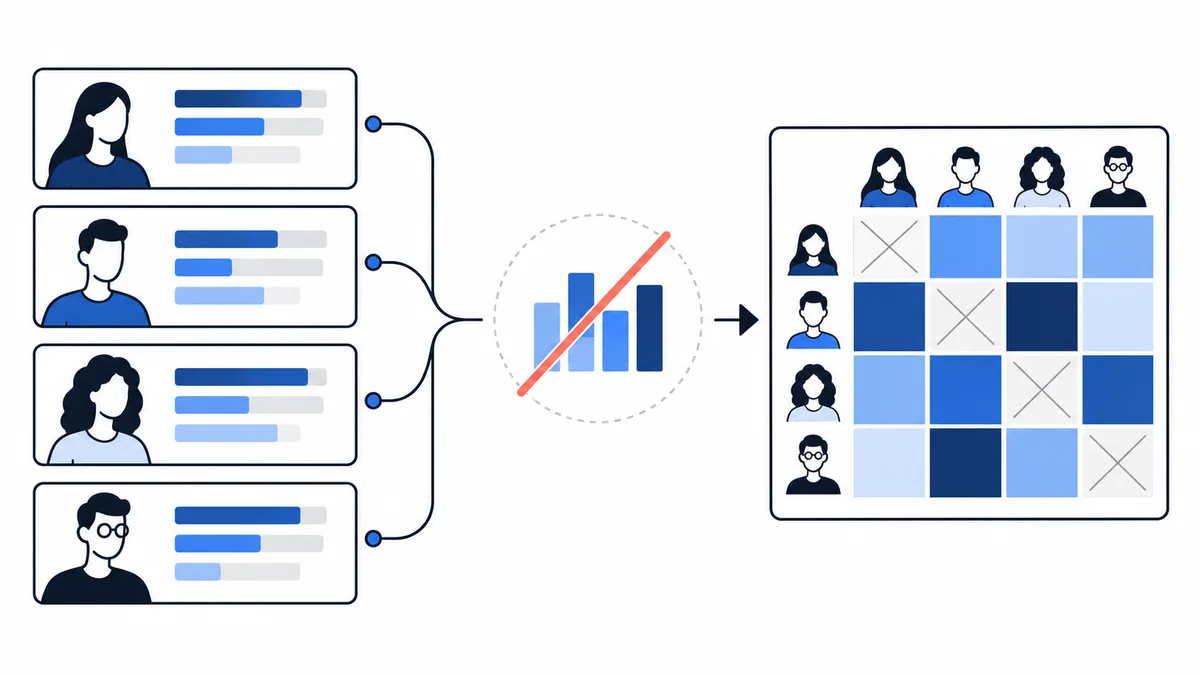
An average of individual EQ scores describes the responding members’ mean on that measure. It can summarize member composition, but it does not by itself show how a team collectively handles emotion. For that claim, check whether questions refer to the team, whether responses support a group summary, who answered, and how the team’s work depends on interaction.
What exactly does an individual-score average describe?
An average of individual EQ scores describes the mean score of the members who answered the same measure. It summarizes those respondents’ reported tendencies as captured by those items. Calling it “team emotional intelligence” makes a further claim: that individual attributes combine into a meaningful team-level property. The arithmetic alone cannot establish that. The item’s subject shows what is being summarized. “I notice my emotional response” asks each person about their own experience; averaging answers estimates the respondents’ average self-report. “People in this team notice one another’s emotional responses” asks each person to judge a group pattern. That is a different question. In multilevel research, this change in target is called a referent shift: the wording moves from “I” to the team. A team-referent question still records members’ perceptions; it does not directly observe colleagues’ behavior. In “Functional Relations Among Constructs in the Same Content Domain at Different Levels of Analysis,” David Chan describes composition models as accounts of how constructs at one level relate to those at another. His framework matters because shared subject matter does not make individual and team constructs interchangeable. Researchers need a reasoned account of how personal scores combine into the team property they want to discuss. Label a spreadsheet mean narrowly: an average member score on a named measure. A high value may describe respondents’ self-reports; alone, it does not show that colleagues collectively notice tension or handle a difficult handoff well.
What changes when the item says “we” instead of “I”?
A team-referent question changes who the respondent is being asked to describe. “I notice when I am becoming frustrated” asks about one person’s reported tendency. “In this team, we notice when tension is rising” asks that person to judge a pattern attributed to the group. Averaging answers to the second kind of item can therefore be more aligned with a claim about shared practice than averaging personal scores. The wording alone, however, cannot establish that the team has a common emotional skill. It changes the target of the report; it does not make the report an observation of what colleagues do.
The distinction is sometimes called a change of referent: the item moves its subject from the individual to the team. In “Team Emotional Intelligence in Working Contexts: Development and Validation of the Team-Trait Meta Mood Scale (T-TMMS),” the authors describe two approaches. One aggregates individual-level information to a higher level; the other asks about the group or team itself. Their T-TMMS was designed around the second approach. Its items ask about a leadership team, for example whether “in this team we are able to describe our feelings.” The item’s “we” is not a stylistic flourish. It tells the respondent which entity to consider when answering.
The study developed the T-TMMS with 1,746 participants grouped into 152 leadership teams, according to the publisher’s abstract. The authors report a cross-sectional design and a three-factor structure: Attention, Clarity, and Repair. In the article, these concern whether team members attend to and value colleagues’ feelings, understand emotions in the team, and use positive thinking to repair negative group moods. That gives the scale a specific subject and content. It is not a generic total that can be swapped into any workplace question about empathy or emotional skill.
Changing “I” to “we” also raises a question about how individual answers become a team description. The T-TMMS authors call their item-writing approach a consensus-based change of reference and state that within-group agreement should be examined. Agreement matters because a team average can conceal different views. If several respondents think their group openly discusses tension while others experience silence, the mean may sit between those accounts without describing a practice everyone recognizes. A team-referent average summarizes members’ reports; convergence among those reports is part of the case for treating the summary as a team-level perception.
That is still a perception measure. A questionnaire asking what “we” do does not directly record whether people notice a colleague’s frustration, invite a concern, or repair a misunderstanding during work. Respondents may interpret “we” differently, remember different situations, or answer with a general impression. The T-TMMS study tested its proposed scale using internal consistency, confirmatory factor analysis, and correlations and hierarchical regression for validity evidence. Those analyses address properties of that instrument in its study setting. They do not turn every team-worded survey into an observation, nor show that an average causes better interaction.
The publisher describes leadership teams in the Basque Country, Spain, drawn from cooperative organizations and several sectors; responses were collected voluntarily by survey. That setting bounds how far the result travels. A stable leadership team answering about shared emotional practices is not automatically equivalent to a short-lived project group or a team whose membership has just changed. The scale is an example of a team-referent design, not a universal standard for measuring team EQ.
For a reader looking at an existing score, the practical question is therefore exact: what did the items ask members to report? If they asked each person about personal emotional habits and those scores were averaged, the result remains a summary of respondents’ individual reports. If the items asked about the team’s attention to feelings, clarity about group emotions, or repair, the wording is closer to a shared-practice claim; next ask whether responses converge enough to justify that summary. The title “team EQ” cannot answer either question by itself.
This distinction helps when a group wants to discuss emotional practice without judging particular members. A team-referent result can provide a common topic, but the number should remain attached to the perceptions its questions elicited. Members can examine a relevant interaction separately: what cue was noticed, whether anyone named it, and what happened next. That conversation may sharpen a development question; it does not validate the survey or prove that the score explains the interaction.
When is a member average a useful team-composition measure?
A mean of individual emotional-intelligence scores can be useful when the claim is about the average emotional skills or self-reported tendencies members bring to a team. It does not, by itself, describe a shared team practice. To move from the first statement to the second, a researcher needs a defensible account of how individual attributes combine into a team-level property. Frye, Bennett, and Caldwell offer a useful example of the narrower approach in “Team Emotional Intelligence and Team Interpersonal Process Effectiveness.” Their exploratory study included 33 self-directed work teams. The researchers aggregated members’ scores from the BarOn Emotional Quotient Inventory, or EQ-i, by summing the individual scores and dividing by the number of team members. They report that average interpersonal emotional-intelligence scores were associated with team task orientation (r = .37) and team maintenance functions (r = .31). In their regression analyses, average interpersonal emotional intelligence accounted for 10 percent of variance in team maintenance function; together with average general-mood emotional intelligence, it accounted for 16 percent of variance in team task orientation. Those results show that an individual-score average can be used as a team-composition variable in a defined research question. In this case, the researchers asked whether members’ measured emotional-intelligence characteristics, summarized as team averages, related to two dimensions of team interpersonal process. That is a reasonable way to study a pool of member resources: the score summarizes what the responding members report or display on the selected measure, and the study tests whether that summary travels with a team-level outcome. It does not establish that the average directly measures an agreed team norm, a shared emotional climate, or the quality of an interaction. The study is explicitly exploratory, concerns a particular instrument and kind of self-directed team, and reports associations. Its authors call for further research with a larger sample and a modified or reworded instrument. The findings therefore support a bounded example of aggregation, not a general rule that any EQ score can be averaged and relabeled as team ability. Whether a mean fits depends partly on how work is organized. In a simple additive or compensatory interpretation, individual resources contribute to a pool: a team may have a broader set of emotional skills available because its members bring different capacities. An average can summarize that pool when the research question concerns typical member resources and when the theory explains why the average should matter for the task. Some tasks make the average a less informative description. Consider, as an illustration rather than a research case, a project handoff in which one person notices a client’s concern but the next person does not receive that information. The team may have many members who are usually attentive to emotion, yet this particular exchange can turn on one missed cue or an unclear transfer of responsibility. When work depends on a sequence of people responding to one another, overall member capacity may not compensate for a break at a critical point. The question may concern a process among members rather than their average attribute. Chan’s “Functional Relations Among Constructs in the Same Content Domain at Different Levels of Analysis” provides a way to frame that distinction. Composition models specify how constructs at one level relate to constructs at another, including how individual-level information may be combined to represent a team-level concept. The model must match the question: an additive summary treats the higher-level value as a sum or average of individual values, while a claim about a shared team property requires a rationale for how that property is constituted. Chan’s article is theoretical, not an EQ study, so it does not validate the Frye team score or any current workplace assessment. It clarifies why arithmetic alone cannot settle the interpretation. The practical test is to ask, before reading the number, what the average is supposed to represent. If the answer is “the typical individual score among these members,” averaging may provide a concise composition summary, provided the same measure and a relevant set of respondents are being considered. If the answer is “how well this team collectively handles emotion,” an individual mean does not answer it without an explicit model linking members’ attributes to that shared or interactional claim. Keep the label narrow, then ask whether average member capacity is relevant to the work the team actually has to do.
Sources: Team Emotional Intelligence and Team Interpersonal Process Effectiveness; Functional Relations Among Constructs in the Same Content Domain at Different Levels of Analysis: A Typology of Composition Models
Which measure fits a claim about how colleagues work together?
A report meant to describe how colleagues work together should ask about the team’s practice, not only average what each person says about themselves. A mean of personal emotional-intelligence scores can summarize member composition; a team-referent measure, which asks about the group as the subject, is better aligned with a claim about shared emotional practice. Neither label alone settles the matter: the team-level interpretation still depends on suitable items and evidence that member responses can be summarized meaningfully. The difference is visible in the wording. “I can tell when I am becoming frustrated” asks about one respondent’s own tendency. “In this team, we notice when frustration is affecting our work” asks members to judge a collective pattern. Averaging the first item’s responses tells you about the group’s members on that personal measure. Averaging the second may describe a shared perception of the team, if members’ answers converge sufficiently. That is a difference in the target of the report, not just its arithmetic. “Measuring Team Emotional Intelligence: A Multimethod Comparison” tested why that distinction matters. In the study, researchers compared three measures: an individual-referent subjective measure, an individual-referent performance measure, and a team-referent measure. The first two concern individuals, though one asks for self-assessments and the other uses performance tasks; the third asks respondents to evaluate the team. For emotion-related criteria, including relationship conflict and cohesion, the team-referent measure was the strongest predictor and added predictive information beyond both individual-referent measures. That added information is called incremental validity: it means the team-referent scores contributed to prediction after the other measures were considered. The pattern did not hold for task-related criteria such as task conflict and performance. That split matters more than a simple declaration that one kind of score is superior. The findings support matching the measure to the claim: a question about relationship conflict or cohesion concerns emotional life within the group, so a team-referent judgment may capture something that scores about separate individuals miss. For task conflict or performance in this study, the advantage was absent. A reader should therefore resist carrying the emotion-criteria result over to every team outcome or workplace. The study compares operationalizations in its own research setting; it does not show that team-referent measures always predict better, that they record behavior directly, or that an individual score average is useless. The design of “Team Emotional Intelligence in Working Contexts: Development and Validation of the Team-Trait Meta Mood Scale (T-TMMS)” illustrates how a group-focused question can be made concrete. The authors developed a team-referent questionnaire around Attention, Clarity, and Repair: whether members perceive attention to teammates’ feelings, understanding of team emotions, and attempts to repair negative moods. Their cross-sectional validation involved 1,746 participants grouped in 152 leadership teams, and the publisher reports a three-factor structure for the scale. These details show a measure designed to ask about perceived team practice. They do not make the questionnaire a universal standard or turn perceptions into direct observation. A team may need both kinds of information, provided it keeps their meanings separate. An average of personal scores can help describe the emotional resources or self-reported tendencies represented among respondents. A team-referent score can summarize what members perceive about a shared practice, subject to agreement and other aggregation evidence. When the question concerns what actually happens in a tense exchange, a relevant interaction supplies a different check: it can show what people noticed and did in that instance, though one conversation cannot validate a scale. The research comparison makes no case for collapsing those sources into one number. So choose the measure before computing the summary. If the intended statement is “the responding members’ average personal score was…,” an individual-referent mean may fit, with a label that says exactly that. If the statement is “this team notices and repairs emotional strain,” look for items that ask about the team, evidence that responses support a group summary, and an interaction relevant to the claim. The measure should follow the inference: perceived group process and members’ individual tendencies are related questions, but they are not interchangeable answers.
Sources: Measuring Team Emotional Intelligence: A Multimethod Comparison; Team Emotional Intelligence in Working Contexts: Development and Validation of the Team-Trait Meta Mood Scale (T-TMMS)
What evidence makes the team mean interpretable?
Before calling a number “team emotional intelligence,” check whether it is a meaningful team-level summary. The survey must measure the same defined construct across members, the respondents must cover the group you intend to describe, and the pattern of responses must support combining them. Researchers use several statistics to examine the last point. They answer different questions; none can rescue items that ask about individual habits when the claim concerns a shared team practice. Within-team agreement asks whether members of the same team give sufficiently similar answers for their mean to stand for a common perception. If some colleagues say that concerns are discussed openly and others say they are routinely ignored, their average may sit in the middle without describing anyone’s experience. Agreement is therefore evidence about convergence, not proof that the converged view is true. The item wording and the claim still need to fit. Two intraclass correlation coefficients, usually written ICC1 and ICC2, address related but distinct questions. ICC1 estimates how much variation in answers is associated with team membership: do people in one team tend to answer differently from people in another? ICC2 estimates how reliably the team means distinguish teams in the sample. A high ICC1 does not automatically make every team mean precise, and a reliable difference between team means does not prove that the questionnaire captures emotional skill well. These statistics concern the structure and precision of group summaries, not whether an item measures the right idea. “Team Emotional Intelligence: Emotional Processes as a Link Between Managers and Workers,” published in Frontiers in Psychology in 2021, illustrates why those checks matter. The researchers analyzed 1,566 managers in 188 teams across 90 firms, alongside 4,564 workers from those firms. Their team-referent measure concerned emotional processes in the management team; the study’s analysis also examined aggregation indices for passion and cohesion. The authors describe within-group agreement and intraclass statistics as parts of the case for treating responses at a group level. Their model linked management-team emotional intelligence and employees’ passion to the association between transformational leadership and employee cohesion. Because this was cross-sectional research in particular firms, it cannot establish causation or a general threshold for accepting a mean. The practical distinction is between evidence that responses can be summarized and evidence that the summary answers your question. Agreement says something about similarity within a team. ICC1 concerns how much answers cluster by team. ICC2 concerns the dependability of differences between team means. Even when all look favorable, they do not establish that the items are valid, that the respondents represent absent colleagues, that the rating is objective, or that it predicts behavior. A self-report about the group remains a report of members’ perceptions; no coefficient turns it into direct observation of a tense meeting or a repair after conflict. Response coverage deserves its own check. Suppose nearly all respondents in a small unit agree that feedback is handled constructively, but several members who were away, new to the team, or reluctant to answer are missing. Strong agreement among those who replied cannot automatically be generalized to the people who did not. Ask how many eligible members responded, whether membership was stable during the survey period, and whose perspective the measure was designed to capture. Do not treat a published cutoff as a universal pass mark. Statistical conventions can help researchers report a particular analysis, but the appropriate evidence depends on the measure, the group, the purpose, and the cost of being wrong. No team EQ average should be used as a hiring, promotion, ranking, diagnostic, or membership score. For any interpretation, ask what exact item wording was used, who answered, how similar their answers were within each team, and how reliably the team means differed. If a report supplies only a mean, those missing details remain unanswered. The simplest useful request is specific: “Which questions asked about our team, who responded, and what evidence supports combining their answers?” If the items instead ask each person about their own habits, label the result as an average of respondents’ individual scores. Before accepting a team-level label, ask to see the item referent and the evidence for the aggregation.
Sources: Team Emotional Intelligence: Emotional Processes as a Link Between Managers and Workers; Team Emotional Intelligence in Working Contexts: Development and Validation of the Team-Trait Meta Mood Scale (T-TMMS)
Why do agreement, coverage, and the work itself matter?
A team mean can be carefully calculated and still say little about how the team handles emotion in its actual work. Missing voices, changing membership, and task dependencies affect what the number represents. Agreement among respondents is one part of the interpretation; coverage and the work’s demands are separate questions. A 2023 construction-team study offers a bounded example. “A Mediating and Moderating Analysis of the Relationship Between Team Emotional Intelligence and Team Performance” analyzed employee and supervisor survey data from 53 teams. Before treating responses as team-level measures, the researchers calculated rwg, ICC1, and ICC2. They report average rwg values of .91 for team EI, .79 for trust, and .78 for task interdependence; ICC2 values were .86, .72, and .82, respectively. These statistics supported aggregation in that sample and with those measures. Another team cannot simply inherit the result. The indices address different issues. Within-team agreement, reported as rwg, describes how similar members’ ratings are within a team. ICC1 estimates how much response variation is associated with team membership. ICC2 concerns how reliably team means distinguish teams. Members can give similar answers while means still distinguish teams unreliably; one statistic cannot stand in for all three questions. The 2021 Frontiers study “Team Emotional Intelligence: Emotional Processes as a Link Between Managers and Workers” also explains these indices in its study of team-referent EI among management teams. Neither study makes an index proof that a questionnaire captures every relevant practice or directly observes behavior. Response coverage is separate. Agreement among respondents describes those respondents; it cannot establish how absent members would answer. In the construction study, teams with a 50% response rate were retained, and two teams with lower response were dropped. That is a study decision, not a universal rule that half a team is enough. If roles or shifts are missing from a local survey, the mean may summarize only a partial view. Say who responded and how membership was defined before calling the result a team property. If membership has changed, ask whether the score still describes the group under discussion. Work conditions matter too. The construction study examined task interdependence, or how much completing work requires members to interact, and reported that it moderated the association between team EI and performance in the model. Its purposively selected construction sample and observational survey design limit the inference. It does not show that a particular EI score causes performance or that the relationship generalizes across occupations. It does show why a team mean should be considered alongside the work: emotional tendencies may matter differently when people must coordinate dependent tasks. A mean also hides the spread of responses. Two teams could share an average while one has similar ratings and the other sharply divided views. That possibility is a reason to inspect disagreement, not to invent a dispersion score or cutoff. In interdependent work, disagreement about whether people can raise concerns may matter to a handoff even when the average looks favorable. The mean compresses this difference; it does not explain it. Treat agreement, coverage, and task conditions as distinct checks. Agreement supports a claim that respondents share a perception; coverage affects whose perception is represented; task conditions help judge whether member composition is relevant. None converts a questionnaire into direct evidence of behavior. When coordinated responses matter, a strained handoff or unresolved disagreement deserves attention even if the mean appears sound. Use the number to frame a question about the work, then examine the interaction that makes it consequential.
Sources: A Mediating and Moderating Analysis of the Relationship Between Team Emotional Intelligence and Team Performance; Team Emotional Intelligence: Emotional Processes as a Link Between Managers and Workers
How can you use the result without turning it into a verdict?
Keep the label close to what was measured: an average of respondents’ individual scores describes their reported tendencies on that measure. To understand how work unfolds, set that number beside one recent interaction. Ask what cue people noticed, what they did next, and whether anyone tried to repair a misunderstanding. The discussion adds behavioral detail; it does not validate the score or show that the score caused what happened.
Consider an illustrative handoff in which the average personal emotion-regulation score looks strong, yet a concern goes unspoken and ownership of the next step remains unclear. That gap does not prove that anyone lacks emotional skill. The survey and the handoff answer different questions: one summarizes individual responses, while the other gives an event to examine. A team can ask whether someone noticed hesitation, whether the concern had a route into the conversation, and whether responsibility was made explicit. These are questions about the exchange, not conclusions about a colleague’s character.
The Team-Trait Meta Mood Scale (T-TMMS) gives example of team-referent questions about attention to emotion, clarity, and repair. Its development study concerned leadership teams and measured reported perceptions, so it does not turn a workplace conversation into a validated observation method. Its dimensions suggest useful prompts: what emotional signal entered the discussion, did people understand it similarly, and what happened after tension surfaced? The conversation can suggest a behavior to try; it cannot establish that the survey number predicts the next handoff.
Choose one small practice tied to the event, such as asking how feedback landed before closing the discussion. At the next relevant exchange, note whether the question was asked and what followed. That is a practical way to learn about a work habit, not a controlled test of emotional intelligence. Keep individual profiles private and avoid using the group mean to judge members. The conversation should leave people with a behavior they can discuss together, while the score remains a bounded summary of its responses.
Sources: Team Emotional Intelligence in Working Contexts: Development and Validation of the Team-Trait Meta Mood Scale (T-TMMS); Team Emotional Intelligence: Emotional Processes as a Link Between Managers and Workers
What should you do before repeating the team score?
Before sharing the number, label what it contains: which individual scores, which measure, and how many members responded. If it is called team emotional intelligence, check the item wording. Questions about personal habits describe respondents; questions about how “we” notice, understand, or repair emotion ask members to judge a team pattern. The Team Emotional Intelligence in Working Contexts study describes a team-referent measure built around Attention, Clarity, and Repair. Do not relabel an average.
For a claim about shared practice, ask whether responses can be summarized at that level and whether enough members answered. Choose an interaction: where was feedback given, what response followed, and did anyone check how it landed? Agree on one practice to revisit. This discussion can guide reflection; it does not validate the score or show that the score caused the interaction. Keep the number out of hiring, ranking, diagnosis, and promises about future results. An individual can use the 32-item Emotional Skills Profile at /assessment to reflect on personal habits; it does not produce a team score.
Sources
- Functional Relations Among Constructs in the Same Content Domain at Different Levels of Analysis: A Typology of Composition Models
Provides a theoretical framework for why a cross-level team claim needs a reasoned composition model.
- Team Emotional Intelligence in Working Contexts: Development and Validation of the Team-Trait Meta Mood Scale (T-TMMS)
Reports development of a team-referent emotional-intelligence measure and distinguishes it from aggregating individual-referent data.
- Team Emotional Intelligence and Team Interpersonal Process Effectiveness
Reports an exploratory study of 33 self-directed teams using averaged individual EQ-i scores and team-process measures.
- Measuring Team Emotional Intelligence: A Multimethod Comparison
Compares individual-referent and team-referent measures and reports differing criterion evidence in the studied sample.
- Team Emotional Intelligence: Emotional Processes as a Link Between Managers and Workers
Explains distinct aggregation statistics and reports a cross-sectional study of team-referent emotional processes.
- A Mediating and Moderating Analysis of the Relationship Between Team Emotional Intelligence and Team Performance
Reports aggregation checks and conditional associations in an observational study of 53 construction project teams.
Apply it to the real situation
Turn a personal EQ reflection into one behavior to practice
From this guide: A team average cannot show which personal habit you want to examine in a specific conversation.
If the discussion leaves you wondering how your own emotional habits show up in feedback, disagreement, or repair, the private 32-item Emotional Skills Profile offers a personal reflection point and practical development priorities. It is an individual educational tool, not a team score or a measure of validated ability. Use it to choose a behavior to notice in your next relevant exchange.