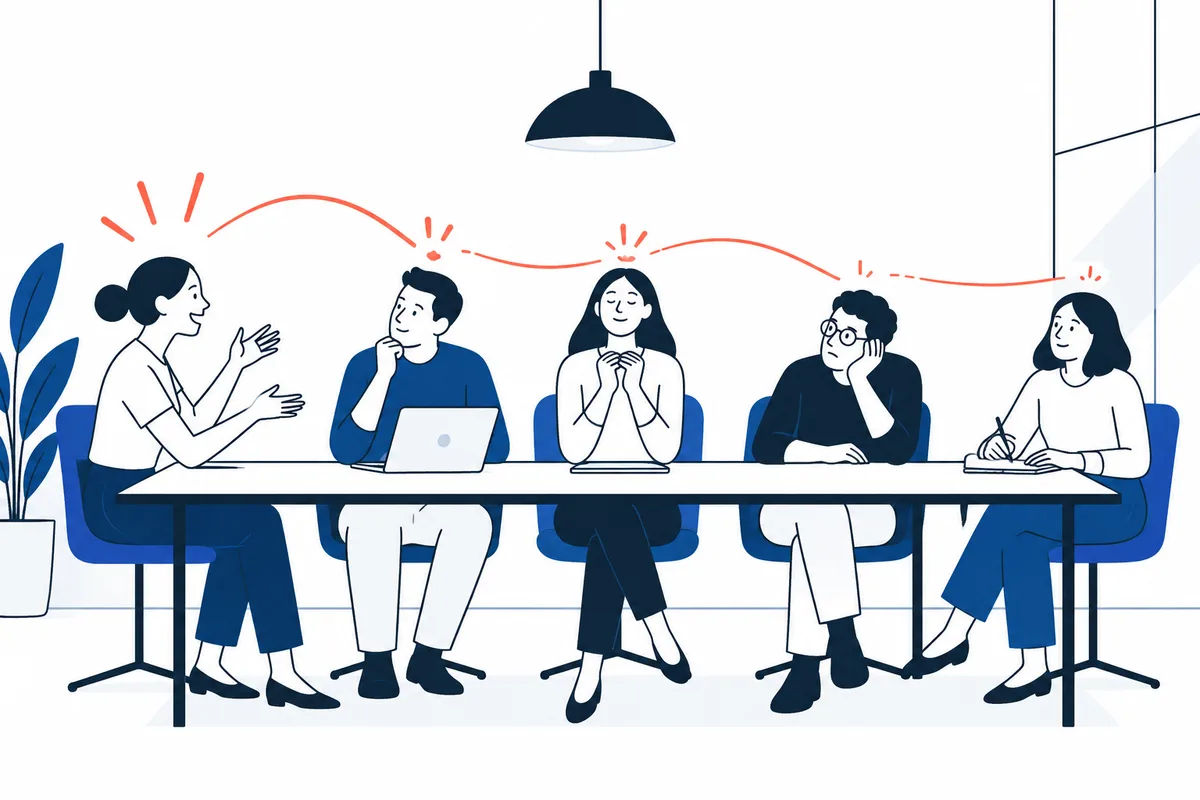
Yes. A coworker’s tone or expression can influence how others feel, while each person still judges an event through different stakes, information, and responsibilities. Similarity in a room may reflect emotional influence, a shared event, or the way discussion unfolds. Mood alone cannot establish that coworkers share an interpretation. Ask what consequence each person is responding to before treating a room’s tone as agreement.
Can emotions spread while interpretations differ?
Yes. A colleague’s tone can influence your feeling while an announcement carries different consequences for different people. Feeling influenced does not mean adopting the same judgment. If a manager says a product launch date has moved forward, a tense voice may make the room feel urgent. One coworker may worry about testing; another, client commitments. These are illustrative possibilities, not evidence about what anyone thinks. Emotion is the feeling someone experiences; appraisal is the meaning or consequence they assign to an event. They can shift together, but they are not identical.
A controlled group exercise in “Emotional Contagion in Groups” found that a confederate’s enacted mood influenced participants during a staged managerial discussion. A three-week diary study, “In Other Words: The Role of Social Influence in Emotion, Risk, and Decision Making,” found that another person’s perceived emotions related to participants’ anxiety and excitement during everyday decisions. These findings make social influence plausible; they do not show that coworkers reached the same conclusion about a deadline. Similar tone is a clue about shared affect, not proof of consensus or anyone’s private view. Before treating a mood shift as agreement, ask what consequence each person is responding to.
Sources: The Ripple Effect: Emotional Contagion and Its Influence on Group Behavior; In Other Words: The Role of Social Influence in Emotion, Risk, and Decision Making
What does a “shared mood” actually describe?
A “shared mood” can describe resemblance in coworkers’ feelings, a common response to an event, or a pattern across a group. These descriptions answer different questions. If several people seem tense after a deadline changes, that tells you what the room looks or sounds like. It does not tell you whether one person’s tension influenced the others, whether each reacted to the deadline, or whether they agree about what it means.
Here, affect means felt emotion or mood. An emotion is often tied to a moment, such as frustration at a decision; mood usually describes a more diffuse feeling. In a meeting, clipped replies might be read as irritation or general strain. Such observations are starting points, not direct access to anyone’s private state.
Researchers use “convergence” for similarity in members’ reported or observed affect. Emotional contagion is a more specific explanation: one person’s emotional expression or behavior influences another person’s feeling. Convergence describes a resemblance; contagion proposes how it arose. A group could show similar feelings after a shared event without feelings passing from one coworker to another. Both processes may occur together.
The review “Socially Shared Affect: Shared Affect, Affect Sharing, and Affective Processing in Groups” organizes sharedness around affective events, states, and appraisals. A group may share an event, show similarity in what members feel, or develop a common understanding of what it means. These levels can come apart: coworkers may receive the same announcement yet feel differently, or feel similarly while disagreeing about whether a change is fair. The review points to examining response distributions, since an average can hide differences within a group.
That matters when someone says, “The team was anxious.” The phrase can flatten a room where one person is worried, another energized, and a third has not formed a reaction. An average cannot tell you whose response fits, or whether anyone’s feeling changed during the meeting. “Dynamic Affect in Team Meetings,” a chapter in The Cambridge Handbook of Meeting Science, reviews convergence and divergence and argues for studying group affect as it unfolds. A snapshot can miss that movement.
Ask two questions: what similarity did people report or display, and what might have produced it? The first is a description; the second needs more evidence than a room’s tone. Keeping them apart leaves space for coworkers to respond differently to the same event, and prevents an apparent group mood from being mistaken for consensus about what should happen next.
Sources: Socially Shared Affect: Shared Affect, Affect Sharing, and Affective Processing in Groups; Dynamic Affect in Team Meetings
What the experiment establishes—and what it doesn’t
A controlled group exercise supports the claim that one person’s enacted mood can influence other people’s feelings. It does not show that everyone interpreted the underlying decision alike, or that the effect has the same strength in ordinary workplace meetings. In “The Ripple Effect: Emotional Contagion and Its Influence on Group Behavior,” Sigal G. Barsade studied 94 business-school undergraduates placed in 29 groups. Each group took part in a managerial decision exercise about allocating a bonus, with a trained confederate joining the discussion and enacting one of four mood conditions in a 2 × 2 design. The confederate followed the study’s instructions while appearing to be an ordinary group member, allowing the researcher to vary the emotional display. The study assessed participants’ moods through their own reports and through ratings by outside observers who coded the discussion. Both kinds of measure indicated that the enacted mood influenced group members’ moods. This pairs reported feeling with trained observers’ ratings of visible behavior. Neither reveals whether every participant privately attached the same meaning to the bonus decision. The paper also reports that positive emotional contagion was associated with greater cooperation, less conflict, and higher perceived task performance. “Perceived” matters: the reported performance outcome was an assessment of how well the group seemed to perform, not a demonstrated improvement in an objective business result. The result belongs to this exercise; it does not establish that a positive atmosphere improves every meeting or that tension worsens a decision. The experimental arrangement supports a causal conclusion within bounds. The researcher varied a confederate’s display and observed differences in participants’ reported and coded moods, giving stronger evidence of influence than simply finding that coworkers felt alike at one point in time. The participants were students in a staged discussion, not colleagues handling a live deadline or client relationship; a trained confederate’s display may also be more consistent than a coworker’s spontaneous reaction. The design therefore demonstrates that feelings can move socially in a group task; it cannot tell us how often that happens in workplaces or how large the effect would be there. That boundary matters when a real meeting turns tense. If several people grow quieter after a colleague objects, the pattern may fit social influence, but the experiment cannot tell an observer which person influenced whom, whether the silence reflects shared worry, or whether the group has reached agreement. The objection may have changed others’ feelings while leaving their judgments of the proposal different. Check those questions with participants and decision facts; facial expression and room tone cannot answer them. Barsade’s study is therefore a credible demonstration that emotional influence can occur during group discussion, with associated differences in cooperation, conflict, and perceived performance in the exercise. A person’s expressed mood can become part of a group’s emotional experience. Treating a tense meeting as proof of a shared interpretation goes beyond what the experiment measured. The next step is to ask what consequence each person sees, rather than assume the room’s mood has supplied the answer.
Sources: The Ripple Effect: Emotional Contagion and Its Influence on Group Behavior
How feeling changes without agreement about meaning
Another person's reaction can affect your feeling and serve as information about the event. Those routes can overlap without giving coworkers the same interpretation. In “Affecting Others: Social Appraisal and Emotion Contagion in Everyday Decision Making,” social appraisal means using another person's emotional response to infer what a situation may mean: a colleague's anxiety can suggest that a decision carries risk or importance. Affect transfer describes the feeling shifting in response to another person's emotion. One route involves reading significance; the other can occur without deliberately working out what the cue means.
The diary study followed 41 participants reporting decisions involving other people over three weeks. Their reported anxiety and excitement were related to the perceived anxiety and excitement of the person present. For anxiety, participants' appraisals of risk and importance partly accounted for the link. Yet the other person's reported emotion still predicted the participant's emotion after those appraisals were considered. The authors also report affect-transfer effects after controlling for participants' perceptions of the other's emotion and measured appraisals. That pattern supports two influences operating together: a reaction may alter how someone feels, and it may inform their judgment. The study examined everyday interpersonal decisions, not team meetings; it cannot tell us how much either route contributes when coworkers react to an announcement.
The same sharp comment can land in two ways. Imagine, as an illustration rather than a reported case, that a launch date moves forward. A coworker's clipped objection may make another person tense before they consider the details. The listener may also take the objection as evidence of risk, then judge that risk through their own responsibilities. Someone responsible for client commitments might focus on delivery; someone whose work is unaffected may feel little concern. The example does not establish what either person feels. It shows why a changed feeling and an inferred meaning should be checked separately.
The 2018 review “Emotional Contagion in Organizational Life” adds a counterpoint: research describes affective divergence, sometimes called counter-contagion, where observing one person's emotion elicits a different or opposing feeling in an observer. The review discusses findings from varied research, including reactions to disliked or out-group individuals, and notes that more direct organizational tests are needed. Divergent reactions are therefore a credible possibility, not a routine explanation for meeting disagreement. A frown or brisk objection does not reveal whether a coworker shares the speaker's alarm, reads it as a warning, or rejects its premise.
To distinguish influence from inference, ask about the consequence behind the reaction: “Which part of the revised date creates the greatest risk for your work?” Listen for the person's account before answering the objection. Their reply gives evidence about the concern they state; it does not prove that your unease came from their emotion or that everyone else agrees. A coworker's reaction can be useful information, but it is not a direct reading of their conclusion. Test the meaning in words.
Sources: In Other Words: The Role of Social Influence in Emotion, Risk, and Decision Making; Emotional Contagion in Organizational Life
How the meeting itself can shape a common emotional direction
Some convergence can come from coworkers tracking the same changing task or event together, even when no one person's feeling is the sole source of the shift. When a deadline moves, for example, several people may become more alert because the project has changed in front of them. That shared exposure can shape the room's emotional direction without making the event equally consequential to everyone. A useful distinction is between sharing an event, sharing a feeling, and sharing an appraisal: the judgment about what the event means. In “Socially Shared Affect: Shared Affect, Affect Sharing, and Affective Processing in Groups,” the 2023 review organizes group affect across these three dimensions. It discusses both affect convergence, where members' responses become similar, and affect sharing, including contagion. The review also points to the distribution of members' responses as important. A group average can therefore hide meaningful differences: some people may feel worried, others energized, and others little change. Similarity at one level does not establish similarity at the others. The distinction matters when people respond to a revised launch date. The date is common information, but its practical meaning depends on what each person must do next. A project owner might need to reset internal milestones; a colleague speaking with customers may have to renegotiate a commitment; an analyst may first need to check whether the revised schedule changes the data available for a decision. These are illustrative possibilities, not claims about what any particular coworker feels. They show how one event can focus attention across a team while leaving members with different concerns and evaluations. Meetings also unfold over time. “Dynamic Affect in Team Meetings,” a chapter in The Cambridge Handbook of Meeting Science, describes meetings as settings where members can motivate, energize, frustrate, or agitate one another. Its review covers convergence and divergence, contagion, emotional norms, and leadership, and argues that group affect needs a dynamic approach. A single snapshot of a quiet or tense room misses the sequence: what changed, when it changed, and what the group was discussing at that point. The chapter frames a research need; its abstract does not establish which mechanism caused any one meeting's emotional shift. The same caution applies to the common-event explanation. A new deadline might draw everyone's attention, but prior work, task outcomes, or an exchange during the meeting could also shape how people respond. More than one route may operate at once. Someone's worried expression might influence a colleague's feeling, while the deadline itself gives both people a reason to reassess the plan. Without what participants say about their own concerns, observers cannot tell from tone alone which route mattered most. Before attributing a shift to one person's emotion, check whether a shared event or task change could explain why several coworkers reacted around the same time. Then ask what consequence each person sees. “Which part of the revised date affects your work most?” invites an answer about the person's actual concern. Their replies can show whether the team shares an appraisal, even if the room's emotional tone has moved in one direction.
Sources: Socially Shared Affect: Shared Affect, Affect Sharing, and Affective Processing in Groups; Dynamic Affect in Team Meetings
Why coworkers remain different after the same announcement
The same announcement can land differently because sharing an event is not the same as sharing its meaning. When a launch date moves, everyone may hear the revised date and notice tension in the room. Yet one coworker may need to renegotiate a client commitment, another may be checking whether the new schedule changes their own workload, and a third may have no direct dependency. Those are possibilities to ask about, not conclusions to draw from who speaks quickly or stays quiet. A longitudinal study in a naturalistic team performance setting, reported in “Explaining Affective Linkages in Teams,” found that an individual member’s affect over time was related to the average affect of the other team members, even after the researchers controlled for team performance. The strength of that linkage also varied with measured susceptibility to emotional contagion and collectivistic tendencies: it was stronger among people scoring higher on those measures. The abstract available through PubMed does not report the sample size or enough methodological detail to judge how closely the setting resembles a particular meeting. It supports the possibility of affective linkage over time; it does not show that every member felt the same thing, or explain what each person thought the announcement meant. Those measured differences describe patterns in that study, not labels to assign to coworkers. A visible shift in one person's mood could coincide with a shift in others, while their appraisals remain distinct. Appraisal here means the significance a person gives an event, including what it may require of them. The review “Socially Shared Affect: Shared Affect, Affect Sharing, and Affective Processing in Groups” separates shared affective events, states, and appraisals. It also cautions, in effect, against letting a group-level summary hide the distribution of members’ responses. A team may share an event, show some resemblance in mood, and still differ over whether the change threatens delivery, creates a manageable adjustment, or needs more information. Similar affect does not establish a common judgment. In the launch-date discussion, keep the record concrete: the date changed; a coworker objected; another said little. “The objection concerns a client commitment” is an interpretation until that coworker confirms it. Silence gives even less evidence about agreement. A useful follow-up is, “Which consequence of the revised date matters most for your work?” Then listen for whether the concern is the decision itself, its implementation, or a missing fact. If the answers differ, the room has not reached one shared appraisal, even if its emotional tone briefly converged. Ask what matters to each person before treating the disagreement as resistance or assuming that a quiet response means assent. This check makes the next conversation about work consequences people can clarify, rather than a mood you have inferred for them.
Sources: Explaining Affective Linkages in Teams; Socially Shared Affect: Shared Affect, Affect Sharing, and Affective Processing in Groups
When does a meeting’s sequence move the room?
The order of a discussion can track a change in the room’s energy, but it cannot tell you by itself what each person feels or thinks about the issue. A workplace study titled “Verbal Interaction Sequences and Group Mood: Exploring the Role of Team Planning Communication” examined 52 work-group discussions in two German industrial enterprises. Researchers coded the discussions for recurring sequences, including cycles of complaining and exchanges expressing interest in change, then compared those patterns with group mood ratings. Complaining cycles were linked with a more passive group mood; interest-in-change cycles were correlated with a more active one. Neither sequence was correlated with the pleasure dimension. The finding makes interaction order worth noticing, while leaving the cause of any particular meeting’s mood unresolved. The study measured mood along two dimensions: arousal, or how activated the group appeared, and pleasure, or how pleasant the mood was rated. These dimensions can move independently. A discussion may become animated because coworkers are proposing changes, or because they are disputing a risk. Both exchanges can raise energy; that does not make them equally positive. Likewise, a quiet stretch may reflect concentration, fatigue, uncertainty, or reluctance to speak. Silence alone does not show that participants agree. The study’s distinction matters because “the room got more negative” can collapse two observations: whether people seem more activated and whether the tone seems more pleasant. The coded sequences also shift attention from a single expressive coworker to the discussion as it unfolds. Repeated complaints may be followed by more complaints; proposals to change a plan may draw further problem-solving talk. Such a pattern can coincide with a group-level mood without every member displaying or reporting the same feeling. Yet the study was observational: it recorded naturally occurring discussions and their associations rather than assigning a conversational sequence to test its effect. A shared deadline, a difficult task, or new information could shape both what people say and how the group is rated. The findings therefore do not establish that complaining caused passivity, that interest in change caused activation, or that one person transmitted a particular emotion to others. Consider a meeting where a revised launch date prompts several objections, followed by a rapid exchange of proposed adjustments. The visible pattern might be increasing activation. That observation does not settle whether coworkers are worried, engaged, irritated, or simply trying to understand the options. Nor does a livelier exchange mean that the group has reached a common view of the date. The discussion’s sequence tells you what kind of interaction is recurring; participants’ words and the work consequences are needed to understand what is at stake for them. In practice, notice whether the conversation is becoming more activated, quieter, or caught in repeated complaint. Then ask about the task concern rather than naming the group’s emotion: “Which part of the change creates the biggest problem for your work?” A specific answer gives the discussion something testable, such as a dependency, customer commitment, or missing decision. If answers differ, the room may share a response to the announcement while people still face different consequences. The workplace study offers a reason to watch interaction patterns, not a shortcut for reading consensus or assigning private feelings.
Sources: Verbal Interaction Sequences and Group Mood: Exploring the Role of Team Planning Communication; Dynamic Affect in Team Meetings
What can an EQ lens help you do in the moment?
An EQ lens is useful here as a way to manage your next response, not as a method for diagnosing the room. Start with what you can observe in yourself. Perhaps, after a colleague speaks sharply about a revised launch date, you notice that your own speech has become faster and your shoulders are tense. They are clues about your reaction, not proof of what the colleague feels or whether others agree.
Name your feeling privately in ordinary language: uneasy, irritated, worried, or something else that fits. Naming it gives you a moment to distinguish the event from the meaning you have attached to it. “The date moved” is the event. “The client will lose trust” is an interpretation that may be right, partly right, or not yet checked. The task is to avoid treating your first explanation as the only one.
That pause matters because another person's emotion can work in more than one way. In “Emotional Influences on Decision Making: Multiple Mechanisms at Multiple Times,” participants recorded decisions involving other people over three weeks. The 41-person diary study found that perceived emotion in the other person related to participants’ anxiety and excitement. Risk and importance appraisals partly accounted for the anxiety relationship, while the other person’s reported emotion remained an independent predictor after those appraisals were considered. Because the study concerned everyday interpersonal decisions rather than meetings, it cannot identify the process in a particular exchange. It supports a practical distinction: a cue may affect your feeling and inform your inference at once.
Turn the inference into a question about the work. In the launch-date illustration, you might ask, “Which part of the revised date creates the greatest risk for your work?” The answer may point to a client commitment, a dependency, or something you had not considered. It does not presume anger, team-wide alarm, or identical stakes. Listen to the answer before presenting a fix. Then reflect the concern in concrete terms: “So the issue is that the client review happens before the revised build is ready?” Invite correction if you have it wrong.
This sequence uses four practical emotional skills: noticing a feeling, considering what may have prompted it, regulating the urge to react immediately, and responding to another person’s stated concern. It is a practice derived from the evidence and the meeting problem, not a tested intervention. A careful question cannot identify whether a group mood came from contagion, a common event, or interaction patterns, and one exchange cannot guarantee repair. It does replace a guess about someone’s inner state with information they can confirm or correct.
If you want to reflect on your own habits beyond this meeting, the private 32-item Emotional Skills Profile is an educational reflection tool. Its questions cover recognition, understanding, regulation, and responding to others, drawing on recent behavior and emotional situations. The report keeps reflections about habits separate from judgments on authored scenarios; neither should be treated as a team reading or a standardized ability score. Explore the [Emotional Skills Profile](/assessment) as a prompt for choosing one behavior to practice, such as asking what consequence matters before answering.
Sources: Emotional Skills Profile; In Other Words: The Role of Social Influence in Emotion, Risk, and Decision Making
What should you ask before calling the room aligned?
Before calling the room aligned, check what changed, what consequence each person has named, and what decision remains open. Similar expressions or a quieter discussion show visible behavior; they cannot establish that coworkers assign the same meaning to an event. The review Socially Shared Affect, Shared Affect, and Affective treats shared events, states, and appraisals as distinct ways group affect can be shared, so keep those questions separate. Ask plainly: “What part of this change affects your work most?” Listen for the specific consequence rather than treating the first answer as the room’s answer. If someone names a different concern, reflect both points and identify what is known, what still needs a decision, and who should act next. This makes disagreement legible without assuming that a difference in tone signals resistance or silence signals agreement. Direct statements from the people involved, checked against task facts, give better grounds for judging shared interpretation than mood alone. If statements converge and the practical decision is settled, you have evidence of agreement on that matter; feelings may still differ. If stakes or facts remain unclear, leave the conclusion open and ask the next question. For personal reflection on how you notice and respond to emotions, the Emotional Skills Profile offers a private 32-item prompt at /assessment; it does not measure team alignment.
Sources: Socially Shared Affect: Shared Affect, Affect Sharing, and Affective Processing in Groups; Emotional Skills Profile
Questions readers ask
Can emotions spread through a team meeting?
Yes. Controlled group research supports the possibility that one person’s expressed mood can influence others’ feelings. Similarity in a meeting can also follow a shared event or the discussion itself, so mood alone does not identify the cause.
Can coworkers feel similarly but interpret an event differently?
Yes. Coworkers may share a feeling or respond to the same event while facing different responsibilities, information, and consequences. Ask what each person sees as at stake before assuming agreement.
What is the difference between emotional contagion and social appraisal?
Emotional contagion describes another person’s emotional expression or behavior influencing someone’s feeling. Social appraisal describes using another person’s reaction to infer what an event may mean. Both routes can operate together.
Can an EQ test tell whether a team’s emotions are spreading?
The Emotional Skills Profile is a private educational reflection tool about an individual’s recent behavior and emotional situations. It does not measure team contagion or alignment. For a meeting, ask coworkers directly about their stated concerns.
Sources
- The Ripple Effect: Emotional Contagion and Its Influence on Group Behavior
Supports the controlled group-exercise finding that a confederate’s enacted mood influenced participants’ moods, with reported associations to cooperation, conflict, and perceived task performance.
- In Other Words: The Role of Social Influence in Emotion, Risk, and Decision Making
Supports the three-week diary findings that perceived emotions of another person related to participants’ anxiety and excitement, with appraisals partly accounting for anxiety links.
- Emotional Contagion in Organizational Life
Supports the review’s discussion of affective divergence and counter-contagion, and its qualification that direct organizational tests are needed.
- Socially Shared Affect: Shared Affect, Affect Sharing, and Affective Processing in Groups
Supports distinguishing shared affective events, states, and appraisals, and examining members’ response distributions rather than assuming uniform group feeling.
- Dynamic Affect in Team Meetings
Supports treating meeting affect as dynamic and considering both convergence and divergence; the accessible chapter abstract frames scope rather than reporting effect estimates.
- Explaining Affective Linkages in Teams
Supports the abstract’s report of affective linkages over time in a naturalistic team-performance setting and variation associated with measured moderators.
- Verbal Interaction Sequences and Group Mood: Exploring the Role of Team Planning Communication
Supports the observational findings from 52 work-group discussions linking coded interaction sequences with group mood dimensions.
- Emotional Skills Profile
The assigned product description supports presenting the private 32-item profile as an educational reflection tool across recognition, understanding, regulation, and responding to others.
Apply it to the real situation
Turn an emotional reaction into one behavior to practice
From this guide: Notice whether you ask about a coworker’s stated concern before answering an inferred one.
A meeting’s mood cannot tell you whether coworkers share an interpretation. Your own habits are a separate question: how you notice a feeling, consider what prompted it, regulate your response, and hear another person’s concern. The private 32-item Emotional Skills Profile offers reflection on recent behavior and emotional situations, with practical prompts for choosing a behavior to practice. Use it to reflect on your own responses, not to measure a team.