
Yes. Performance-based describes how a test gathers responses; its scoring key still determines which answers receive credit. The MSCEIT 2 reports a revised, research-informed key and encouraging initial evidence, while questions about specific scores, populations, and uses still depend on evidence for that edition. Read a result as performance on sampled tasks under its scoring rule, then examine workplace behavior separately.
Can a performance-based EQ test still have scoring limitations?
Yes. A performance-based EQ test asks you to solve an emotion-related task, so the response comes from what you do with the task rather than only from what you say about your usual behavior. But the test still needs a rule for awarding credit. That key shapes what a higher score means: performance under particular prompts and scoring assumptions, not an automatic measure of how well you will handle every disagreement or feedback conversation at work. For personal development, read the result as a clue about the tested skill, then decide whether it points to a behavior worth examining in real exchanges. For example, a task may ask you to interpret an emotion in a described situation; succeeding on that task gives evidence about your response to that prompt. It does not show, by itself, whether you notice your own frustration early enough to pause before replying to a colleague. Those are related questions, but the test response and the observed workplace behavior are different sources of information. The useful question is therefore both what response the task elicited and what the scoring rule lets you infer from it.
Consensus scoring answers a reference-group question
A consensus key treats the answers given by a reference group as evidence for how responses should be scored. The result therefore depends partly on a comparison: how does a test-taker’s answer relate to answers in that group? In “Consensus scoring and empirical option weighting of performance-based Emotional Intelligence (EI) tests,” the scoring methods themselves are the subject of comparison. The title points to a basic but consequential choice: a performance item does not award credit on its own. A scoring rule translates the selected response into a score, and different rules can encode different ideas about what counts as a stronger answer.
The difference between two consensus rules is easiest to see when a question offers several choices. Under mode scoring, credit goes to the option most frequently selected by the norm group. A less common answer receives no credit even if many people in a smaller subgroup chose it. Under proportion scoring, each option receives credit in proportion to the share of the reference group that selected it. A response that was less frequent can therefore still earn some credit. Both rules use the group’s response pattern; they translate that pattern into points differently.
“Bias in consensus scoring, with examples from ability emotional intelligence tests” examines what can happen when the reference group includes subgroups with different modal responses. Suppose, for illustration, that two subgroups tend to choose different options for an item, and one subgroup is smaller. With mode scoring, the overall group’s most frequent option will generally reflect the larger subgroup. Members of the smaller subgroup can then lose credit for giving the answer that is most common within their own subgroup. As the size imbalance grows, that difference in credit can affect the comparison between groups’ mean scores. The study demonstrates this mechanism; it does not estimate bias in every consensus-scored test or quantify the size of an effect in a contemporary instrument.
Proportion scoring can reduce this particular smaller-group disadvantage because it gives credit to options according to how common they are, instead of treating only the single most common option as creditworthy. That is a meaningful difference in how the key uses the response distribution. It does not establish that proportion scoring removes every possible bias. “Bias in consensus scoring, with examples from ability emotional intelligence tests” also discusses extreme cases in which proportion scoring can remain biased, and its conclusion is that no known option eliminates bias altogether. The paper prefers proportion scoring while keeping that qualification in view.
For a reader interpreting a score, “stronger” under a consensus key has a specific meaning: the answer earned credit according to the reference group’s distribution and the rule applied to that distribution. It does not, by itself, mean the group has established one universally correct emotional response for all people and situations. An answer common in one reference sample may reflect that sample’s composition as well as a response the key treats as more creditworthy. The article comparing consensus and empirical option weighting reinforces the practical point that scoring is a design decision, with alternatives that embody different rules for assigning credit.
That matters when you use a performance score to decide what to work on. The score can show how your task responses compare under its stated key. To carry that result into everyday work, first understand what the reference-based scoring rule rewards; then treat the result as information about performance under that rule, rather than as a universal ranking of emotional judgment. The reference group is part of the interpretation because its answers help define the comparison the score reports.
Sources: Bias in consensus scoring, with examples from ability emotional intelligence tests; Consensus scoring and empirical option weighting of performance-based Emotional Intelligence (EI) tests
A key is a rule, not a neutral window
Why can researchers disagree about the “correct” response to an emotion problem? Because a task may present a situation in which more than one answer has a defensible rationale. A response can be common, fit a theory of emotion, or align with expert judgment; those are different grounds for awarding credit. The scoring key turns one ground into a rule. It does not make the underlying situation less open to judgment.
That distinction matters because agreement with a key and evidence for interpreting a score are separate questions. Agreement asks whether people or a scoring method converge on which response receives credit. Interpretation asks what a resulting score supports saying about the test-taker. A key can be applied consistently—two scorers, or repeated scoring procedures, can produce the same result—without that consistency establishing that the score represents a broad ability, predicts how someone will behave at work, or applies equally across groups. Reproducibility makes a result less dependent on ad hoc scoring; it does not by itself justify the meaning attached to that result.
The older study “Does Emotional Intelligence Meet Traditional Standards for an Intelligence? Some New Data and Conclusions” makes the issue concrete as historical evidence. Its analyses of the MEIS included 704 participants, and the authors reported equivocal evidence on traditional intelligence criteria, with results differing under expert and consensus scoring. The disagreement is informative: changing the basis for deciding which answers count as better can change the evidence obtained from the same broad testing program. It does not establish that a later MSCEIT edition has the same weakness, and it cannot settle whether emotional problem-solving is measurable.
A scoring rule can also be transparent without being self-justifying. A manual might state exactly how a response earns points, so another person can reproduce the calculation. That answers a procedural question: was the score calculated as specified? It leaves open the substantive question: why should those points represent the ability named in the report? The older MEIS comparison helps separate the two. Different scoring approaches can yield different results, so a reader needs to know not only that a score was computed consistently but why that method is relevant to the intended interpretation. This is the bridge between a key as a rule and a score as evidence.
The practical question is therefore not simply whether a key is objective. Ask what rationale the key uses, whether that rationale is defensible for the item, and what evidence connects the resulting score to the interpretation being made. For example, if a report treats a higher task score as evidence of emotion understanding, a reader should be able to distinguish support for scoring responses from support for that particular conclusion. Those claims need not rise or fall together.
Nor does the possibility of more than one defensible answer make performance measurement meaningless. Emotional situations can still contain patterns that trained judges or a broader group recognize, and structured scoring can make responses comparable under a stated rule. The older MEIS disagreement is a reason to inspect that rule and the evidence behind it, not a demonstration that every emotional task lacks a meaningful answer. The useful conclusion is narrower: a reliable scoring procedure can produce a stable number, while the claim that the number captures a particular emotional ability needs its own support.
Expert judgment can converge without ending the argument
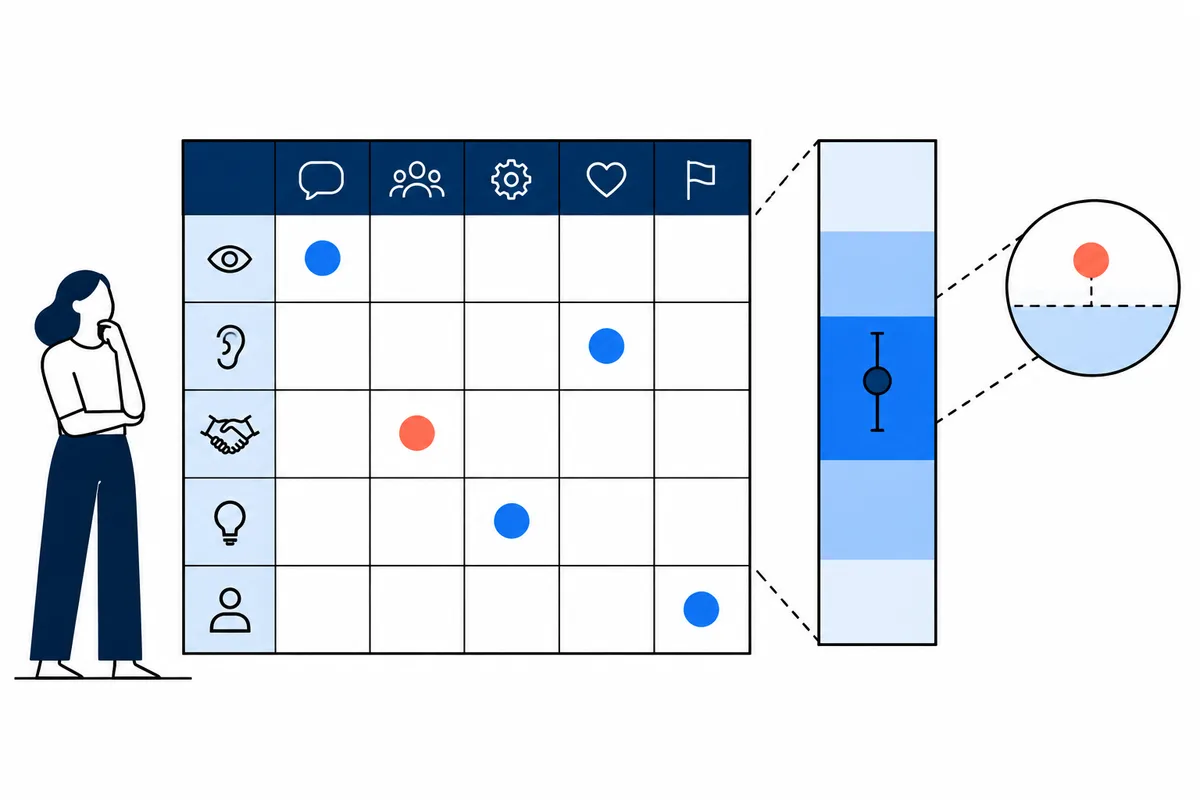
An expert key offers a different answer to the worry that emotional-task scoring is arbitrary. In “Measuring Emotional Intelligence With the MSCEIT V2.0,” the authors reported agreement between expert judgments and judgments from the test’s standardization sample. Here, expert scoring means using judgments by people treated as knowledgeable about emotional responses to identify or weight stronger answers. When those judgments converge with the sample’s pattern, the key has a rationale that is not merely one scorer’s private preference.
That agreement is meaningful evidence for the plausibility of the MSCEIT V2.0 key. It makes a simple dismissal—“the answers were just made up”—harder to sustain. The standardization sample and the experts provide different reference points, and their reported convergence suggests that the key’s choices were not wholly disconnected from how the broader sample judged the responses. For this edition, agreement supports the claim that the scoring rule had an articulated basis with some shared footing.
Convergence also has a useful limit as evidence: it concerns the agreement pattern observed in the development and standardization context described by that paper. It cannot answer every question a later user might bring to the score. A shared judgment among the relevant groups makes the chosen answer less idiosyncratic, yet the evidence would need to address other populations or outcomes before a reader could extend the same conclusion there. The point is not to demand that one finding answer unrelated questions; it is to name precisely what that finding contributes to the scoring argument.
But convergence answers a bounded question: did these two sources of judgment align for this instrument and its standardization sample? It does not, by itself, show that an agreed response is uniquely correct in every emotional situation. Nor does it establish that people from different language or cultural groups would receive equally fair scores, or that a score predicts how a person will handle an ordinary disagreement at work. Those are further interpretations requiring evidence fitted to those claims. Agreement is relevant to the key’s justification; it cannot stand in for every kind of validation.
This is why “expert key” should describe a method, not function as a quality label. Expert judgment can be informed and systematic, and its agreement with a broader sample is relevant evidence. Still, experts and sample respondents may share assumptions, and agreement alone does not test every consequence of using those assumptions. The article’s evidence supports convergence in this specific case; claims about fairness or prediction need measures designed to examine those outcomes.
For an individual reader, this changes how to describe the result. A score can represent performance under a key whose choices had support from both expert and sample judgments. That is a stronger account than treating the key as arbitrary, but it remains specific to the edition and evidence described in the MSCEIT V2.0 report. If the score is being used to reflect on a skill, the convergence can make the scoring rationale more credible; it still does not turn a task result into a direct forecast of behavior in a meeting.
The edition boundary matters. The finding belongs to MSCEIT V2.0 and its standardization sample; it should temper broad criticism of expert keys without being automatically transferred to a later test. A later edition can revise its theory, items, or scoring, so its own documentation and evidence must carry that case. The sensible reading is neither that expert agreement settles correctness nor that it tells us nothing: it supports the plausibility of this version’s scoring choices, while leaving subgroup fairness and workplace prediction as separate questions.
Sources: Measuring Emotional Intelligence With the MSCEIT V2.0
Item-level disagreement and score consistency are different problems
The 2009 paper “Consensus scoring, correct responses and reliability of the MSCEIT V2” examined a specific tension in two subscales: whether respondents converged on an answer and whether the resulting subscale scores held together reliably. Its sample included 206 people; 80.6% were women and most were university educated. The authors analyzed Changes and Blends, both of which used categorical response options. That scope matters. The paper is a close look at item responses and alternative scoring in part of one edition, not a survey of every MSCEIT score or a test-wide verdict.
At the item level, the authors found options for which participants did not clearly agree on a correct response. This complicates the easy inference that the option selected by the largest group must therefore be uniquely right. A response distribution can show which answer is more popular in a sample; where answers are dispersed, popularity alone leaves the status of less common options unsettled. The authors’ title poses that distinction directly: consensus about an option and reliability of a subscale are related scoring questions, but they are not the same finding. The analysis therefore qualifies a simple consensus-means-correct argument without proving that every item lacks a defensible answer. The distinction is practical because a consensus key converts the group’s pattern into credit, while the study’s question concerns what that pattern can warrant at the item level. If people split across plausible options, the modal response still exists mathematically, yet its status as the sole correct response is less secure than the existence of a plurality might suggest. A scoring rule can choose one option for calculation without resolving the underlying judgment. The study tested that issue in actual MSCEIT V2 responses rather than treating consensus as self-explanatory.
The paper also reports a different result at the subscale level. Using optimal scaling, the researchers changed how categorical responses contributed to the analysis and found reliability improvements for both Changes and Blends, with the improvement less pronounced for Changes. Reliability here concerns how consistently the subscale score behaves under the tested scoring and sample conditions. A score can show that kind of consistency even when some individual options do not command clear agreement as the correct answer. The two observations can coexist: the response pattern may leave some item-level judgments disputed, while a scoring transformation produces a more consistent overall subscale score. Optimal scaling is relevant here because it treats response categories according to their empirical relationships rather than presuming that the original categorical assignments capture all useful ordering information. In this paper, the reported reliability gains show that score consistency was sensitive to the way responses were represented and weighted. The benefit was not uniform across the two subscales: Blends improved more, while Changes improved less. That difference itself cautions against describing the method as a simple fix that uniformly strengthens every score.
That result does not make optimal scaling a replacement standard for the MSCEIT V2 key. The authors used consensus weights derived from their current sample rather than the standard American weights, and their analysis covered only Changes and Blends. Its contribution is narrower and useful: it shows why response-option consensus cannot stand in for every question about score consistency, and why score consistency cannot settle whether a particular answer is uniquely correct. When a performance score is interpreted, those claims need to be kept distinct; this study supplies a focused case, not a global reliability estimate. The authors’ sample composition also limits how far to carry the alternative weights: a predominantly university-educated, mostly female sample may produce a response distribution unlike another population’s. Since the alternative analysis used weights from these participants, its reliability result belongs to those scoring choices and conditions. It does not establish what reliability would result from applying the same weights elsewhere, nor whether an individual score should be interpreted using this reanalysis in place of the instrument’s documented scoring procedure.
Sources: Consensus scoring, correct responses and reliability of the MSCEIT V2

What changed in the MSCEIT 2—and what does its first evidence say?
The 2025 paper “Measuring emotional intelligence with the MSCEIT 2: theory, rationale, and initial findings” presents the MSCEIT 2 as a revised instrument built around an updated theory of emotional intelligence and a different scoring rationale. Its authors describe the central change as veridical scoring: developing a key with evidence intended to identify responses that correspond to emotion-related reality. Experts took part in developing that key. The rationale differs from awarding credit simply because an answer was frequent in a reference group, or because experts favor it; the authors’ aim is to ground the keyed response in how emotions work. That is the proposed basis of the method, not a general demonstration that one scoring philosophy wins for all emotion problems. In that account, ‘veridical’ names the intended relation between a keyed response and an emotion-relevant reality; it should not be mistaken for proof that every item has one context-free answer. The key-development study’s expert involvement is part of how the developers attempted to operationalize that relation. This gives the scoring method a substantive target beyond respondent popularity, while the empirical studies must still show how scores behave under the resulting key.
The paper reports five studies that move from item development toward initial score evidence. First, an item-viability study involved 43 participants. A separate expert-assisted key-development study involved 8. The pilot study included 523 participants, followed by a normative study with 3,000. A final study of 221 participants examined the relation between the older and newer tests. Together, these stages provide evidence from item work, expert participation, pilot administration, a large normative sample, and a comparison with the earlier instrument. They make the MSCEIT 2 a version-specific development program rather than a relabeling of the older MSCEIT V2 scoring debate. The sequence also separates development questions that can otherwise blur together. Item viability asks whether proposed tasks can function well enough to proceed; key development establishes how responses will be evaluated; the pilot and normative stages examine administration and score behavior at larger scales. The old/new relation study adds a comparison between editions, but a relationship between scores is not itself proof that the editions measure identical constructs or support interchangeable interpretations. Each stage contributes a different piece of the test’s development case.
The authors report that the MSCEIT 2’s subscale structure received factor support, that overall score reliability was good, and that reliability was acceptable for three of the four subscales. They also report adequate precision across most of the ability range represented by test-takers in their study. These findings address different parts of the score argument: the factor analysis concerns whether score groupings fit the proposed structure; reliability concerns consistency; and precision describes how informative scores are across ability levels. The results give the revised test an initial empirical case, rather than relying only on the rationale for its new key. Read together, these reported findings support a more precise claim than ‘the test is reliable.’ Total-score evidence and subscale evidence differ: acceptable reliability for three subscales leaves one outside that reported description, and adequate precision across most of the range leaves room for less precision elsewhere. Factor support concerns the proposed organization of scores, not whether a score predicts a particular real-world outcome. The paper thus offers several encouraging, distinct kinds of initial evidence, each attached to a particular property of the instrument.
The size of the normative sample is meaningful evidence about the instrument as developed, but it does not settle every question raised by older scoring studies. The five-study sequence was reported by the test’s developers, including an author affiliated with the publisher’s research and development group. The paper is therefore an initial, developer-led account; independent replication has not been established by these findings. Nor does evidence within this program alone establish equivalent score meaning across languages, equal precision at every ability level, prediction of workplace behavior, or validity for every possible use. Those would require evidence aimed at those particular interpretations. The normative sample strengthens the description of score behavior in the study’s own program, but sample size does not replace the need for independent evidence. In particular, the paper’s reported precision is not a claim that every person’s score is equally exact. A workplace reader considering an inference about collaboration would need research that connects the relevant score to that kind of interpretation; the study’s design, as summarized here, reports development and measurement findings rather than a demonstrated workplace outcome.
The appropriate update to the older debate is consequently specific. MSCEIT 2 has a revised model, a veridical-key rationale, and an initial program reporting structural and score-quality findings; it should not inherit every conclusion about MSCEIT V2 unchanged. At the same time, a new scoring rationale and promising initial results do not erase the question of what evidence supports a given response key or the interpretation attached to its scores. For a reader comparing the editions, the 2025 paper changes the evidence available for the newer version. It does not establish a universal winner between veridical, consensus, and expert-based scoring, or answer how a result will function beyond the populations and purposes studied.
Sources: Measuring emotional intelligence with the MSCEIT 2: theory, rationale, and initial findings
A score cannot travel farther than its evidence
The International Test Commission’s *The ITC Guidelines for Translating and Adapting Tests (Second edition)* gives a practical standard for deciding whether a score can support a new interpretation: check the adaptation and the intended use in the target context. A translated set of items may look faithful sentence by sentence while changing what a question asks people to notice, how a response sounds, or which answer seems plausible. The guidance therefore treats adaptation as a process requiring evidence, not a word substitution exercise. It does not report that a particular emotional-intelligence test or language edition has failed. It tells readers what must be established before carrying an interpretation across contexts.
Consider a hypothetical test item about recognizing what a colleague might feel after receiving blunt feedback. Suppose an edition is adapted for another language, and the phrase used for “blunt” carries a different everyday force there. This is an illustration of the question to investigate, not a claim about a real MSCEIT translation. Would respondents meet the same emotional situation? Would the keyed response reflect the same judgment, or could the revised wording make a different response more natural? Literal similarity cannot settle these questions. Evidence about the adapted items and their scores would be needed to see whether the change leaves the intended task intact.
A reader can make the check concrete by matching five things: the test edition, the language version, the particular score, the population being considered, and the interpretation or use proposed. If a paper studies one edition in one language with one group, it may inform a claim about that edition and group. It cannot automatically answer whether another edition, translation, or population supports the same score meaning. Nor does evidence that a score distinguishes responses in a test setting alone show that it describes how people handle a workplace exchange. That last step changes the interpretation from performance on sampled items to behavior in a different setting; evidence has to connect those settings if the broader claim is to be made.
Three terms help keep the questions separate. Reliability is about whether scores are consistent under specified conditions; validity evidence concerns whether evidence supports the interpretation being made from them; transfer asks whether that support carries to a different version, language, population, or use. A consistent score can still leave the interpretation question open. A study supporting one interpretation can be relevant without establishing another. These are related checks, but they answer different questions, so one positive result should not silently stand in for the others. The ITC guidelines are useful here as an adaptation standard: they direct attention to the target setting and the intended score use, rather than treating translation quality as sufficient evidence by itself.
For a workplace reader, the intended interpretation deserves particular attention. A performance test samples responses to its own emotion problems. If someone wants to use a score to reflect on collaboration, ask whether the available evidence concerns that score and the intended kind of conclusion, rather than assuming that a test’s general label settles the matter. Evidence can support a narrow use more strongly than a wider one. A result may describe how a person performed on the test’s tasks under its scoring rule; extending that result to recurring conduct in meetings asks for additional support. The distinction is not a reason to discard test evidence. It helps the reader phrase the conclusion at the level the evidence can carry.
The earlier discussion of MSCEIT 2 illustrates why exact edition matters: evidence reported for a revised edition should be read as evidence about that version and the studied conditions. The same discipline applies when language or population changes. A strong adaptation study matched to the question can justify a more confident conclusion; the general need for adaptation evidence should not erase what a particular study does establish. When the match is incomplete, keep the inference narrow and name what remains untested. For example, a reader might treat a score as a prompt to ask about a specific emotional judgment, while avoiding the stronger claim that it establishes a stable workplace pattern unless evidence supports that step.
When documentation is available, look for an account of how the adapted version was developed and evaluated, who was studied, which scores were examined, and what uses the evidence supports. The ITC’s guidance frames these as meaningful parts of adaptation and interpretation. If the documentation does not answer one of them, that gap limits the conclusion that can be drawn; it is not proof that the version is defective. Likewise, evidence that directly matches the edition, language, score, population, and intended interpretation gives the reader a firmer basis for applying the result. The practical judgment is to carry forward only the interpretation whose evidence matches the version and question in hand.
Sources: The ITC Guidelines for Translating and Adapting Tests (Second edition)
Use the result to choose a behavior to examine
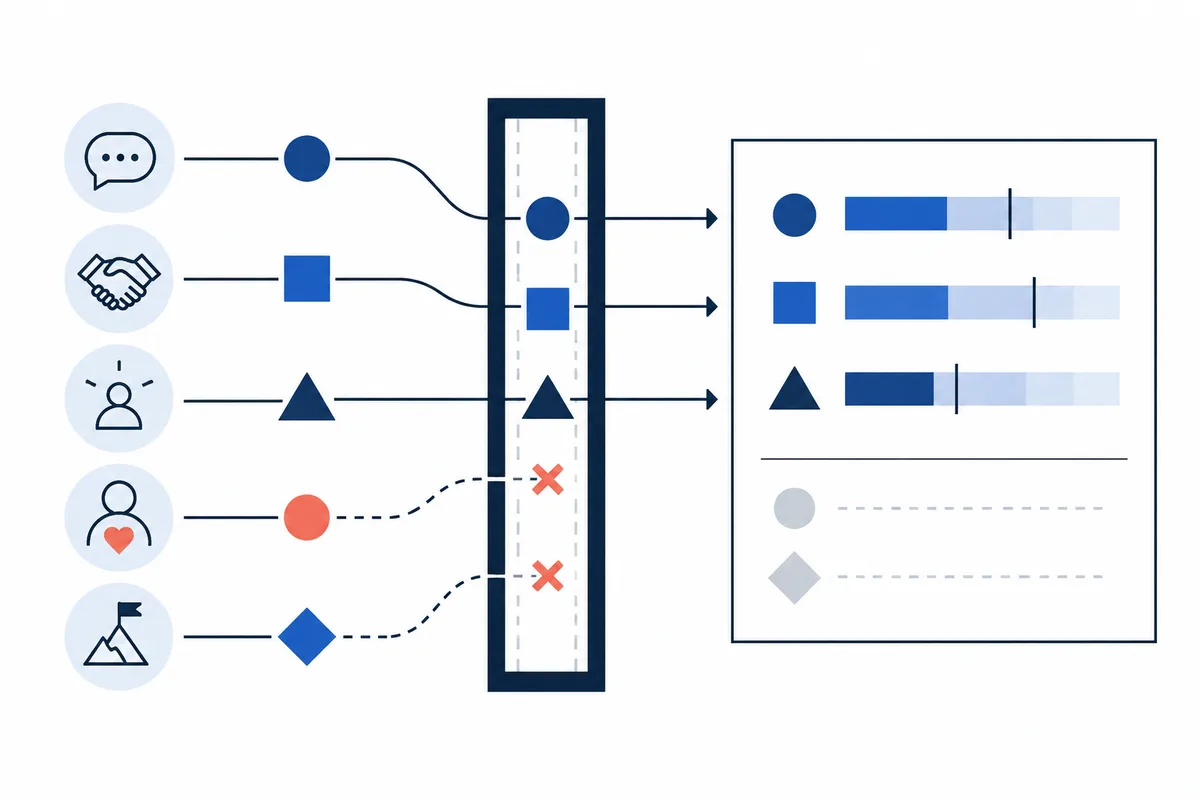
A proportionate next step is to treat a useful score as a question about one behavior, then observe that behavior in context. For example, after a tense project exchange, notice whether you asked a clarifying question before defending your view; that is an illustration, not a test finding. The score offers a sampled performance under its scoring basis; an actual conversation adds information about what you did in that setting. Keep the observation specific: what happened just before your response, what you noticed, and what you tried. If the same question keeps arising, compare notes across several exchanges before drawing a pattern. Choose one action to practice in the next similar conversation and reflect on what happened at work, without turning one exchange into a verdict about yourself or assuming the same response fits every situation. The private 32-item Emotional Skills Profile at [/assessment](/assessment) offers a separate self-report route for reflection on recent behavior and emotional situations; it is not a performance-based ability test. Explore the profile if that kind of reflection would help you choose what to examine in your own working life.
Sources: Emotional Skills Profile
Questions readers ask
What does consensus scoring show?
It scores responses by reference to a group’s answers. The result therefore depends partly on the scoring rule and reference sample; it does not by itself establish a universally correct answer.
Does the MSCEIT 2 resolve scoring concerns?
Its 2025 developer-authored paper reports a revised, veridical-scoring rationale and initial evidence, including score reliability findings. Those findings apply to the studied version and conditions; they do not settle every population or intended use.
Sources
- Bias in consensus scoring, with examples from ability emotional intelligence tests
Mode consensus scoring can disadvantage smaller subgroups whose modal answers differ; proportion consensus scoring avoids that specific size effect in many cases but can still be biased in extreme conditions.
- Consensus scoring and empirical option weighting of performance-based Emotional Intelligence (EI) tests
Compares variants of consensus scoring and empirical option weighting for performance EI tests; useful for explaining that different keys encode different rules and tradeoffs.
- Does Emotional Intelligence Meet Traditional Standards for an Intelligence? Some New Data and Conclusions
Reports MEIS analyses with 704 participants and equivocal evidence, including results that differed under expert and consensus scoring.
- Measuring Emotional Intelligence With the MSCEIT V2.0
Reports evidence about agreement between expert judgments and a standardization sample in MSCEIT V2.0 scoring, providing a counterpoint to claims that every key is arbitrary.
- Consensus scoring, correct responses and reliability of the MSCEIT V2
In 206 participants, analyses of MSCEIT V2 Changes and Blends responses found some options lacked clear agreement about the correct answer; optimal scaling improved reliability for both subscales, less so for Changes.
- Measuring emotional intelligence with the MSCEIT 2: theory, rationale, and initial findings
The developer-authored 2025 article reports five studies: item viability (N=43), expert-assisted veridical key development (N=8), pilot (N=523), normative study (N=3,000), and old/new test relation (N=221); it reports factor-supported subscales, good total-score reliability, acceptable reliability for three of four subscales, and adequate precision across most test-takers’ ability range.
- The ITC Guidelines for Translating and Adapting Tests (Second edition)
The International Test Commission guidance treats adaptation as more than literal translation and calls for evidence that the adapted test and scores support the intended interpretation and use in the target context.
- Emotional Skills Profile
EQ Test presents the current 32-item Emotional Skills Profile as a private educational self-reflection product; assigned publication context specifies recent-behavior and emotional-situation prompts, not standardized ability measurement or population norms.
Apply it to the real situation
Turn an EQ result into a focused reflection
From this guide: A performance score can prompt a question about a sampled emotion task; reflecting on recent behavior is a separate route to choosing a development priority.
If you want to reflect on your own recent emotional habits, the Emotional Skills Profile offers a private, 32-item educational self-reflection process. It is a self-report tool, distinct from the performance-based tests discussed here, and its results are prompts for reflection rather than population-normed or established ability scores. Explore the profile to identify a pattern you may want to examine and choose a practical next step.