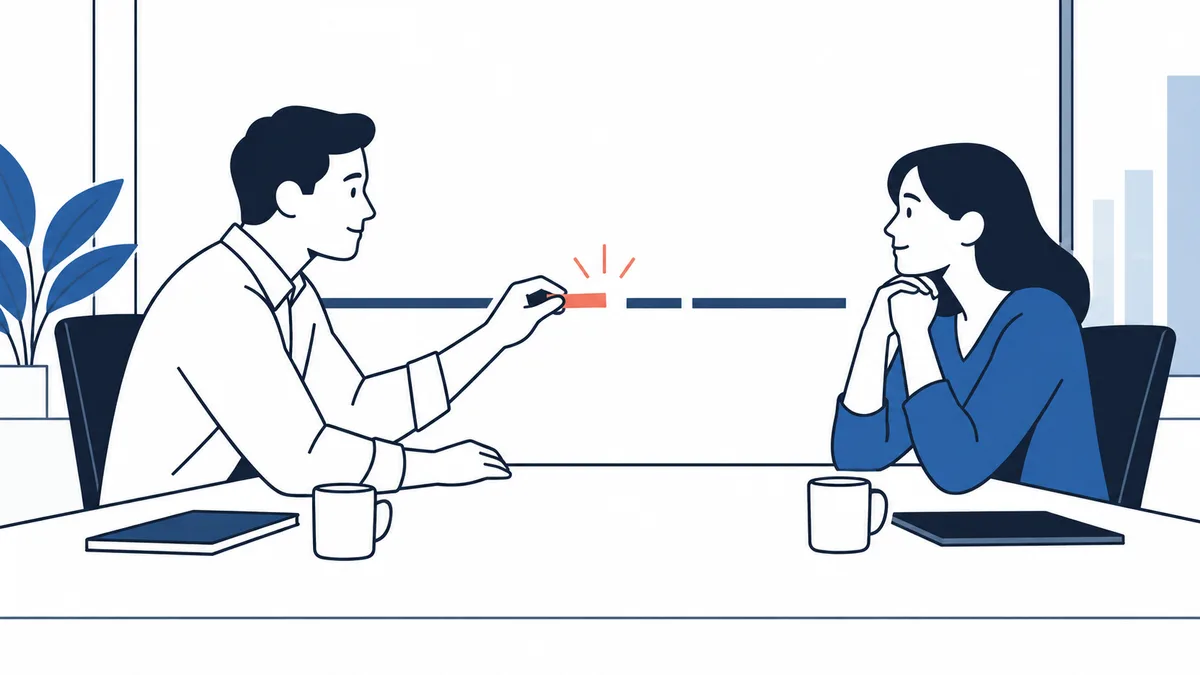
Apologize for the specific words or action, accept responsibility without using pressure as an excuse, acknowledge the work or relationship impact you can see, and offer a repair that fits it. A private conversation often suits a personal exchange; if you publicly undermined a colleague, a brief correction to the same group may also be needed. Research on apologies and trust repair supports taking responsibility and addressing the actual breach, but much of it uses scenarios, negotiations, or trust games rather than ordinary meetings. Your apology can begin repair; the colleague’s response and later trust remain theirs to decide. Follow through in the next disagreement.
The meeting ended, but the exchange may still be affecting the work
A sharp response can mean two different things to the person who said it. It may feel like one lapse in a crowded, pressured meeting. To the colleague who received it, it may make the next disagreement feel less safe, especially if other people heard it. You cannot know which meaning they have assigned to the moment simply by replaying it in your head. You can take responsibility for the behavior you know occurred and ask, without demanding an answer, what work impact needs attention.
A useful first step is small. Name the words or action you regret, then separate the delivery from the work issue underneath it. If you cut someone off and said, ‘That’s a ridiculous idea,’ you can apologize for the insult and interruption without pretending that you now agree with the proposal. The merits of the proposal can be discussed later, when each person can speak to it without the personal edge. This distinction lets the apology be honest rather than a bargain in which you trade away your view of the work for a quick return to comfort.
Trust is the expectation that another person will behave in ways that make cooperation possible, despite some uncertainty. In organizational research, a trust violation is conduct that gives someone a reason to question the other person’s reliability, care, or fair dealing. A meeting outburst may affect that expectation, but the effect depends on what was said, whether it is part of a pattern, the relationship, and the work at stake. The 2017 review ‘Trust Repair’ describes apologies as one short-term response among several, alongside longer-term changes and actions. It also emphasizes how much context and measurement complicate broad claims about repair. That review supports a practical starting point: treat the apology as one move in a relationship, not a switch that restores trust on command.
This guide addresses a case where you recognize that your own delivery crossed a line. It is not a way to settle a dispute over what happened or to turn harassment, discrimination, threats, or repeated conduct into a one-conversation problem. When responsibility for the outburst is clear, a direct apology is usually more useful than waiting for the colleague to raise it. When the account is disputed, own the part you accept and address the disagreement through an appropriate process. Those paths differ because the first requires accountability for known conduct, while the second should not use an apology to confess to facts you do not believe are true.
The answer is not a perfect sentence. It is a sequence: describe your conduct precisely, acknowledge its likely impact, offer a practical repair if there is one, and show through later interactions that the behavior has changed. The colleague may accept the apology, decline to discuss it, or need time. Their reaction is not a score of whether you performed the words correctly. It is information about their experience, which you can hear without trying to control the conclusion.
A colleague’s quietness after the meeting could mean many things, including that they are busy, uncomfortable, or still deciding what to say. Avoid turning that silence into a diagnosis of the relationship. You do not need certainty about their private reaction to make the first step. Start with the observable event and leave space for the part you cannot know.
Sources: Trust Repair; After a Fight with a Coworker, Be Proactive About Apologizing
What exactly needs repairing: the remark, its impact, or a pattern?
Before you choose a channel or wording, separate three things: what you did, what it may have affected, and whether it has happened before. These are not interchangeable. A clipped reply that interrupted a discussion is still yours to own. A public insult about a colleague’s competence may also have affected how the room sees their contribution. A repeated pattern asks for more than another apology because the colleague has already received evidence that the behavior can recur.
Describe the act in language a camera or meeting transcript could plausibly capture: ‘I interrupted you and called the proposal ridiculous,’ rather than ‘I was a little intense.’ The second description shifts attention toward your temperament and softens the action. It also leaves the colleague to decide whether the behavior counts as hurtful. Specificity does not require dramatic language. It means naming the observable part without renaming it as a mood, a misunderstanding, or a shared event.
Then keep the delivery separate from the underlying disagreement. Perhaps the schedule really was unrealistic, or the proposal left out an important constraint. That may still be true after an apology. You can say, ‘I still think we need to revisit the delivery date, but I should not have cut you off or called your proposal ridiculous.’ This does not dilute the apology; it narrows responsibility to the part you actually own. A later work conversation can examine the deadline with the evidence on the table and without asking the colleague to accept your tone as the price of hearing your concern.
The distinction matters because trust research does not treat every violation as the same. ‘Removing the Shadow of Suspicion,’ a pair of experiments reported in the Journal of Applied Psychology, compared responses to alleged competence-related and integrity-related breaches. The authors found that responses depended on violation type and on later evidence: apologies worked more successfully in the competence condition, while denying culpability could be more effective for an integrity allegation or when evidence supported innocence. This is not a recipe for workplace arguments. It is a warning against using apology as a substitute for determining what actually happened. If you plainly snapped, own that conduct. If you are accused of something you did not do, do not make a false admission just to make tension stop.
The experiments studied perceived trust violations in controlled settings, not the everyday combination of a tense agenda, hierarchy, history, and shared work. They help explain why responsibility must match the evidence, but they do not tell you whether your colleague feels safe or what exact repair will work. The review ‘Trust Repair’ likewise describes attribution—how people explain the cause of the breach—as a central part of repair research. A colleague may read a sharp remark as a one-off lapse or as evidence of how you handle challenge. You can clarify your intention, but intention does not erase the behavior or dictate their reading.
Impact is the next question. Did the outburst stop the colleague from finishing? Did it leave an unfair impression of their proposal? Did the meeting move on without recording their information? Did the exchange delay a decision or make a handoff harder? These are questions about work, not invitations to guess private feelings. If you do not know the impact, ask gently: ‘I interrupted and spoke sharply in the meeting. I’m sorry. Is there anything about the discussion or follow-up that I should correct?’ The question offers room to respond and does not require the colleague to disclose more than they want.
Finally, consider whether this is isolated or familiar. Repeated snapping can make a promise such as ‘It won’t happen again’ less credible, even when you mean it. A better response names a behavior you can practice and, if needed, a support or process that can help interrupt the pattern. Where there is a power imbalance, a complaint, or a serious impact, the colleague should not be made responsible for coaching you through change. Follow workplace policy and seek appropriate support. A private apology may be part of accountability, but it cannot replace whatever formal response the situation requires.
This scope check keeps the apology proportionate. It prevents the speaker from calling a public slight ‘just stress,’ but it also prevents a legitimate disagreement from being rewritten as wrongdoing. The goal is not to score the harm on an invented scale. It is to describe the event accurately enough that the words and the repair address the same thing.
Sources: Removing the Shadow of Suspicion: The Effects of Apology Versus Denial for Repairing Competence- versus Integrity-Based Trust Violations; Trust Repair
What should you say when you apologize?
A useful apology says what you did, takes responsibility, recognizes the impact you can identify, and offers an appropriate next action. Keep it shorter than the explanation you may feel tempted to give. The colleague should not have to listen through a defense of your intentions before they hear that you understand your own behavior was wrong.
The research study ‘An Exploration of the Structure of Effective Apologies’ examined six components: expression of regret, explanation, acknowledgment of responsibility, a statement of repentance or commitment not to repeat the act, an offer of repair, and a request for forgiveness. Across two studies, participants judged apologies with more components as more effective than those with fewer, and some components mattered more than others. The study also found that apologies after competence-related violations were judged more effective than apologies after integrity-related violations. Its authors tested component definitions and a trust-violation scenario; they did not follow coworkers through real meeting repair. The findings are therefore useful for identifying ingredients, not for requiring a six-part speech.
For a known sharp remark, responsibility and a repair offer are more relevant than a long account of why you were under pressure. A compact version might be: ‘I interrupted you and called your idea ridiculous. I’m sorry. I was frustrated about the timing, but that does not excuse how I spoke. I cut off your chance to explain the proposal. If it would help, I’ll make sure the group hears the point I dismissed, and I’ll raise the schedule concern separately.’ The specific language will depend on what actually happened. The structure is what matters: behavior, accountability, impact, and a feasible action.
Avoid conditional apologies such as ‘I’m sorry if you felt disrespected.’ The condition makes the other person’s reaction the problem to be examined, rather than your choice of words. ‘I’m sorry I spoke to you that way’ identifies your part. Likewise, ‘I’m sorry, but I was exhausted’ moves quickly from ownership to mitigation. Fatigue or deadline pressure can be relevant later if you are discussing how to prevent recurrence; in the apology itself, it can sound like a request to reduce your responsibility.
An explanation is not forbidden. It simply needs the right job and place. If the colleague asks what was happening, you can describe the pressure without treating it as a defense: ‘I was worried about the deadline and reacted badly. I should have asked for the timing assumptions instead of snapping.’ That account may help explain the trigger and support a better next response. It does not establish that the colleague caused your outburst or that the impact should be dismissed. The apology study included explanation among its components, but its result does not mean every explanation helps in every case.
A promise should be small enough to keep and specific enough to notice. ‘I’ll never be frustrated again’ is impossible. ‘When I disagree, I’ll let you finish and ask about the schedule before I respond’ describes a behavior you can attempt. If the same cue has led to several outbursts, a promise alone is thin. You might set a meeting practice, ask a trusted colleague to flag interruptions, or seek appropriate coaching or workplace support. The action should address the pattern you can observe, rather than claiming to change your personality overnight.
Do not ask for a verdict at the end. ‘Can you forgive me?’ or ‘Are we okay?’ can make the colleague responsible for comforting you while they are still processing the exchange. In the six-component experiment, request for forgiveness was one research category, not a requirement for a good apology in every relationship. At work, leaving the question open is often more respectful: ‘You don’t need to respond now. I wanted to acknowledge it, and I’ll correct the point I cut off.’ Then stop speaking and let the colleague choose whether to answer.
The comparison between vague regret and specific ownership is not a contest in eloquence. ‘Sorry about earlier’ may be sincere, but the colleague has to infer what you understand. A brief naming of the behavior removes that burden. Adding every component in a rehearsed sequence can also feel performative. The evidence supports the idea that content matters in judgments of apology effectiveness; it does not prove that length or completeness will overcome a serious breach. Use the minimum words that clearly own the event and support a proportionate repair.
Sources: An Exploration of the Structure of Effective Apologies; Removing the Shadow of Suspicion: The Effects of Apology Versus Denial for Repairing Competence- versus Integrity-Based Trust Violations
When should you apologize privately, and when does the room matter?
A private conversation usually fits a personal exchange because it gives the colleague space to respond without an audience. Ask for a brief conversation rather than cornering them between meetings. If they decline or seem unable to talk, send a short message acknowledging the behavior and leave the door open. The point is to make contact respectfully, not to secure an immediate response.
A public remark can create a public consequence. If you interrupted a colleague and dismissed their contribution in front of the group, a private apology may repair the relationship but leave the inaccurate impression intact. In that case, ask the colleague what would help before making a correction to the group. A brief statement such as ‘I dismissed that point too quickly in the meeting. The schedule risk you raised still needs review’ can restore the contribution without forcing the colleague to stand beside you during a public apology.
The Harvard Business Review tip ‘After a Fight with a Coworker, Be Proactive About Apologizing’ recommends a one-on-one conversation, a specific acknowledgment, and a discussion of how to keep the situation from recurring. Its example describes a meeting where someone’s contribution may not have been credited and suggests discussing how contributions can be acknowledged publicly. This is practical editorial advice, not a controlled study. It supports the distinction between a private relationship conversation and a work correction that may need the same audience as the original slight.
A public apology is not automatically more accountable. It can expose the colleague to unwanted attention, ask them to reassure you in front of others, or turn the repair into a performance. If you outrank the colleague, even a well-meant invitation to talk may feel difficult to refuse. Give a genuine option: ‘I want to apologize for what I said. Would you prefer a quick conversation, a note, or some space?’ Do not make the recipient decide your process or take on the work of guiding your behavior. If the incident falls under a formal policy, use that route rather than relying on a private exchange alone.
The competence/integrity experiments matter here in a narrower way. They show that an apology is not a universal answer to every allegation; the fit depends on what happened and what evidence supports it. A clearly admitted sharp delivery is different from a disputed claim that someone lied or acted unfairly. Apologize for the part you know you did. Do not use public self-accusation to settle a complex work dispute that needs fact-finding.
There may be two audiences: the person you addressed and the people who witnessed the exchange. Consider each separately. The colleague may want no public attention, while the group may need a correction so a proposal is judged on its merits. You can make the correction about the work without narrating the colleague’s feelings: ‘I cut off the discussion before we heard the operational concern. Let’s return to that point.’ This preserves their contribution and avoids asking them to confirm that the relationship is repaired.
Timing matters, but there is no evidence-based countdown for an ordinary meeting apology. If both people are visibly angry, a short pause may help the conversation stay focused. The HBR guidance similarly suggests waiting a day or two when emotions are running high. That is a practical suggestion, not a finding that a specific delay produces better repair. A pause should not become avoidance. A short note can say you recognize the incident and will follow up when the colleague has room.
The channel decision can be expressed as a simple test: who needs to hear what in order for the actual harm to be corrected? A one-to-one apology can acknowledge the personal impact. A group correction can restore information or standing that was damaged in public. Use both only when both serve a real purpose, and consult the colleague where their preference matters. Do not repeat the exchange in front of everyone just to show that you are sorry.
Sources: An Exploration of the Structure of Effective Apologies; Removing the Shadow of Suspicion: The Effects of Apology Versus Denial for Repairing Competence- versus Integrity-Based Trust Violations; After a Fight with a Coworker, Be Proactive About Apologizing
What repair is proportionate to the harm?
An apology is more useful when the proposed action addresses a consequence you can name. If your interruption kept the colleague from presenting a concern, make space for that concern to be heard. If you dismissed their recommendation as foolish and the group moved on, correct the impression that the recommendation had been answered when it had not. If the meeting simply became tense and no work was derailed, a direct acknowledgment and a change in how you respond next time may be enough.
The three-study article ‘Repairing Violations of Trustworthiness in Negotiation’ compared verbal accounts or apologies with deeds, separately and in combination, in a negotiation context. The abstract reports stronger repair effects for deeds than words and says the combined effect was largely accounted for by deeds. It also reports that addressing the past violation was more effective than focusing only on future behavior in those studies. These are findings about perceived trustworthiness in simulated international negotiations, not a direct test of colleagues after a tense meeting. The practical inference is modest: where your conduct caused a concrete work cost, act on that cost rather than relying on a promise about the future.
A repair might be returning the floor, updating a meeting note, restoring a missing credit, reopening a decision that moved forward without relevant information, or taking ownership of a follow-up task you blocked. It should be feasible and connected to the event. ‘I’ll send the corrected notes today and make clear that your concern still needs a decision’ is more useful than offering lunch if the problem was that the group never heard the concern. A gesture unrelated to the impact can seem like an attempt to buy a return to normal.
Sometimes you do not know what repair the colleague wants. Ask once, without turning the question into homework: ‘I can correct the point with the group if that would help. Is there something else about the work I should address?’ If they name a reasonable correction, do it. If they do not want to discuss it, you can still complete any obvious work repair and adjust your own conduct. Avoid repeated requests for suggestions; the colleague should not have to design a behavior plan for you.
Proportion does not mean minimizing. A public insult about a colleague’s competence may deserve an explicit correction to the audience, not merely a private statement that you were stressed. Conversely, an isolated sharp phrase may not call for a formal announcement or elaborate symbolic gesture. Overcorrection can put pressure on the recipient to reassure you that the apology was enough. The measure is whether the action addresses the practical or relational effect without creating another burden.
The negotiation studies also caution against promising only a future change while leaving the past untouched. If the colleague’s work was undermined in the meeting, ‘I’ll be more careful next time’ does not restore what the room failed to hear. Address the known consequence first, then make a realistic commitment for future interactions. The order is not a universal formula; it follows the issue. If there was no concrete work consequence, a future behavior may be the most relevant action.
Do not offer compensation where none is appropriate. A colleague’s trust is not a debt you can pay off with a favor, and a repaired document does not purchase forgiveness. The work action shows that you understand what your behavior disrupted. The colleague remains free to decide how they feel about the relationship. That separation helps keep the repair sincere: you take action because the work or person was affected, not because you expect a particular response in exchange.
The practical comparison is between a sentence that says ‘I will do better’ and an action that makes the affected work whole where possible. Use both when both are needed. Keep the action proportionate, name the follow-through, and complete it without seeking applause. A quiet correction that restores a colleague’s point to the discussion may carry more meaning than a grand apology that leaves the work consequence in place.
Sources: Trust Repair; Repairing Violations of Trustworthiness in Negotiation
Why does the apology start repair rather than finish it?
Trust develops through what people observe across interactions. An apology can signal that you understand a line was crossed, but the colleague has reason to notice whether your next disagreement follows the same pattern. The next meeting is not a test you need to stage. It is an opportunity to make your stated intention visible in ordinary work: let the person finish, ask about the concern, and disagree with the idea without attacking its author.
The review ‘Trust Repair’ separates short-term responses such as apologies and compensation from longer-term strategies that change the relationship or its structure. It also treats forgiveness as one possible response, not something the person who caused harm can deliver on the other person’s behalf. This helps explain why an apology may be accepted without the relationship immediately feeling the same, and why a colleague’s continued reserve is not proof that the apology was worthless. The review is broad and does not establish a personal timetable. It argues that trust repair is sensitive to context and to how the breach is understood.
A controlled trust-game experiment offers one example of a short-term effect. In ‘Apologies Repair Trust via Perceived Trustworthiness and Negative Emotions,’ 221 Chinese undergraduate students played a two-round token trust game. Participants experienced no violation, a violation, or a violation followed by an apology. Those receiving an apology were more likely to trust their counterpart than those who received no apology after the violation; the authors reported that perceived trustworthiness mediated this relationship. Their analyses also examined negative emotion, which moderated an indirect pathway. This is evidence that an apology can affect trust-related judgments in that task, not proof that a coworker will respond the same way.
The experiment used an anonymous counterpart and tokens in a structured game, not colleagues with shared deadlines, histories, reputations, and authority differences. Participants’ trust decisions came before some retrospective measures, which the authors note limits causal interpretation of the emotional pathway. A token investment is also not the same outcome as speaking openly in a meeting or collaborating on a difficult project. The result supports a plausible mechanism—an apology may change how trustworthy the other person seems—but it cannot establish whether your colleague has forgiven you or predict when they will feel comfortable again.
This boundary matters because people often treat an apology as a request for a visible signal: a smile, a quick ‘it’s fine,’ or an immediate return to familiar conversation. Those reactions may not arrive. The colleague can accept your accountability and still want time. They can continue the work professionally while privately deciding what the incident means. You do not need to monitor their tone or ask others to interpret it. Continue to be reliable and respectful in the shared work.
Follow-through should be observable, not theatrical. If you said you would correct the meeting record, do it. If you promised to let the colleague finish, practice that in the next discussion. If you are still frustrated with the proposal, write down the work concern before the meeting and ask a question that surfaces the evidence: ‘What assumption gives us this delivery date?’ That gives the disagreement somewhere useful to go without personalizing it.
A single lapse and a repeated pattern differ in what follow-through requires. One incident may call for a direct apology and a specific change. A pattern requires more sustained effort because the colleague has seen the behavior recur. Do not promise certainty you cannot guarantee. Identify an early cue you can monitor, choose a response that interrupts the pattern, and seek support if the behavior continues. Accountability is not a claim that you will never feel anger; it is responsibility for what you do with it.
There is also a limit to what you can control. You can choose the words, correct a work consequence, and behave differently in subsequent conversations. You cannot make the other person restore trust on your schedule. This limit is not an excuse to give up on repair; it keeps your effort aimed at evidence you can provide. The colleague’s response remains theirs.
Sources: Trust Repair; Apologies Repair Trust via Perceived Trustworthiness and Negative Emotions

How should you respond if your colleague is still upset?
Listen first. If the colleague says the remark affected them differently than you expected, do not argue with the feeling or rush to explain your intention. You can acknowledge what you now understand: ‘I see that calling the proposal ridiculous made it harder to raise the concern. I’m sorry.’ If a work detail is disputed, separate that discussion and return to it when both of you can look at the facts.
A colleague’s upset response does not automatically tell you why they feel that way, whether the incident has damaged trust permanently, or what they will need next. Ask about the practical work only if that question is relevant: ‘Is there a follow-up I should correct?’ If they do not want to talk, accept the answer and keep your work communication clear. Repeatedly asking whether they are okay can put them in the position of reassuring you.
The trust-game study found an apology effect in its controlled task, but the authors’ results also indicate that negative emotion shaped the relationship between apology, perceived trustworthiness, and trust behavior. That result should not be turned into a label for the colleague. It does not mean that stronger emotion is irrational or that the recipient is blocking repair. The study involved undergraduates and an economic game; in a workplace, an upset reaction may reflect the immediate remark, its public setting, prior experiences, or other facts you do not know.
You can acknowledge impact without agreeing to every claim about the work. Suppose the colleague says your remark made the whole project impossible. You might answer, ‘I understand that my response shut down the conversation, and I’m sorry for that. I’d like to review the project risk separately so we can decide what needs to change.’ This keeps accountability intact while preserving the distinction between a harmful delivery and a substantive assessment. Do not use the distinction to dodge a real effect; use it to keep both issues discussable.
If the colleague declines a conversation, send one concise note rather than pursuing them. State the behavior, apologize, and mention any repair you will complete. Then let them choose whether to reply. A message should not contain a long chronology designed to prove you had reasons. It should not ask the recipient to confirm that everything is fine. The purpose is to take responsibility, not to extract emotional closure.
Power changes the stakes. A manager who snapped at a direct report cannot assume an invitation to talk is freely accepted. The employee may worry that rejecting the conversation will affect work or evaluation. Make space for another channel, respect formal complaint procedures, and avoid retaliating or treating a lack of immediate warmth as defiance. If the incident involved discriminatory language, a threat, or repeated behavior, consult the relevant policy or organizational support. A personal apology does not replace those responsibilities.
If the colleague identifies a concrete harm, respond to that harm instead of defending your character. ‘I didn’t mean to undermine you’ may be true, but it does not correct a meeting record that left their contribution out. You can say, ‘I didn’t intend that effect, but I see what happened. I’ll correct the notes and make sure your point is included.’ Intention can matter to a later conversation; it should not crowd out the repair that is available now.
There may be no satisfying resolution in the first conversation. The colleague may accept your apology but set a boundary, ask to keep communication in writing, or continue to disagree with you. Respect those choices while meeting your work obligations. Trust is not a performance review you can appeal by listing the right phrases. Keep the commitment you made and let the future interaction carry the evidence.
Sources: Apologies Repair Trust via Perceived Trustworthiness and Negative Emotions; Trust Repair
What does an EQ test measure in a moment like this?
An emotional-intelligence test does not measure one universal ‘EQ’ that answers whether you handled a particular meeting well. Ability-based tests use performance tasks involving emotion-related problems. Self-report measures ask people to describe their typical behavior or perceived skill. Mixed measures combine emotional competencies with other self-perceptions. The distinction matters because a score from one approach is not interchangeable with another, and none can establish what a colleague thinks about your apology.
The MSCEIT is an example of an ability-based measure. In the 2003 paper ‘Measuring Emotional Intelligence with the MSCEIT V2.0,’ researchers compared answers from 21 emotion experts with answers from a 2,112-person standardization sample and examined reliability and factor structure. The abstract reports that experts and sample members agreed on many answers, agreement was especially strong on questions with clearer research answers, the test achieved reasonable reliability, and confirmatory factor analyses supported theoretical models. Those findings concern the MSCEIT V2.0 and its test tasks. They do not validate a self-report reflection profile or show that a person who scores well will apologize effectively.
A meta-analysis called ‘Why Does Self-Reported Emotional Intelligence Predict Job Performance?’ shows another reason to read broad score claims carefully. The authors examined mixed EI measures and reported substantial content overlap with ability EI, self-efficacy, self-rated performance, several personality dimensions, and general mental ability, with a multiple correlation of .79 among these constructs. Their updated meta-analytic correlation between mixed EI and supervisor-rated job performance was .29; after the listed covariates were controlled, the relationship was near zero, with beta = −.02. This evidence concerns broad performance associations across studies, not apology behavior. It does not establish that self-reflection is useless; it shows why the measure’s contents and comparison variables affect what a result can mean.
The current EQ Test Emotional Skills Profile has 32 questions about recent behavior and emotional situations. It is an educational reflection tool that can help a person notice a possible habit or choose a development priority. Its report keeps recent-behavior summaries and judgments on authored scenarios separate. The profile has no validated population norms and is not an established ability test. It should not be described as a standardized ranking or used to predict trust repair, diagnose a problem, or judge a colleague’s fitness for work.
For this incident, an assessment can be a prompt, not a verdict. If reflection brings your attention to a habit such as responding before you understand a concern, turn that observation into a question: when do you notice the urge to answer quickly, and what would help you pause? Then check the question against actual meetings. Did you interrupt? Did you ask for clarification? Did you leave room for the other person to finish? The incident and your later conduct are more direct evidence about this episode than a general profile score.
Assessment categories can still be useful when kept at the right scale. Emotional awareness may help someone notice frustration rising; regulation can describe how they respond to that feeling; perspective-taking can help them consider how the words landed; responding to others can include listening and repair. These are related parts of emotional skill, but they are not all captured by every instrument. A test that measures perceived typical behavior should not be treated as a performance task, and a scenario judgment should not be quietly combined with a report of recent habits as though both were the same kind of evidence.
The research does not tell us that someone with a particular EI result snapped because of low skill, or that a higher result would have prevented the outburst. It also does not show that a self-report profile changes behavior by itself. Those would be causal and individual-level claims beyond the evidence described here. The more defensible use is narrow: choose one behavior to observe, practice it, and review what happened. If that kind of structured reflection would help, the Emotional Skills Profile is available at /assessment. It offers private reflection guidance; it does not certify that trust is repaired.
Sources: Why Does Self-Reported Emotional Intelligence Predict Job Performance? A Meta-Analytic Investigation of Mixed EI; Measuring Emotional Intelligence with the MSCEIT V2.0
How can reflection become a practice before the next meeting?
Reflection becomes useful when it produces a behavior you can observe. ‘I need to be better with people’ is too broad to guide the next conversation. ‘When I disagree, I will wait until the other person finishes and ask one question about the evidence before I respond’ gives you something to try. The goal is not to suppress disagreement. It is to express it without making the colleague the target.
Start from the meeting rather than an imagined explanation of your character. Write down what happened immediately before you snapped: a deadline changed, someone challenged a proposal, you had been interrupted, or the discussion was running late. These are possible situational cues, not excuses or established causes. The next question is what you noticed in yourself. Perhaps your voice became faster, you felt heat, or you formed a quick judgment about the other person’s competence. If you did not notice anything until afterward, record that too. This gives you a concrete point to watch in a later meeting.
Next, identify the part of the work issue you wanted to raise. Maybe you needed a clearer estimate, an account of who owned a task, or a reason to believe a deadline was feasible. A sharp comment often mixes the work question with an assumption about the other person: ‘You haven’t thought this through.’ Translate it into the information you need: ‘What estimate are we using, and what could make it slip?’ That change preserves the disagreement while making it answerable.
Choose one interruption point. You might write the concern down instead of speaking over someone, ask for a pause when you need to gather your thoughts, or say, ‘I disagree with the timing; can we check the dependency?’ If you notice your voice rising, try a neutral request for clarification before making a judgment. These are practice ideas derived from the incident, not a validated intervention protocol. The sources reviewed here do not test whether any one phrase prevents workplace outbursts. Their value is that they turn a general intention into a behavior you can observe and adjust.
After the meeting, review the attempt with a few factual prompts: Did I let the person finish? What did I ask? Did I state the work concern without labeling the person? What happened to the discussion after that? A single attempt cannot establish a stable trait. It can show whether the selected behavior was feasible in that situation and whether the question helped the group address the issue. If the behavior did not work, revise it rather than using the result to assign yourself a fixed identity.
A colleague’s feedback can add information, but it should be requested in a way that leaves them free to decline. A manager might ask a peer they trust, ‘I’m trying to catch myself before I interrupt in planning meetings. If you notice it, would you be comfortable flagging it privately?’ A direct report should not be put in that position by someone who controls their work. Choose a feedback source with an appropriate relationship and do not treat one person’s view as a complete measurement of your skill.
An EQ profile can help structure reflection by drawing attention to emotional habits or scenario choices. The published product is private and educational, and the result can suggest a development question. For example, someone might examine whether they notice frustration early enough to choose a response. That is a possible reflection route, not a conclusion that any reader’s score reveals why they snapped. The profile’s self-report and authored-scenario material remains distinct, and neither has validated norms. Use a result as a starting point for observation, then check it against behavior in the setting that matters.
This approach resembles a small personal experiment: choose one action, try it in an ordinary meeting, and note what happened. It is not a clinical treatment or an assessment of your fitness to work with people. If anger or conflict keeps causing harm, if someone has raised a formal concern, or if the behavior is connected to a broader workplace problem, a self-reflection exercise is insufficient. Seek the appropriate organizational support. Development belongs alongside accountability, not in place of it.
Do not turn the next meeting into a performance for the colleague you apologized to. The practice is for how you work, not a demonstration designed to win forgiveness. You may still disagree sharply with an idea. A better sign is that you can question assumptions, hold a boundary, and keep the other person’s dignity intact. Notice whether you can return to the shared task after disagreement without demanding that the relationship feel settled first.
Sources: Why Does Self-Reported Emotional Intelligence Predict Job Performance? A Meta-Analytic Investigation of Mixed EI; Measuring Emotional Intelligence with the MSCEIT V2.0
Make the apology; let the next interaction carry the promise
Say what you did, apologize without a defense, acknowledge the impact you can see, and make any correction the work needs. Then let the colleague decide how much conversation or trust follows. The apology starts repair; your next disagreement shows whether your commitment has substance.
Sources: Trust Repair
Questions readers ask
Should I apologize to a colleague in private or in front of the team?
Start privately for a personal exchange. If your remark publicly undermined the colleague or left the group with a false impression, ask what would help and make a short correction to that same audience. Keep the correction focused on the work and avoid turning the colleague into an audience for your apology.
Sources
- An Exploration of the Structure of Effective Apologies
Two studies tested six apology components in definitions and trust-violation scenarios; more components generally received more favorable effectiveness judgments, with differences by violation type.
- Removing the Shadow of Suspicion: The Effects of Apology Versus Denial for Repairing Competence- versus Integrity-Based Trust Violations
Two experimental studies report that apology or denial effectiveness varied with competence versus integrity violations and with later evidence of guilt or innocence.
- Trust Repair
This 2017 organizational psychology review distinguishes short-term verbal and compensatory strategies from longer-term repair and flags context and measurement concerns.
- Repairing Violations of Trustworthiness in Negotiation
Three negotiation studies compared words, deeds, and their combination; the abstract reports stronger repair effects for deeds in the simulated negotiation context.
- Apologies Repair Trust via Perceived Trustworthiness and Negative Emotions
A two-round token trust game with 221 Chinese undergraduates found greater trust after apology than after an unrepaired violation, mediated by perceived trustworthiness.
- Why Does Self-Reported Emotional Intelligence Predict Job Performance? A Meta-Analytic Investigation of Mixed EI
This meta-analysis reports construct overlap in mixed EI measures and a supervisor-performance association near zero after listed covariates were controlled.
- Measuring Emotional Intelligence with the MSCEIT V2.0
An instrument evaluation compared 21 emotion experts with a standardization sample of 2,112 and reported agreement, reasonable reliability, and factor-structure support for MSCEIT V2.0.
- After a Fight with a Coworker, Be Proactive About Apologizing
This practical workplace tip recommends a specific one-to-one apology and discusses correcting public attribution when a colleague’s contribution was overlooked.
Apply it to the real situation
Turn a difficult exchange into one behavior you can practice
From this guide: After you have addressed the incident, you may still be unsure which emotional habit to watch in the next disagreement.
The Emotional Skills Profile offers private, educational reflection on recent emotional habits and authored-scenario judgments. It can help you choose a question to observe, such as whether you notice frustration before responding. Use it as a prompt for practice alongside real interactions; it does not predict whether a colleague will forgive you or certify that trust has returned.