
The 2026 study found that negative affect tended to come before people used their smartphones to express emotion or avoid it. Across the roughly three-hour gaps between reports, neither strategy showed meaningful evidence of reducing later negative affect. Avoidance had a tiny positive association with later negative affect, below the researchers’ threshold for a practically meaningful effect. The finding is about short-term patterns in a volunteer Belgian adult sample, not proof that phones cause distress, not a verdict about one person, and not an EQ test result.
The study shows what people reach for, not that the phone resolves the feeling
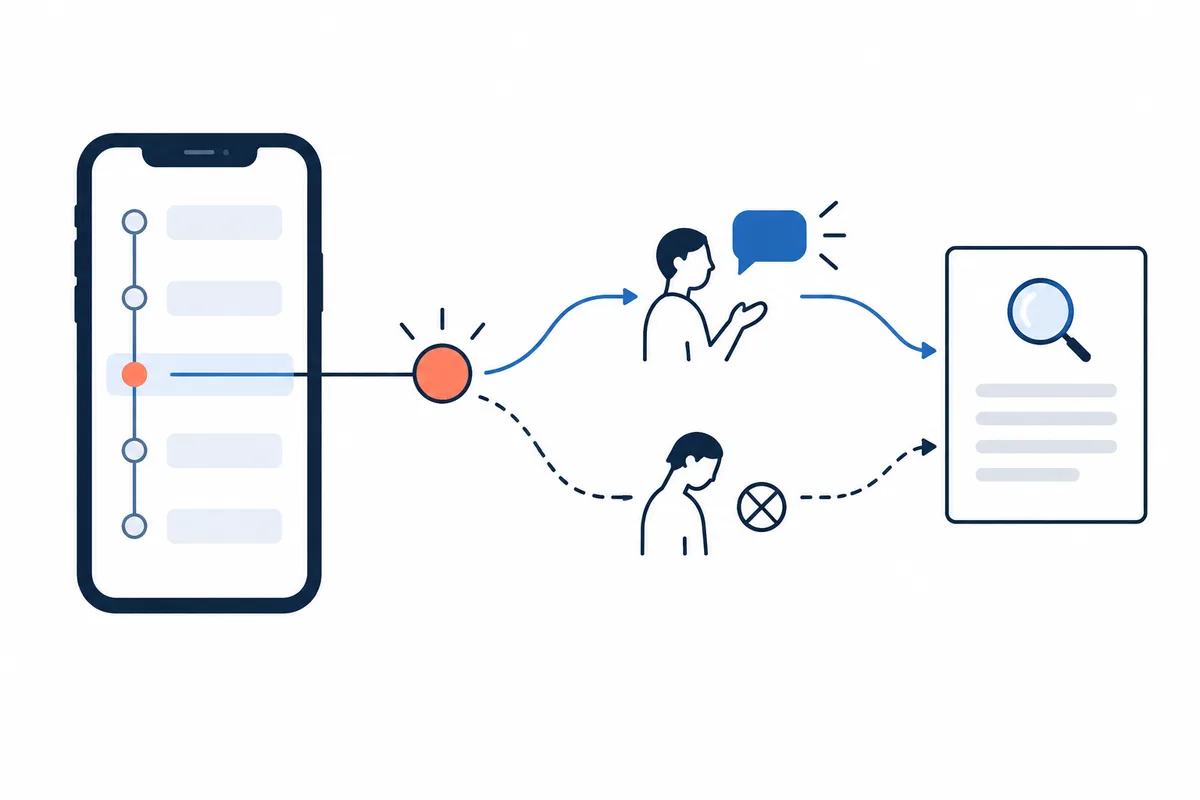
When people felt more negative than usual, they were more likely to report using a phone to express that emotion or to avoid it. The reverse pattern was much less persuasive: the researchers did not find meaningful evidence that either behavior predicted lower negative affect at the next report. Avoidance was linked to a very small increase, but that estimate fell below the study’s own threshold for an effect large enough to matter in practice. The study therefore gives a clearer answer about what tends to precede phone behavior than about whether the behavior changes how someone feels.
The authors distinguish media selection from media effects. Selection means a state such as negative affect predicts what media behavior comes next. An effect means that behavior predicts a later emotional state. This distinction matters because a person may open a messaging app or start scrolling precisely because they already feel upset. If mood remains low later, that sequence alone cannot show that the phone made it worse. Nor does it show that the phone failed in every sense: a conversation could help someone decide what to do, or a brief distraction could make a difficult moment easier, without producing lower negative-affect ratings several hours later.
The evidence comes from repeated reports by adults in Belgium, collected in 2022 and published as a journal article in 2026. Reports were, on average, about two hours and forty-four minutes apart. A short-lived shift could have happened between prompts and disappeared before the next one. A delayed effect could also occur after the measured interval. The defensible conclusion is narrower: in this design, phone-based expression and avoidance followed negative affect more clearly than either predicted emotional relief across the next few hours. That is useful evidence about sequence, but not a causal verdict about smartphones or an individual’s emotional skill.
Sources: Tapping into feelings: An experience sampling study examining the dynamics of smartphone-based emotion regulation and negative affect; Tapping into feelings: An experience sampling study examining the dynamics of smartphone-based emotion regulation and negative affect
What did the researchers actually observe?
The study combined experience sampling with smartphone activity records. Experience sampling asks people to report on recent states repeatedly during ordinary life, rather than relying on one distant memory at the end of a month. Over 14 days, participants received six short questionnaires a day. The prompt asked about the period since waking or since the previous questionnaire. Although data collection yielded 67,762 reports from 1,315 people before exclusions, the analyses used 52,737 reports from 1,053 participants. The average age in that analyzed sample was 37.2. Questionnaires arrived between morning and late evening, with the average gap just under three hours.
The title’s year can mislead unless publication and observation are separated. Data collection ran from October to December 2022. The paper appeared online in 2025 and in the journal Emotion’s March 2026 issue. Calling it a 2026 study identifies the publication, not the year participants were observed. This distinction is common in research: data take time to analyze and publish, so the newest paper does not always describe the newest behavior or technology environment.
The authors recruited through a Belgian newspaper as part of a broader digital-wellbeing project. That gave the study a substantial number of repeated observations, but the participant pool was not a random sample of all Belgian residents, much less smartphone users worldwide. People who volunteer for a long digital-wellbeing project may differ from those who do not. The results also do not describe a workplace sample. They may inform a reader thinking about a difficult message or a workday, but the study did not test teams, managers, feedback conversations, or job performance.
The survey asked participants whether, since the prior prompt, they had used their smartphone to express negative emotions to others and whether they had used it to avoid negative emotions. They also reported negative affect. Negative affect is a broad label for unpleasant feeling states; here it is a momentary self-report, not a diagnosis or a clinical measure. The questions describe perceived purpose. They do not capture every unconscious reason someone uses a device, and they depend on participants noticing and remembering their own actions.
The log analyses were narrower still: matching app records were available for 16,640 of the 52,737 analyzed survey reports (about 31.5%), from 590 participants. These records captured categories and duration of app activity. Pairing them with reports places stated motives alongside observed phone use, but the two sources answer different questions. A report can indicate that someone meant to express a feeling; a log can show time in a communication category. The log cannot read the message, identify its recipient, or tell whether the person was heard. These estimates therefore rest on a smaller subset than the self-report analyses.
Repeated prompts improve one thing that a single survey often misses: order. If a participant answers several times each day, researchers can ask whether a report at one moment is associated with the next report from that same person. Yet the measurement is still retrospective within each interval. A person answering at 14:00 may be summarizing several events since the previous prompt. The study does not know the exact minute the emotion began, when the phone behavior occurred, or whether the two overlapped. ‘Earlier’ and ‘later’ are accurate at the prompt level, but they do not form a complete second-by-second record of cause and response.
Response frequency also shapes what a large dataset means. Participants completed 59.2 percent of the questionnaires they were sent. That rate yielded tens of thousands of observations, but participants did not respond to every prompt. People may be less likely to answer when busy, upset, driving, or away from the phone. The article’s conclusions concern observed reports and modelled patterns among them. If missingness relates to the emotional event or phone behavior, the observed sample of moments may not perfectly represent every moment in participants’ days. This is a general concern with repeated self-report, not evidence that the reported result is wrong.
The analysis focused on people with variation in the digital regulation items, since someone who never reported a behavior cannot contribute the same within-person comparison for that behavior. The manuscript notes that participants excluded from the analyses for lack of variation were older on average, about 47. The analytic sample therefore answers a particular question among people with enough variation to estimate the paths. It should not be casually generalized to those who did not report these behaviors. This is another reason to keep the result attached to the studied group and design rather than turn it into a universal rule about phone use.
Sources: Tapping into feelings: An experience sampling study examining the dynamics of smartphone-based emotion regulation and negative affect; Tapping into feelings: An experience sampling study examining the dynamics of smartphone-based emotion regulation and negative affect
Why is the direction of the link the central finding?
The analysis compared changes within the same person over time. In plain terms, it asked whether a person’s higher-than-usual negative affect at one prompt was followed by more reported phone expression or avoidance at a later prompt, and whether one of those behaviors was followed by higher or lower negative affect. This is different from comparing two people, one generally distressed and one generally calm. The within-person approach reduces the risk of mistaking stable differences between people for a moment-to-moment sequence.
The estimated standardized association from negative affect to later expression was 0.139; the corresponding estimate for avoidance was 0.151. Both were positive and similar in size. The path from expression to later negative affect was 0.012, with no meaningful evidence of an effect. Avoidance’s estimate was 0.031, with a reported 95 percent credible interval from 0.019 to 0.043. A credible interval summarizes the uncertainty around a model estimate under its assumptions. The authors prespecified 0.05 as the smallest effect size of interest. The avoidance estimate was statistically distinguishable from zero in their model but remained below that practical-interest threshold.
That gap between detectable and important is easy to lose in a headline. A large repeated-measures dataset can estimate a tiny association precisely. Precision does not make the association large. The authors also found that the difference between the expression and avoidance estimates was small. So it would overstate the paper to say scrolling makes people feel worse. The model found a slight positive association for the average pattern, but the size did not reach the researchers’ own threshold for an effect they considered meaningfully different from zero.
The direction supports a restrained account: difficult feelings can prompt people to use a phone in different ways. It does not establish that negative affect causes the behavior, because an unmeasured event could influence both. A tense exchange, for example, could raise distress and lead someone to message a friend. The measured sequence would register the association, but not prove which part of the event produced it. The authors’ cross-lagged model adds temporal ordering: one report came before another. It does not reproduce random assignment, where people are assigned to a behavior and compared under controlled conditions.
This is why the study’s strongest contribution is not a phone rule. It is a distinction in how readers interpret an observed sequence. If someone reports distress, then reports messaging, the later message does not reveal whether the original feeling caused the message, whether the message helped, or whether a third event intervened. The study estimates average directional patterns across many repeated occasions. It does not tell a reader what one message did in one conversation.
The term ‘within-person’ can sound technical, but its practical meaning is simple: the model asks whether a given person’s unusually high negative affect predicts a later behavior for that same person. It does not ask whether people with generally higher negative affect use phones more than people with generally lower negative affect. That separation matters because stable differences such as age, occupation, or habitual app use could otherwise create a misleading pattern. The analysis is better suited to momentary dynamics than a one-time survey, though it still relies on reports and observational timing.
The effect-size threshold deserves attention because p-values alone can mislead. A p-value is a model-based measure of how surprising data at least this extreme would be under a specified null assumption; it does not say whether a difference is large enough to matter in daily life. The authors used a smallest effect size of interest of .05 for standardized paths. Their avoidance-to-affect estimate, .031, was below it. That does not erase the estimate or prove it is exactly zero. It changes how strongly the article should describe it: a small association worth tracking in further work, not evidence to advise people that avoidance worsens their mood.
Likewise, ‘no meaningful effect’ is not identical to proving there can never be an effect. The study estimates relationships over its chosen interval, with its measures and sample. An estimate near zero can still be compatible with immediate changes that were missed, different effects for specific contexts, or effects that unfold over longer periods. The authors report little person-to-person variation in the average media-effect paths, but this is still based on their model and measure. Their finding is appropriately read as no clear average short-term benefit in this dataset, not as a universal null law.
The contrast between .139 and .012 may invite a ratio-style interpretation: negative affect’s link to expression appears much larger than expression’s link to later affect. Ratios of standardized coefficients are not direct measures of how many times more likely a person is to message, nor do they show which process matters more in a life. Each path represents a model estimate under its own variables, timing, and assumptions. The useful comparison is directional and qualitative: distress preceded both forms of behavior more clearly than either form preceded measured emotional improvement.
Sources: Tapping into feelings: An experience sampling study examining the dynamics of smartphone-based emotion regulation and negative affect; Tapping into feelings: An experience sampling study examining the dynamics of smartphone-based emotion regulation and negative affect
What does expression mean when it happens through a phone?
In this paper, expression means reporting that a person used a smartphone to express negative emotions to others. It is one specific digital behavior. It is not a general measure of emotional openness, assertiveness, feedback skill, empathy, or repair. A person can name a feeling clearly and still communicate in a way that makes a conversation harder. Someone can also choose not to express a feeling immediately because the timing is poor, because privacy matters, or because a pause would help them speak more carefully.
The passive records connected reported expression with mobile communication. That pairing makes sense: a person who wants to tell someone how they feel may use chat or another communication app. But the behavioral match is not a transcript. It cannot show whether a message was sent to a trusted friend, a colleague, a group chat, or an audience. It cannot distinguish a direct request for support from an accusation, a brief update, or a practical question. The same app can carry all of these.
Consider an explicitly hypothetical work moment. After receiving a terse project comment, an employee messages a colleague: “I’m frustrated by how that landed. Can you help me check whether I’m reading it fairly?” The act of expression may make the emotion more visible and invite another view. Yet the study did not observe this exchange, and it did not measure whether a message helped the employee understand the feedback or repair a relationship. This example illustrates why the label ‘expression’ is too broad to stand in for a social outcome.
Other relationship research makes that point from a different direction. Cameron and Overall’s four studies used experience sampling and longitudinal methods to examine emotional expression and suppression in close relationships. Their paper reported that expression was associated with greater perceived acceptance, relatedness, and relationship satisfaction, while suppression was associated with several less favorable self-reported outcomes. Those findings do not contradict the phone study: they concern broader interpersonal settings and different measures. They also do not prove that expressing any feeling, through any channel, produces a better relationship.
An important question is therefore not only whether someone expressed a feeling, but what the expression was meant to do and what happened next. Did the person ask for listening, information, a boundary, or a change in behavior? Was the recipient able to respond? Was this a private exchange or a public post? The 2026 paper does not answer these questions. It shows that people reported more phone-based expression after negative affect. It does not measure the quality of expression or establish the interpersonal skill involved.
There is a second reason to keep the word expression narrow. In ordinary conversation, it can mean anything from naming an emotion privately to sharing it publicly, and from describing a feeling to acting it out. The study’s survey item explicitly refers to expressing negative emotions to others through smartphone use. It does not ask whether the expression was accurate, considerate, timely, or proportionate. It also does not separate a person who wanted comfort from someone who wanted advice or accountability. Those are relevant distinctions for emotional skill, but they were not the study’s measured outcomes.
The earlier research by Cameron and Overall is useful because it shows how outcome selection can change a conclusion. Across four studies, they examined expression and suppression in close relationships, including momentary experience sampling and longitudinal reports. Their associations involved perceived acceptance, relatedness, and relationship satisfaction. The focal phone study instead modeled negative affect at later prompts. A behavior may have value for connection without changing a broad unpleasant mood rating; it may also change mood without repairing a disagreement. The studies address different parts of human experience, so the reader should not force them into a single scorecard.
The setting matters too. Sharing negative emotion with a close partner can invite care, but a message to a colleague during a deadline may be read through role expectations, workload, and prior conflict. Neither finding licenses a blanket workplace instruction to disclose more. A useful work conversation often includes a clear observation and request: what happened, how it affected the work, and what would help next time. Emotion may be part of that exchange, but disclosure alone does not guarantee mutual understanding. The phone study did not evaluate such communication skills.
Sources: Tapping into feelings: An experience sampling study examining the dynamics of smartphone-based emotion regulation and negative affect; Emotional Expression and Emotion Regulation in Close Relationships
Why might avoidance look different from expression?
The study defined avoidance as using a smartphone to avoid negative emotions. It is not interchangeable with expressive suppression, the effort to hide an emotion from others. Someone might suppress an emotion while staying fully engaged with the cause of it; someone else might avoid an emotion by shifting attention to unrelated content. Both can be described loosely as ‘not showing’ or ‘not feeling,’ but those phrases conceal different actions and goals. The paper’s item concerns the reported purpose of phone use, not a stable tendency or a clinical pattern.
The authors found that avoidance reports were associated with social-media activity, while expression reports were associated with mobile communication. They proposed that browsing may offer a way to redirect attention, while messaging may provide a route to share a feeling. These are plausible interpretations of the app categories, not direct evidence about what participants read or wrote. Social media includes direct messages and active conversation as well as passive browsing. An app log does not reveal whether a person watched a work tutorial, replied to family, or scrolled through short videos.
A brief diversion can serve different purposes at different moments. Stepping away from a heated thread for ten minutes might prevent a reactive reply and make it easier to return. Opening a feed because a task feels uncomfortable might also postpone the task without resolving the underlying issue. The relevant difference is not the screen itself; it is whether the person’s next action becomes more deliberate or the unresolved matter simply grows harder to revisit. This practical distinction follows from ordinary reasoning about goals and consequences. It was not experimentally tested by the focal study.
Daily-life studies also warn against treating self-rated effectiveness and later emotion as the same outcome. Mikkelsen and colleagues studied 406 adults who reported six regulation strategies five times daily over seven days. They assessed perceived effectiveness when participants said they had used a strategy, alongside daily emotion and age-related patterns. That design asks people how effective their chosen strategy seemed; it is not a trial of smartphone avoidance. It shows why a researcher’s measure matters: believing a behavior helped, feeling better immediately, and reporting lower negative affect at a later prompt are related but distinct observations.
For the phone study, the small positive avoidance estimate should remain small in the telling. It is below the authors’ prespecified threshold of practical interest. The paper discusses possible explanations, including the possibility that avoidance does not prevent later rumination or that phone use may conflict with another goal. Those possibilities were not established as mechanisms. The study did not measure guilt caused by scrolling, unfinished work, or whether people returned to the avoided issue. A fair practical question is whether a pause helps someone come back to the matter they need to address. The result does not support labeling all distraction as harmful.
The distinction between distraction and avoidance can be especially difficult to make from the outside. Two people could spend ten minutes with the same app while doing different things psychologically. One might be deliberately pausing before a charged conversation; the other might be trying not to think about an issue that continues to demand attention. Conversely, the same person may move from one purpose to another during one session. App duration cannot establish the motive, and a self-report of avoidance does not tell us whether the strategy was flexible or habitual.
A second possible interpretation is that the behavior reflects the availability of a phone at the moment, not a preference for digital regulation over other options. The study did not compare phone use with walking away from a desk, taking a breath, speaking with someone in person, or focusing on a task. People may use the phone because it is nearby and socially accessible. If the study observes a phone-mediated response, it cannot conclude that phone-based regulation is the only response a person uses or the response they would choose in another environment.
The age correlation is relevant here, but it does not settle the reason for behavior. Older participants reported less phone-based expression and avoidance. Differences could reflect habits, app familiarity, social networks, life stage, or selection into a long research project. Age is a descriptive correlate in this dataset, not an explanation of emotional maturity. A manager should not infer that a younger employee is less regulated because they message a friend, nor that an older colleague handles emotion better because they report less phone use. The paper did not measure those judgments.
Sources: Tapping into feelings: An experience sampling study examining the dynamics of smartphone-based emotion regulation and negative affect; The effect of age on emotion regulation patterns in daily life: Findings from an experience sampling study
What can app activity add—and what can it not tell us?
People do not always remember how long they used an app, and they may not notice every time they shifted from one activity to another. Passive smartphone records add a behavioral trace that a questionnaire alone cannot provide. In this study, the researchers matched activity logs to some experience-sampling windows and tested whether reported expression and avoidance were associated with time in communication or social-media apps. Expression partly accounted for the link between negative affect and mobile communication; avoidance partly accounted for the link between negative affect and social-media activity.
‘Partly accounted for’ describes a statistical mediation pattern. In a simplified sequence, negative affect related to a reported strategy, and that strategy related to a category of app activity. The wording does not prove that the strategy caused the app use or that app use caused a later change in emotion. Because the study was observational, a third factor could influence the reported feeling, motive, and device behavior together. The mediation results are useful as a map of associations across measures, not a demonstrated causal route from distress to app to mood.
App categories also have limited psychological meaning. ‘Communication’ is not equivalent to support. It could be a work message, calendar coordination, a family discussion, or a difficult argument. ‘Social media’ is not equivalent to mindless scrolling. A person may post, watch, read, reply, or privately message. The log may capture duration in an app family but not the content, intention, social response, or interruption context. A minute count can help describe where phone activity occurred, but it cannot tell what the activity meant to the person.
This is a broader measurement lesson rather than a criticism unique to the study: behavior traces become informative when their category matches the question. If the question is whether time in an app follows a self-reported motive, an app category may help. If the question is whether a colleague’s reply felt understanding, activity duration is the wrong measure. For that outcome, researchers would need measures of message content, perceived responsiveness, or a follow-up report. The phone logs strengthen one part of the evidence while leaving the interpersonal part outside the frame.
Passive logs may look objective because they are generated by a device, but objectivity is always relative to the question. A log can record that an app was foregrounded for a duration. It does not automatically establish that the person was attentive to it, that they were alone, or that they were using it for the motive they reported. A phone can remain open while a person speaks to someone nearby. Someone can send a relevant message in seconds and spend much longer rereading it. The trace is a useful behavioral record, but it does not contain the psychological explanation by itself.
There is also a mismatch between units. The survey asked about emotion regulation since the previous prompt, while log data summarized app activity within a corresponding window. If both expression and avoidance happened in that window, or if one app served multiple purposes, a broad category may not isolate which seconds of use belong to which goal. The researchers’ mediation analysis accounts for a statistical relation across the defined windows; it cannot identify a particular tap as the mechanism. More granular data could help, but would still need to be paired with information about intent and experience.
This measurement issue affects how an article should report a ‘link to communication’ or ‘link to social media.’ The result is not that people who feel bad necessarily send a message, nor that scrolling is the characteristic form of avoidance for every participant. It is a modelled association between self-reported strategy and logged category activity. That is a meaningful bridge between experience and behavior, and it is more informative than screen-time totals alone. But the bridge stops before content, quality, and consequences.
Sources: Tapping into feelings: An experience sampling study examining the dynamics of smartphone-based emotion regulation and negative affect; Tapping into feelings: An experience sampling study examining the dynamics of smartphone-based emotion regulation and negative affect
How much does the average pattern describe an individual?
The researchers examined whether the cross-lagged links varied across people. They found more person-to-person variation in selection, meaning how strongly negative affect preceded later phone expression or avoidance, than in media effects, meaning how the behaviors related to later affect. The variance estimates for the selection paths were larger than those for the effect paths. This is evidence that people differ in how often or how strongly they turn to phones when distressed. It is not evidence that each person has a precisely estimated personal response pattern.
A group model can detect variation without producing a useful forecast for a particular reader. Each participant contributes repeated reports, but those reports are still limited in number and context. A person may have many calm days and only a few difficult episodes; the observed pattern may shift with the problem, social support, workload, or whether the phone is the only available route to someone. The study authors describe person-specific estimates, yet readers should not convert those estimates into a personal label such as ‘you use avoidance’ or ‘your phone makes you feel worse.’ The paper was not designed as an individual assessment.
Age was associated with reported frequency: older participants tended to report less smartphone-based expression and avoidance than younger ones. The paper reports correlations of minus 0.22 for expression and minus 0.24 for avoidance. These are associations in this sample, not proof that age itself causes a person to use a phone differently. Generational differences, device habits, social context, and volunteer selection could all be involved. The result should not become a stereotype about young people being more dependent on phones or older people having better regulation.
The findings also cannot tell whether an individual’s use is skillful. A person might use a phone to seek help, clarify a boundary, delay a response until calmer, or avoid a painful exchange indefinitely. The observed behavior label does not rank these actions. Emotional skill is visible in choices and their fit to the situation: noticing an emotion, deciding what is needed, and responding in a way that considers both immediate and longer-term consequences. The study does not measure that complete process, and it does not claim that a phone behavior reveals someone’s underlying capacity.
For an individual, the study is best used as a prompt for observation rather than a conclusion about identity. If a difficult feeling leads to checking a feed, one can notice whether that pause creates room to return to the issue or whether the issue becomes harder to face. If it leads to a message, one can notice whether the message asks for the kind of support that would help. Those questions turn a broad research result into a small reflection about one’s own context without pretending the published average already answers it.
A person-specific estimate is also not a personal diagnosis. The model estimates how much pathways may vary across participants, but an individual’s own slope can be uncertain when there are few occasions of the relevant behavior. The average participant provided many reports, yet the emotion-expression and avoidance items may be endorsed infrequently. A sparse set of episodes provides less information about that one person than the overall dataset provides about an average pattern. The paper’s person-specific analysis is valuable for showing that uniformity should not be assumed; it is not a consumer report that can classify each participant with confidence.
The study did not identify a simple profile of people for whom phone behavior helped or harmed. It found more variability in whether negative affect preceded a later digital strategy than in the strategy-to-affect associations. The data therefore speak more clearly to heterogeneity in the choice or selection process than to sharply different emotional outcomes by person. That should temper a familiar assumption: just because people differ in what they do when distressed does not mean the study has proved that each person’s chosen strategy has a unique effect on mood.
Context can still matter without being measured as a moderator. A message sent during a supportive relationship may be experienced differently from one sent into a hostile exchange. A distraction before a solvable task may differ from distraction during an event that needs immediate action. These are plausible conditions readers can examine in their own lives, not subgroup findings from this paper. Keeping that distinction explicit lets an article be useful without claiming that the study answered questions it did not ask.
Sources: Tapping into feelings: An experience sampling study examining the dynamics of smartphone-based emotion regulation and negative affect; Tapping into feelings: An experience sampling study examining the dynamics of smartphone-based emotion regulation and negative affect
How does the 2026 result compare with earlier daily-life evidence?
The 2026 paper builds on an earlier study by Shi and colleagues, published in 2023, that combined experience sampling with interviews. Forty participants, mostly students at one Australian university, completed seven days of reports. Participants described using smartphones around unpleasant states such as boredom and stress and often perceived the behavior as useful for reaching a preferred feeling. Yet the lagged analyses did not show corresponding mood changes across the several-hour interval. The authors considered whether perceived benefits might be brief or shaped by self-report.
The comparison is useful because the studies ask related questions with different designs and boundaries. Shi and colleagues used a small, student-heavy sample and broader categories of smartphone emotion regulation. The newer study recruited a much larger adult sample in Belgium, separated expression from avoidance, and paired surveys with passive phone logs for a subset. Both report a gap between perceived purpose or benefit and later mood change across the sampling interval. The newer study adds detail to the selection-versus-effect question; it is not a direct replication of every measure in the earlier paper.
A larger research synthesis offers context but not a direct test of smartphone behavior. A systematic review and meta-analysis examined emotion-regulation strategies and affect in ecological momentary and daily-diary studies. It included 37 experience-sampling studies and 39 diary studies. The review organized strategies such as reappraisal, distraction, suppression, and rumination and found that relationships with affect depend on which strategy, time frame, and outcome are measured. Its evidence cannot be used to infer what phone-based expression or avoidance should do, because those specific digital behaviors were not the same exposure across the pooled research.
This distinction prevents an easy but invalid shortcut. Someone might reason that expression is often associated with better relationship outcomes, so smartphone expression should lower negative affect. Or they might reason that avoidance is often treated as maladaptive, so any phone distraction must make feelings worse. Both claims carry evidence from one setting into another without checking whether the behavior and outcome match. Sharing an emotion with a partner, hiding it, browsing social media, and reporting a later mood are different measures. General strategy research provides possible explanations to investigate, not a replacement result for the focal paper.
The comparison therefore supports a modest synthesis. In two daily-life smartphone studies, people report using devices in response to emotional states and do not show clear later mood improvement across the multi-hour measurement window. The larger, newer study provides stronger repeated-observation evidence for that short-term pattern and separates two strategies. Neither study rules out immediate relief, benefits that appear in relationships rather than mood, effects after a longer delay, or differences for particular people. The evidence has accumulated, but it has not turned into an experimental verdict on whether phones help or harm emotional regulation.
The earlier Shi study is informative partly because its interviews and survey results do not line up as a simple contradiction. Interview participants could describe feeling that phones helped them reach a desired state, while lagged quantitative models found no corresponding change in momentary mood over the next interval. A person’s account of relief and a group-level average several hours later can both be accurate. One describes perceived experience, often close to the event; the other estimates a later score across many occasions. Different methods preserve different information.
The 2023 paper’s sample also limits what it can contribute. Forty participants, mostly students at one Australian university, are enough for an exploratory mixed-method investigation but not a broad population estimate. Its value here is conceptual and comparative: it asked about everyday use and combined quantitative reports with interviews. The 2026 paper improves scale and differentiates behaviors, but neither study randomly assigned participants to text, scroll, or avoid. The newer study strengthens the evidence about temporal associations; it does not transform the older paper’s subjective reports into objective proof or resolve causality.
The meta-analysis broadens the evidence base in another way. By pooling daily-life studies of many regulation strategies, it can identify recurring patterns and highlight how measurement choices affect conclusions. But a synthesis is only as directly relevant as its included measures. The review’s strategy categories include constructs that are related to, but not identical with, smartphone-mediated expression and avoidance. It should not be cited as if it separately estimated the effect of TikTok scrolling after negative affect. Its contribution is a warning against broad generalization and a map of the wider field, not a replication.
Sources: “Instant Happiness”: Smartphones as tools for everyday emotion regulation; Relations between emotion regulation strategies and affect in daily life: A systematic review and meta-analysis of studies using ecological momentary assessments; Tapping into feelings: An experience sampling study examining the dynamics of smartphone-based emotion regulation and negative affect
Why do findings about expression and avoidance resist a simple verdict?
Everyday regulation is more than selecting a strategy and measuring a feeling afterward. A person first has to notice that a feeling is present, decide whether it needs to change, choose an aim, and act. The same action can serve different aims. A message may ask someone to listen, request a practical solution, or set a boundary. A pause may protect a relationship from an impulsive reply, or it may postpone a necessary conversation. A study that records a short list of strategies captures part of that chain, not the whole process.
Research on interpersonal regulation illustrates this wider frame. Two daily-life studies involved 171 and 239 participants and examined how people tried to regulate their own emotions through others and how they tried to regulate other people’s emotions. Nearly everyone reported some interpersonal regulation, but it was not automatic; participants described different goals and varying effort. The work is not about phone use or workplace outcomes. It supports the narrower point that goals and effort belong to the story of regulation, even when a strategy label alone cannot reveal them.
The 2026 study’s definition of expression focuses on sharing negative emotion. Cameron and Overall’s relationship studies distinguish emotional expression from suppression and associate these processes with different reported relationship outcomes. The comparison helps explain why ‘expression’ cannot be filed as universally helpful or harmful. How an emotion is shared, with whom, and in what context can matter. But the relationship studies did not test phone messages, and their associations do not establish that expressing emotion causes acceptance or satisfaction. They are adjacent evidence, not a missing result from the smartphone paper.
Likewise, the daily-life meta-analysis groups strategies that can sound similar in ordinary speech but differ in operational definition. Distraction may shift attention temporarily; avoidance can describe a broader attempt not to engage with an emotion; suppression concerns hiding expression. Those categories cannot be swapped just because each may involve stepping back from a feeling. Across studies, the relationship with affect can depend on when the measure is taken and whether a researcher asks about use, perceived effectiveness, or later emotional state.
A fair interpretation allows these findings to coexist. The focal paper can show no meaningful average reduction in negative affect across the next few hours, while other research associates expression with better interpersonal outcomes or a person may report immediate relief. These statements concern different outcomes and time windows. Mood ratings do not capture every relational consequence. Perceived usefulness is not the same as measured later change. And an association in a close relationship does not guarantee that a short message will repair a work conflict. The evidence resists a simple verdict because the underlying questions are not identical.
Two daily-life interpersonal regulation studies add another layer: people regulate their own feelings through other people and also try to influence other people’s feelings. Those are distinct directions. Asking a colleague for perspective may help regulate one’s own response; trying to reassure a distressed colleague may be an attempt to regulate the other person’s state. A smartphone can mediate either exchange, yet the focal paper’s single expression item does not specify whether the sender sought support, advice, connection, or a change in someone else’s behavior.
The findings about goals also explain why emotional skill cannot be reduced to ‘always express’ or ‘always avoid.’ People may have reasons to delay, share, reframe, or ask for help. Skill includes matching the response to the purpose and constraints. There may be times when a short pause preserves a conversation; there may be times when avoiding the emotion means leaving a boundary unspoken. The study does not evaluate these judgments, so the article can offer them as practical questions rather than as results attributed to the researchers.
A critical reader can ask what evidence would change the conclusion. A randomized or carefully designed micro-randomized study could compare specific phone behaviors at moments of negative affect, while measuring immediate and later emotion, task completion, and interaction quality. A stronger within-person follow-up might distinguish message content, support-seeking, passive browsing, and deliberate time-limited distraction. Longer follow-up could test whether a short-term non-effect coexists with longer-term learning or avoidance. Until then, the best answer remains bounded by the study’s sampling window and measures.
Sources: Emotional Expression and Emotion Regulation in Close Relationships; Relations between emotion regulation strategies and affect in daily life: A systematic review and meta-analysis of studies using ecological momentary assessments; Mapping Interpersonal Emotion Regulation in Everyday Life; Large-Scale Study Reveals Why Your Phone Cannot Fix Your Bad Mood
What can this study say about EQ—and what decision follows?
The study is relevant to emotional regulation, one part of emotional skill, but it does not measure emotional intelligence. Participants reported recent negative affect and whether they used a smartphone to express or avoid it. Researchers did not administer an EQ test, assess a person’s general ability to perceive emotion, or score workplace behavior. The findings therefore cannot validate an EQ measure or show that someone’s phone habits indicate high or low emotional intelligence.
That boundary matters when moving from research to self-reflection. Emotional intelligence is not a single behavior observed in isolation. A person may notice irritation, understand that it arose after a rushed handoff, regulate the first impulse to reply, and choose to ask for clarification. Another person may choose a brief distraction before having the conversation. Neither choice, by itself, proves a stable skill level. It is the recurring pattern across situations and the person’s ability to reflect and adjust that gives a more useful development question.
The publication’s 32-item Emotional Skills Profile is an educational reflection tool that summarizes recent behavior and scenario judgments to help someone identify a possible practice priority. It has no validated population norms or established ability-test validity. It should not be used as a ranking, diagnosis, hiring score, or prediction of performance. In this article’s context, it cannot determine whether phone expression or avoidance worked for a reader. The next step is private reflection about an actual episode, not treating a study average as a personal result.
A practical observation can be modest. After a difficult interaction, note what feeling appeared, what the phone action was meant to accomplish, and what happened when the person returned to the original situation. If the action was expression, ask whether the message made a need clear. If it was avoidance, ask whether the pause helped with a later response. A single entry is not a test score; it is a record that may help someone choose a useful question for the next conversation.
The evidence supports attention to sequence: feeling, phone action, later state, and next response. It does not support treating phone behavior as a shortcut to a person’s emotional ability. Someone wanting a structured view of recurring emotional habits can explore the Emotional Skills Profile, then connect any insight to one observable behavior they want to practice. The profile’s value is reflection on patterns, not a verdict about who someone is or how they will perform.
The emotional-skill connection is therefore one of relevance, not measurement equivalence. Regulation is a topic within EQ development, but a study of a specific daily behavior is not an assessment of a broad capability. A person may be able to identify and manage emotions in many settings and still use a phone in a way that does not improve mood. Another person may benefit from an ordinary message without having unusual emotional insight. Behavior and capacity are connected imperfectly, and one episode cannot establish a stable tendency.
This is why a development tool should help a person formulate a practice rather than hand down an identity. A private reflection could focus on one recurring moment: What did I notice? What did I assume? What action did I choose? What response did it invite? What might I try next time? These questions are not a validated scoring method; they are a way to make the next behavior observable. When a person seeks a structured prompt, the Emotional Skills Profile’s 32 items and report can support reflection on recent behavior and authored scenarios, within its stated educational purpose.
The product cannot resolve the study’s scientific uncertainties for a user. It cannot say whether the phone caused a feeling, whether a colleague received a message well, or whether a given strategy works across settings. Nor should it be used to rank coworkers or decide who is emotionally competent. A personal report is most useful when a reader can connect its reflection to an actual choice they control, such as asking for clarification before responding or returning to a conversation after taking a pause. The result should invite practice, not prediction.
One useful next conversation
The study leaves a practical question open: what happens after the first phone-based response? It cannot tell whether a message led to understanding or whether a distraction helped someone return with more composure. A reader can examine that missing link in a real, low-stakes exchange. The point is not to ban the phone or to force immediate disclosure. It is to notice the choice and decide what the situation still needs.
A specific conversation might begin: “I noticed I reached for my phone after that feedback. I was frustrated, and I want to understand the comment before I respond. Could we talk through what needs to change in the handoff?” This names an observable sequence, owns the feeling without assigning motive, and makes a request. It does not presume that the other person caused the emotion or that one conversation will resolve everything. It creates a chance to replace guessing with information.
If the reader is reflecting alone, the equivalent prompt is: “When I checked my phone, was I seeking support, taking a pause, or putting off something I still need to address?” The answer may vary by occasion. The 2026 results offer a reason to ask what precedes phone behavior and what follows it, not a rule for how every person should regulate emotion.
A pause can still be intentional. Someone can decide, “I’m too activated to answer well, so I’ll take ten minutes and then return.” That differs from making an open-ended promise to ‘deal with it later’ and never returning. The difference is observable in the next step: does the person re-enter the task or conversation, and can they say what they need? The 2026 study did not test a ten-minute pause or any particular practice. This is a practical illustration of how to examine behavior without presenting advice as a study result.
The same care applies to expression. A message that says only “That was awful” may communicate a feeling but leave the recipient unsure what response is wanted. A more actionable opening might be, “I felt dismissed when the decision changed without telling me. Can we agree how updates will happen next time?” That wording includes an observation, a personal reaction, and a request. It is an example, not a claim that a specific script guarantees repair. People can adapt it to safety, power, relationship, and urgency in the situation.
Questions readers ask
Did the 2026 study show that scrolling worsens mood?
No. Avoidance had a very small positive association with later negative affect, but its estimate was below the authors’ prespecified threshold for a practically meaningful effect. The observational study cannot show that scrolling caused a mood change.
Does phone-based emotional expression count as high emotional intelligence?
The study did not measure emotional intelligence. It recorded self-reported smartphone expression and avoidance, with app activity logs for some reports. The quality and outcome of a message were not measured, so phone behavior cannot be used as an EQ score.
Sources
- Tapping into feelings: An experience sampling study examining the dynamics of smartphone-based emotion regulation and negative affect
Supports focal sample, measures, collection dates, lagged estimates, log coverage, and stated limits of interpretation.
- Tapping into feelings: An experience sampling study examining the dynamics of smartphone-based emotion regulation and negative affect
Confirms the 2026 journal citation and abstract-level summary of selection, effects, and person-specific patterns.
- Emotional Expression and Emotion Regulation in Close Relationships
Provides adjacent relationship evidence distinguishing expression and suppression; it is not smartphone-specific.
- The effect of age on emotion regulation patterns in daily life: Findings from an experience sampling study
Shows that daily-life research measures strategy use and perceived effectiveness separately across repeated reports.
- “Instant Happiness”: Smartphones as tools for everyday emotion regulation
Earlier 40-person mixed-method study reports perceived utility without corresponding lagged mood change over its measured interval.
- Relations between emotion regulation strategies and affect in daily life: A systematic review and meta-analysis of studies using ecological momentary assessments
Provides broader daily-life evidence across 37 experience-sampling and 39 diary studies, not a direct smartphone-behavior test.
- Mapping Interpersonal Emotion Regulation in Everyday Life
Shows from two daily-life studies that regulation goals and effort vary, beyond strategy labels alone.
- Large-Scale Study Reveals Why Your Phone Cannot Fix Your Bad Mood
An opened current result covers the focal study but overstates its avoidance finding, illustrating a gap for a more calibrated account.
Apply it to the real situation
Turn one emotional pattern into a practice question
From this guide: The study cannot tell you what your own phone response means in a difficult work conversation.
The Emotional Skills Profile offers a private reflection on recent emotional behavior and judgments about authored scenarios. Use it to consider whether a recurring response points to a behavior you want to practice, such as naming frustration, asking for feedback, setting a boundary, or returning to an unresolved discussion. It is an educational reflection tool, not a standardized ability score or a verdict about how you will perform.