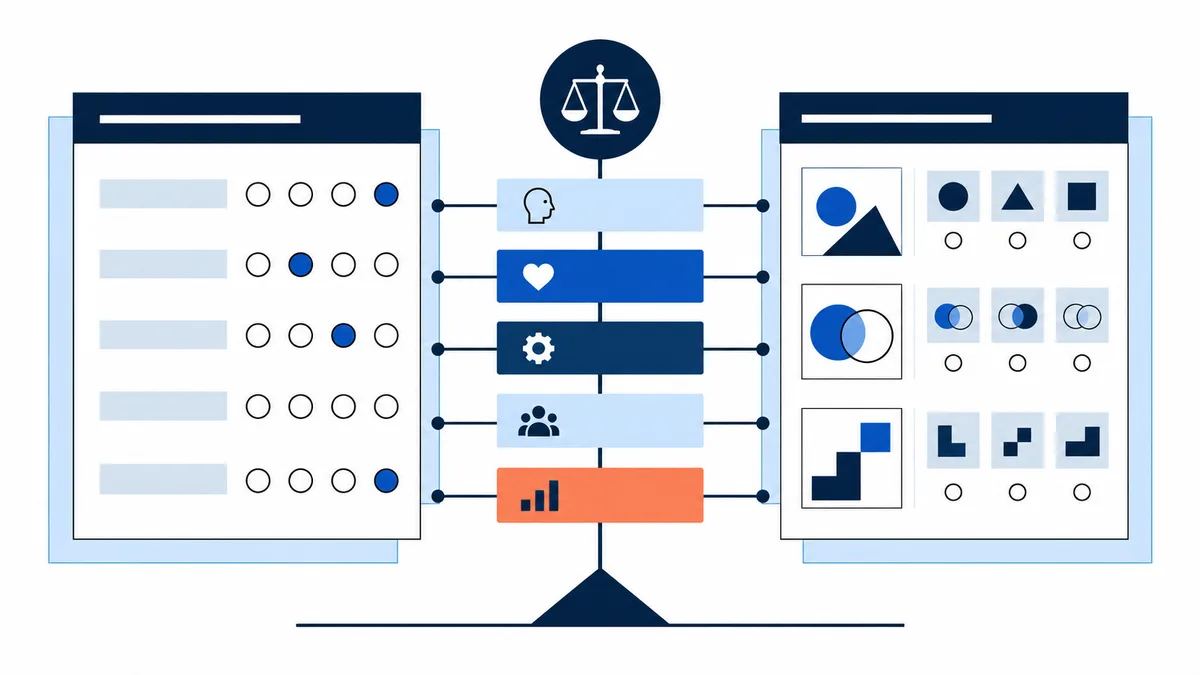
The July 2026 meta-analysis finds broader associations between self-report emotional intelligence (EI) and reported emotion-regulation tendencies than between performance-based ability EI and those tendencies. Both formats were negatively associated with pooled maladaptive-process use, with no statistically significant difference between them. These correlations do not establish that self-report tests measure emotional skill more accurately or predict behavior better.
What does the 2026 meta-analysis show?
The July 2026 meta-analysis, “The Relationship Between Emotional Intelligence and Emotion Regulation: A Meta-Analysis,” finds that self-report emotional intelligence (EI) has broader links with reported emotion-regulation habits than performance-based ability EI. The authors combined 111 studies and 911 effects covering 20 processes. The study linked EI scores with reported use of strategies such as changing a stressful situation, reappraising it, seeking help, or avoiding it. The outcome was tendency to use a process, not success at regulating emotion or conduct observed in a workplace exchange. The paper’s headline needs two qualifications. First, the pattern differs by outcome: self-report EI was associated with more pooled putatively adaptive regulation, while ability EI was not; both formats were associated with less pooled putatively maladaptive regulation. The pooled negative associations were −.21 for ability EI and −.15 for self-report EI, and their difference was not statistically significant. Second, wider associations do not show that a self-report test measures emotional skill more accurately. Correlation is not accuracy, causation, or a forecast of workplace performance. Here, ability EI means performance on structured emotion problems. Self-report EI means ratings of one’s perceived typical emotional abilities or behavior. Since the regulation outcomes were reported tendencies, a match between two self-descriptions does not establish what someone would do in a disagreement. The sections that follow separate process-level findings from pooled results, then examine why measurement format may matter and what a reader can reasonably do with the evidence. Self-report therefore describes perceived habits, not a test-type winner.
Sources: The Relationship Between Emotional Intelligence and Emotion Regulation: A Meta-Analysis
What did the 2026 study actually compare?
The paper’s comparison begins with a distinction between what a test-taker does and what they say they usually do. Performance-based ability EI asks people to work through structured emotional problems: for example, identifying an emotion or selecting a response to an emotional situation. The score is based on performance under test conditions. Self-report EI instead asks respondents to rate statements about their perceived emotional abilities or their usual emotional behavior. In this paper, those formats are separate categories, not two versions of one interchangeable EQ scale. The authors also divide self-report measures by the model behind them. A self-report ability measure asks people to rate themselves against an ability model of perceiving, using, understanding, and managing emotion. A mixed measure covers a broader set of emotion-related qualities, which can include personality traits, motivation, and social competencies. “Mixed” describes that scope; it does not mean that the respondent completed both a performance test and a questionnaire. As the article explains, the distinction matters because a broad self-rating may capture more than perceived emotional skill alone. For regulation, the authors assembled 20 processes drawn from earlier research and commonly used questionnaires. These include direct situation modification, such as taking steps to change a problem; positive reappraisal, or reconsidering a situation in a more positive light; and seeking help. Other processes include avoidance, suppression of emotional expression, distraction, and religious coping. The paper groups some processes as putatively adaptive or maladaptive based on prior associations with health and well-being, while leaving others uncategorized where evidence is inconsistent or context-dependent. Those labels are the study’s organizing scheme, not a claim that a strategy always helps or harms. In “The Relationship Between Emotional Intelligence and Emotion Regulation: A Meta-Analysis,” the authors report 111 studies, 132 samples, and 911 effects. They searched eight databases, with the search conducted in April 2024. The 911 figure counts extracted associations across the synthesis; it should not be read as 911 independent studies, or as equal evidence for each of the 20 processes. The authors test whether associations vary by EI measurement category and, for ability EI, by branch of ability. Their central outcome is the reported tendency to use regulation processes. Thus the comparison concerns how each kind of EI measure is associated with reported habits, not whether a test accurately captures conduct in a particular conversation. The study’s large total gives the authors material to compare categories and processes, but the count alone cannot tell a reader how much evidence supports any one process.
Sources: The Relationship Between Emotional Intelligence and Emotion Regulation: A Meta-Analysis
Where do the two formats diverge?
The clearest difference appears when the meta-analysis separates regulation processes instead of combining them into a single score. In *The Relationship Between Emotional Intelligence and Emotion Regulation: A Meta-Analysis*, ability EI, measured with performance tasks, was positively associated with direct situation modification: taking steps to change a situation or address its problem. Self-report EI, measured with rating scales, had a broader pattern. Its associations were stronger than ability EI’s for five processes: direct situation modification, positive reappraisal, seeking help, distraction, and religious coping. For example, the corrected association for direct modification was .46 for self-report EI and .11 for ability EI; for positive reappraisal, it was .39 and .11. Those are correlations with reported tendencies, not percentages of correct answers or evidence that one format predicts a person’s conduct better. The contrast is not simply “self-report is positive, ability testing is unrelated.” Ability EI’s positive process-level finding was narrow, but it was present. The paper reports no significant positive associations between ability EI and the other individual processes in its abstracted summary; that wording does not prove the true relationships are zero. Self-report EI was positively associated with the putatively adaptive processes of direct modification, positive reappraisal, deep acting, and seeking help, and negatively associated with several putatively maladaptive processes, including avoidance, catastrophizing, denial, self-blame, expressive suppression, surface acting, and substance use. The authors also found positive links with distraction and religious coping. They deliberately left those last processes outside the adaptive/maladaptive categories because their value can depend on circumstances. A short break can interrupt rumination; distraction that replaces a necessary conversation may have a different consequence. The study measured tendencies to use processes, not whether a particular use worked. A second distinction appears inside the self-report group. The paper separates self-report ability EI, which asks people to rate abilities described by an ability model, from mixed EI scales that cover a wider set of emotional traits, motivations, or social competencies. In the moderator analysis, self-report ability measures had stronger associations than mixed measures with acceptance (.24 versus −.05) and distraction (.27 versus .09). These selected contrasts do not establish a general advantage for ability-model self-ratings. They concern two processes, and the study’s instrument categories group measures with differing content. They do show why “self-report” is too broad a label to treat every questionnaire as interchangeable. Read the table as a map of reported associations, not a league table of tests. The pattern changes with the process, and selected within-self-report results change with the scale’s model. Direct situation modification is the most useful anchor for comparing formats because it is the process for which the paper reports a positive ability-EI association and a stronger self-report association. The other contrasts describe where self-ratings tracked reported habits more closely in this evidence base. They do not show that a person who scores higher will reappraise well, seek help at the right time, or regulate emotions effectively in a specific work exchange. The paper’s process categories and correlations can guide interpretation, while leaving the practical question open: what happened in the interaction, and what response did it call for? In an office, someone might describe their usual response to a tense handoff as asking a colleague for help. That rating says something about perceived routine; it cannot tell us whether the person noticed the relevant emotion, chose an apt moment, or resolved that handoff well. The format comparison stops before those event-level judgments.
Sources: The Relationship Between Emotional Intelligence and Emotion Regulation: A Meta-Analysis
Why does the pooled result resist a simple winner?
The pooled result changes with the basket of strategies being counted. In “The Relationship Between Emotional Intelligence and Emotion Regulation: A Meta-Analysis,” the combined association with putatively adaptive processes was stronger for self-report EI (corrected correlation, ρ = .35) than for ability EI (ρ = .07); the difference was statistically significant. For the pooled maladaptive processes, both estimates were negative: ρ = −.21 for ability EI and ρ = −.15 for self-report EI. The paper did not find a statistically significant difference between those two estimates. That is evidence against a simple claim that self-report is stronger across the board. [Read the meta-analysis](https://journals.sagepub.com/doi/10.1177/08902070261469936). The pooled result can seem at odds with individual-process findings. In that analysis, ability EI was not significantly associated with any one maladaptive process, while self-report EI had negative associations with six: avoidance, catastrophizing, self-blame, expressive suppression, surface acting, and substance use. But a combined estimate asks whether the pattern across several processes is related to EI overall. It does not require every individual process to have a statistically detectable association. Pooling combines results but hides which strategies contribute most. The individual estimates are divided across smaller bodies of evidence, so a failure to reach statistical significance for one process is not proof that its association is exactly zero. There is a second distinction: “both estimates are negative” describes direction, while “the difference is not significant” describes the comparison between them. The estimates do not establish that the formats are equivalent. To claim equivalence, researchers would need a design and analysis that set a meaningful equivalence range and show the difference falls within it. The 2026 paper instead reports that its test did not detect a reliable difference for this pooled outcome. The point estimates differ, but the result does not rank them. The comparison also depends on the paper’s grouping. “Adaptive” and “maladaptive” are the authors’ broad, putative categories, based on prior links with health and well-being. They are not labels for what a person should always do. The paper itself places distraction and religious coping outside both groups because their meaning can depend on circumstances. The adaptive basket combines distinct acts such as changing a situation, reappraising it, seeking help, or aligning an emotional display with a role. The maladaptive basket likewise combines different processes. A pooled average is useful for describing the broad association, but it compresses that variety. The pooled results answer a narrow question: how each EI format relates to reported tendencies across grouped regulation strategies. Self-report has the clearer association with the adaptive bundle in this analysis. For the maladaptive bundle, the evidence supports a negative association for each format, without a detected difference between them. Neither result says which test better captures skill, predicts conduct in a particular exchange, or serves every purpose. The headline should follow the outcome being discussed; one format does not uniformly win.
Sources: The Relationship Between Emotional Intelligence and Emotion Regulation: A Meta-Analysis
Why might self-ratings correlate more strongly?
The July 2026 meta-analysis offers two explanations for why self-report emotional intelligence (EI) had broader links with reported regulation habits than performance-based ability EI. One concerns the way both sides of the comparison are measured; the other concerns what the EI scales ask about. The study’s results fit both explanations, but its correlational design cannot tell us how much either one produced the difference. Most regulation outcomes in the synthesis came from questionnaires asking people how often they use a process in daily life. Self-report EI scales also ask respondents to describe their usual emotional tendencies or perceived abilities. When both measures ask the same person to summarize typical behavior, their answers may move together partly because they share a reporting method. Ability tests instead ask people to respond to structured emotional problems, aiming to assess performance under test conditions. The authors call the shared-questionnaire account a method effect; they present it as a reason to expect stronger correlations, not as a mechanism separately isolated by their analysis. “The Relationship Between Emotional Intelligence and Emotion Regulation: A Meta-Analysis” cannot establish whether people’s self-ratings are accurate descriptions of their conduct in particular situations. Content matters too. Within the self-report category, the paper distinguishes scales based on an ability model from broader “mixed” measures. An ability-model self-rating asks about perceived capacities such as understanding or managing emotions. Emotion regulation, in this study, concerns processes people report using to influence their emotional experience. Those subjects are close in meaning: someone who sees themself as able to manage emotion may also describe using reappraisal or seeking help. Mixed measures can include additional material, such as personality traits, motivation, or social competencies. Their broader scope may make them less directly aligned with specific regulation habits, even if those other qualities matter in everyday life. Consistent with this account, the meta-analysis found stronger self-report ability-model associations than mixed-measure associations for acceptance and distraction. That selected result does not make the categories interchangeable or show that one type is generally superior. A separate meta-analysis helps explain why a broad self-report score can reflect more than emotional skill narrowly defined. “Overlap Between the General Factor of Personality and Emotional Intelligence: A Meta-Analysis,” available through UCL Discovery, combined 142 data sources and 36,268 participants. It reported a correlation of about .85 between the general factor of personality and trait EI, compared with about .28 for ability EI. The finding concerns overlap with a broad personality factor; it does not show that trait EI is invalid or that every self-report scale measures personality to the same degree. It does, however, give a reason to read broad ratings as a blend of self-perceived qualities rather than a direct demonstration of maximum emotional performance. These explanations remain interpretations of an association pattern. Shared method could contribute to the stronger links, and content proximity could contribute as well; the 2026 meta-analysis did not experimentally separate them. So a self-report result that aligns with a reported habit is useful evidence about how someone sees their typical behavior. It is not independent confirmation that they can manage emotion effectively in a difficult exchange. To assess that exchange, a reader would need information about what happened there, not only a general rating of personal tendencies.
Sources: The Relationship Between Emotional Intelligence and Emotion Regulation: A Meta-Analysis; Overlap Between the General Factor of Personality and Emotional Intelligence: A Meta-Analysis
What is genuinely new since the earlier synthesis?
The 2015 meta-analysis, “Integrating emotion regulation and emotional intelligence traditions,” and the 2026 paper ask related questions, but do different analytical work. The earlier review brought two research traditions together using a process model of emotion regulation. It coded 90 studies, yielding 200 effect sizes based on 23,174 participants, and organized findings across five broad families of regulation strategies. Its focus was the pattern of associations between emotional intelligence and regulation, including whether people with higher EI appeared to draw on strategies flexibly. Those figures describe the evidence coded for that review; they do not mean every strategy had the same number or quality of studies. The newer “The Relationship Between Emotional Intelligence and Emotion Regulation: A Meta-Analysis” revisits the connection with a more explicit measurement question. It distinguishes performance-based ability measures from self-report EI, then splits self-report measures into ability-model ratings and broader mixed measures. Across 111 studies, 132 samples and 911 effects, the authors test whether EI measurement category changes associations with regulation processes. The paper says the 2015 synthesis reported aggregated effect sizes for ability and self-report EI but had not statistically tested differences between those measurement types. That moderator test is the specific addition: the newer paper asks whether observed links vary with how EI is measured. A larger effect count and finer categories expand the comparison; they do not turn the older synthesis into a failed version of the newer one. This distinction explains why “newer” should not mean “settled.” The 2015 article made a broad integrative argument about EI and regulation. The 2026 meta-analysis tests a narrower contrast in measurement format and reports associations across multiple processes. Different questions mean their results are not a simple before-and-after experiment. The newer paper informs its tested moderator, while the earlier one remains relevant to the conceptual account that regulation is varied and context dependent. The 2015 review cautions that a strategy’s usefulness can depend on the person, emotion, intensity and setting. That remains a check against reading labels such as adaptive as universal prescriptions. A separate 2026 review, “A meta-synthesis of emotional intelligence research: methodological rigour and linguistic hype in systematic reviews and meta-analyses,” adds a reason for careful wording, not a verdict on the focal paper. Its accessible abstract reports that it appraised 73 EI reviews published through April 2024 and rated 59, or 81%, as low or unacceptable quality. Its search window closed before the July 2026 meta-analysis appeared, so it cannot assess that study. It concerns the wider review literature and warns that confident language can outrun evidence. The practical lesson is to inspect the focal study directly: its new comparison updates the question asked, while neither publication date nor larger evidence count proves that one assessment format captures emotional skill better in everyday work.
Sources: Integrating Emotion Regulation and Emotional Intelligence Traditions: A Meta-Analysis; A meta-synthesis of emotional intelligence research: methodological rigour and linguistic hype in systematic reviews and meta-analyses; The Relationship Between Emotional Intelligence and Emotion Regulation: A Meta-Analysis
What can a frequency report miss in a real exchange?
A frequency report answers a narrow question: how often someone says they use a strategy. It does not show whether that response matched the feeling, the goal, the other person, or the limits of the situation. In a tense work exchange, a pause may give two colleagues time to lower the temperature and return with clearer questions. The same pause, if it becomes silence through a deadline, can leave an unresolved decision for someone else to guess at. Frequency alone cannot distinguish those outcomes. The 2023 paper “A Meta-Analysis of the Relationship Between Emotion Regulation and Social Affect and Cognition” makes this measurement gap concrete. Across 58 samples and 549 effect sizes, almost all emotion-regulation measures in its evidence base were self-reports; the authors identify only one performance-based measure. They also note that commonly used questionnaires such as the Emotion Regulation Questionnaire ask about the frequency of two strategies, reappraisal and suppression, without assessing whether a strategy fit the situation. This review examined links between emotion regulation and social affect and cognition, not the 2026 meta-analysis’s EI comparison. It supplies context about how regulation has often been measured, not a replication. That distinction matters when reading “The Relationship Between Emotional Intelligence and Emotion Regulation: A Meta-Analysis.” The 2026 paper examined tendencies to use regulation processes. Its authors distinguish selecting a strategy from the later question of whether it worked; the analysis focuses on selection because that is where validated habitual-use measures were available. A relationship between a self-rated EI measure and reported strategy frequency cannot tell us that a person handled a particular disagreement well. Nor does a frequent strategy carry the same value in every setting. Distraction might create a brief pause before a difficult conversation; used to avoid it indefinitely, it leaves the practical problem untouched. An earlier synthesis, “Integrating Emotion Regulation and Emotional Intelligence Traditions: A Meta-Analysis,” also describes strategy effectiveness as varying across circumstances. This guards against turning “adaptive” and “maladaptive” into moral labels for a person. The 2026 analysis uses those terms as broad groupings based on prior associations with outcomes; it does not establish that every instance of a listed strategy helps or harms. A short delay can be restraint while someone waits for a useful moment to respond. A delay with no return can block needed problem-solving. What matters is observable timing and consequence, not an assumed motive. Use a frequency result as a prompt for a specific check. Choose one recent disagreement: what did you do, when did you return to the issue, and what happened to the decision or working relationship afterward? If asking a colleague for feedback, ask about an observable action—whether you came back to the question, for example—rather than whether you are “good at regulation.” One conversation cannot measure overall ability. It can show where a broad self-description fits, or fails to fit, a real interaction.
Sources: A Meta-Analysis of the Relationship Between Emotion Regulation and Social Affect and Cognition; The Relationship Between Emotional Intelligence and Emotion Regulation: A Meta-Analysis; Integrating Emotion Regulation and Emotional Intelligence Traditions: A Meta-Analysis
Does broader association mean a better EQ test?
A larger association answers a narrower question than “Which test is better?” In “The Relationship Between Emotional Intelligence and Emotion Regulation: A Meta-Analysis,” the outcome is a reported tendency to use regulation processes. The paper compares how those tendencies relate to ability-task results and self-ratings; it does not compare tests against observed workplace behavior. Correlation strength is not an accuracy score. A performance-based ability test asks someone to respond to structured emotional problems under test conditions. A self-report asks how the person sees their usual emotional behavior or ability. Each gives evidence about a different target: performance on the problems presented, or perceived typical tendencies. Neither automatically tells a reader how someone acted during a disagreement or handled feedback. The 2026 meta-analysis found a stronger association between self-report EI and reported adaptive regulation tendencies than between ability EI and those reports. That pattern is informative about perceived habits. Yet both sides of many associations come from questionnaires: people rate their EI and report how often they use strategies. Similar formats can strengthen a relationship without either measure checking behavior directly. The authors discuss this shared-method possibility; their analysis does not isolate how much of the gap it explains. Neither the number of significant links nor a pooled correlation settles test quality. A correlation describes how measures vary together; it does not establish that a test captures its intended skill accurately, works fairly across groups, or predicts outcomes outside the study. “A Meta-Analysis of Emotion Regulation and Social Affect and Cognition” offers a related caution: the reviewed literature relied predominantly on self-report, and common questionnaires often recorded strategy frequency rather than situational fit. That review contextualizes the issue; it does not replicate the 2026 comparison. A meta-analysis in the UCL repository found greater overlap between broad trait EI and personality than between ability EI and personality, based on 142 data sources and 36,268 participants. This does not make self-report useless or show that every self-report scale is mostly personality. It does show why a broad self-rating should not be casually called a measure of emotional ability. Choose according to the question. For perceived habits, self-report can prompt reflection. For performance on structured emotional problems, an ability measure addresses that task. To understand a real workplace exchange, examine the exchange and seek specific feedback. The meta-analysis names no universal winner; it shows why these questions should remain distinct.
Sources: The Relationship Between Emotional Intelligence and Emotion Regulation: A Meta-Analysis; A Meta-Analysis of the Relationship Between Emotion Regulation and Social Affect and Cognition; Overlap Between the General Factor of Personality and Emotional Intelligence: A Meta-Analysis
What should a reader do with an EQ result at work?
A self-report result is a hypothesis about a habit you recognize in yourself. The 2026 meta-analysis, “The Relationship Between Emotional Intelligence and Emotion Regulation: A Meta-Analysis,” links self-rated emotional intelligence with reported regulation tendencies. Its outcomes are reports of typical behavior, not observations of a particular exchange. Use the result to choose something specific to examine, such as how you responded when a colleague challenged a decision. Start with one recent interaction. Describe the behavior plainly: you asked a clarifying question, interrupted, paused the discussion, or returned to the issue later. Keep the account close to what another person could also notice. Then ask someone who was present for one concrete observation and its effect. Did the pause make room for a calmer discussion, or leave an important point unresolved? The answer can refine your reflection; it need not confirm a score or label. The Emotional Skills Profile is a private 32-item educational reflection tool about emotional habits and judgments in authored scenarios. It has no validated norms or established ability-test validity, and the meta-analysis does not validate it. For a structured prompt to reflect on your own patterns, explore the profile at [/assessment](/assessment). Treat the result as a starting point for observation, not a verdict about how you will act or a promise that work relationships will improve.
Sources: Emotional Skills Profile; The Relationship Between Emotional Intelligence and Emotion Regulation: A Meta-Analysis
What should the 2026 finding change?
The finding should change the meaning readers attach to a larger correlation. In “The Relationship Between Emotional Intelligence and Emotion Regulation: A Meta-Analysis,” self-report EI tracks reported habits more broadly than ability-test performance does. That is evidence about how perceived emotional tendencies relate to reported regulation choices. It does not show that self-report tests measure emotional skill more accurately, or that their scores better predict what someone will do in an exchange. The authors’ distinction matters: regulation outcomes in the synthesis describe tendencies, while ability tests assess performance on structured emotional problems.
So use the comparison to choose a question, not a winner. If you want to reflect on what you usually do when a conversation gets tense, a self-report measure addresses perceived typical behavior. If your question concerns solving structured emotion problems, an ability task addresses performance in that testing setting. Neither result settles whether a response fit the demands of one conversation. A next check is to name an observable action from that exchange, such as pausing before replying or asking a clarifying question, and compare your interpretation with feedback about what happened and its effect.
This is a inference from the measurement boundary, not a finding that feedback will improve a score or workplace outcome. “A Meta-Analysis of the Relationship Between Emotion Regulation and Social Affect and Cognition” likewise points to the need for observational or performance-based measures and different contexts in future research; its question is related, not a replication of the 2026 comparison. Evidence from such comparisons could change the conclusion. Until then, broader self-report associations support reflection on perceived habits, while claims of superior skill measurement or better conduct prediction remain unsettled.
Sources: The Relationship Between Emotional Intelligence and Emotion Regulation: A Meta-Analysis; A Meta-Analysis of the Relationship Between Emotion Regulation and Social Affect and Cognition
Questions readers ask
Does the 2026 meta-analysis show that self-report EQ tests are better?
No. It finds broader associations between self-report EI and reported regulation tendencies, but does not establish that self-report tests measure emotional skill more accurately or predict behavior better.
Sources
- The Relationship Between Emotional Intelligence and Emotion Regulation: A Meta-Analysis
Supports the study design, sample and effect counts, process-level and pooled findings, measurement categories, and limits of the 2026 comparison.
- Overlap Between the General Factor of Personality and Emotional Intelligence: A Meta-Analysis
Supports the reported differences in overlap between a broad personality factor and trait EI versus ability EI.
- Integrating Emotion Regulation and Emotional Intelligence Traditions: A Meta-Analysis
Provides historical context on the earlier EI and emotion-regulation synthesis and its strategy framework.
- A meta-synthesis of emotional intelligence research: methodological rigour and linguistic hype in systematic reviews and meta-analyses
Its accessible abstract reports a quality appraisal of EI reviews through April 2024, not an appraisal of the focal July 2026 paper.
- A Meta-Analysis of the Relationship Between Emotion Regulation and Social Affect and Cognition
Supports context on self-report-heavy emotion-regulation research and the limits of frequency reports for judging situational fit.
- Emotional Skills Profile
The supplied publication profile identifies the private 32-item educational reflection tool and its limits; the live page was not retrieved during research.
Apply it to the real situation
Turn a general EQ result into one behavior to examine
From this guide: The meta-analysis concerns reported tendencies; a specific work exchange can help you examine how a perceived habit shows up in practice.
The 2026 findings can help you read a self-report result as a reflection on perceived habits. To explore your own emotional habits and judgments in authored scenarios, the private 32-item Emotional Skills Profile offers a structured starting point. Use it to identify a behavior to examine in a recent interaction, then compare your interpretation with observable feedback. The profile is an educational reflection tool, not a normed ability test.